Click image for a midrash.
"For every kind of vampire, there is a kind of cross."
— Gravity's Rainbow


See also Heidegger + Rift in this journal.
In memory of art historian John Golding,
whose obituary appeared (finally) in
today’s online Telegraph—
“His most recent book, Paths to the Absolute (based on
his 1997 series of AW Mellon lectures in the Fine Arts
delivered at the National Gallery of Art, Washington DC),
addressed seven abstract artists — Mondrian, Kazimir
Malevich, Kandinsky, Pollock, Barnett Newman, Rothko
and Clyfford Still — and argued that abstract art was
not simply decorative but ‘heavily imbued with meaning
[and] with content’. The book won the Mitchell Prize for
the History of Art in 2002.”

Commentary on Golding’s obituary suggested by
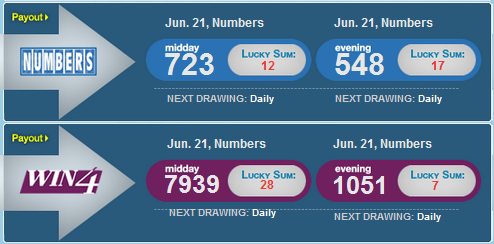
this evening’s 4-digit New York Lottery number,
1051—
Post 1051 in this journal, together with a post from
April 1, 2012 found in a search for the digits 1051
in Log24. That search may serve as a review.
* A phrase from Gravity’s Rainbow
Page 1590 —

Log24:
Thomas Pynchon:
"For every kind of vampire,
there is a kind of cross."
The Year 1591 —

For the title, see the Aug. 17 post Vampire Workday.
Scholium for Beckinsale —

“For every kind of vampire, there is a kind of cross.” — Gravity’s Rainbow
"For every kind of vampire,
there is a kind of cross."
— Thomas Pynchon, Gravity's Rainbow
"Sometimes I hit London."
— Saying ascribed to Wernher von Braun
Inscribed Carpenter's Square:

In Latin, NORMA
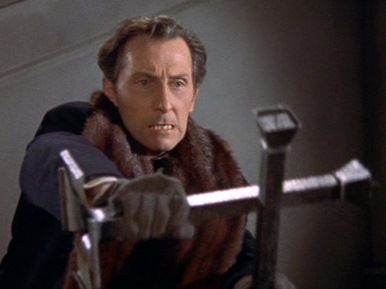
"For every kind of vampire, there is a kind of cross."
— Gravity's Rainbow

“For every kind of vampire, there is a kind of cross.” — Gravity’s Rainbow
“I don’t write exclusively on Jewish themes or about Jewish characters.
My collection of short stories, Strange Attractors , contained nine pieces,
five of which were, to some degree, Jewish, and this ratio has provided me
with a precise mathematical answer (for me, still the best kind of answer)
to the question of whether I am a Jewish writer. I am five-ninths a Jewish writer.”
— Rebecca Goldstein, “Against Logic”
Midrashim for Rebecca:
The Diamond Theory vs. the Story Theory (of truth)
Story Theory and the Number of the Beast
The Palm Sunday post “Gray Space”
For those who prefer the diamond theory of truth,
a “precise mathematical” view of a Gray code —

For those who prefer the story theory of truth,
Thursday with the Nashes —
The actors who portrayed Mr. and Mrs. John Nash in
‘A Beautiful Mind’ now portray Mr. and Mrs. Noah…

“For every kind of vampire, there is a kind of cross.” — Gravity’s Rainbow
“I don’t write exclusively on Jewish themes or about Jewish characters.
My collection of short stories, Strange Attractors , contained nine pieces,
five of which were, to some degree, Jewish, and this ratio has provided me
with a precise mathematical answer (for me, still the best kind of answer)
to the question of whether I am a Jewish writer. I am five-ninths a Jewish writer.”
— Rebecca Goldstein, “Against Logic”
Related material: The cross of five ninths, from Epiphany 2006.
This morning's previous post, on sacred space,
linked to "Positively White Cube Revisited,"
an article by one Simon Sheikh.
Sheikh writes well, but he seems to be a disciple
of the damned Marxist lunatic Louis Althusser.
As Pynchon put it in Gravity's Rainbow ,
"For every kind of vampire, there is a kind of cross."

In this case, a video starring Sheikh on the exhibition "All That Fits"
suggests, by its filming date (May 27, 2011), a Maltese cross.
"The stuff that dreams are made of." — Bogart

(See also Oct. 25, 2012.)
Tonight was Honors Night at the Kennedy Center.
"For every kind of vampire,
there is a kind of cross." — Pynchon
|
From "Colin Wilson: The Persistence of Meaning" "At a literary conference at SUNY New Paltz three years ago, among people who I thought would be positively disposed to Wilson, my mentioning of his name resulted in any number of arched eyebrows and suavely disparaging remarks. Now this might itself be, not an affirmation of justified oblivion, as one could easily assume, but rather a kind of indirect evidence for intrinsic merit. I stress the academic character of the event and the self-assured oiliness of the dismissal. In context, the reference seemed to carry a distinctly un-PC valence so that the reaction to it, as I picture it in retrospect, resembled that of a patrician vampire to garlic."
— Thomas F. Bertonneau on Thursday, |
"Take a cube, and write the numbers 1,…,6 on its faces.
Now the pairs of numbers on opposite faces
form a syntheme. (Standard dice, for example, represent
the syntheme 12|34|56.) "
— Peter J. Cameron, weblog post of May 11, 2010
"For every kind of vampire, there is a kind of cross."
— Gravity's Rainbow

From the weblog of Dr. David Justice today :
C.S. Lewis somewhere (in time, in retirement, I might recover
the passage) surveys the spectrum of plot-outlines, and notes
that that of Orpheus retains its power to spellbind, even in a
bare-bones form, whereas that of almost all worthy modern novels,
become as dust upon such summary.
We venture now upon that territory where words fail ….
Related material :
C. S. Lewis on Orpheus (click to enlarge) —

Lewis, according to Justice, "surveys the spectrum of plot-outlines."
A related image (see, too, today's previous post) —

C. S. Lewis on myth —
"The stories I am thinking of always have a very simple narrative shape—
a satisfactory and inevitable shape, like a good vase or a tulip."
Conceptual Art
For concepts of prism, spectrum, and tulip combined, see Sicilian Reflections.
"For every kind of vampire, there is a kind of cross."
— Gravity's Rainbow
… For the Harvard Arts Weekend:
"Grids, You Say?" by Josefine Lyche, with
Lyche's quotation from Rosalind Krauss in October
(Vol. 9, Summer 1979) —
 |
See also last evening's Elevation of the Host, with Vampire Weekend.
"For every kind of vampire, there is a kind of cross." — Gravity's Rainbow
The previous post suggests two sayings:
"There is such a thing as a Galois space."
— Adapted from Madeleine L'Engle
"For every kind of vampire, there is a kind of cross."
Illustrations—

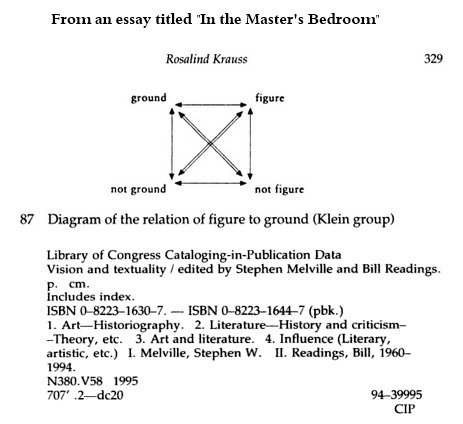
"In the master's bedroom, they gathered for the feast…."
— Suggested by the current film Hotel Transylvania
"For every kind of vampire, there is a kind of cross."
– Thomas Pynchon, Gravity's Rainbow
Related material— the Feast of Saint Patrick in 2009.

Related material:
See a search for the author of
Venus on the Half-Shell .
"For every kind of vampire,
there is a kind of cross."
— Gravity's Rainbow
"Rosetta Stone" as a Metaphor
in Mathematical Narratives
For some backgound, see Mathematics and Narrative from 2005.
Yesterday's posts on mathematics and narrative discussed some properties
of the 3×3 grid (also known as the ninefold square ).
For some other properties, see (at the college-undergraduate, or MAA, level)–
Ezra Brown, 2001, "Magic Squares, Finite Planes, and Points of Inflection on Elliptic Curves."
His conclusion:
When you are done, you will be able to arrange the points into [a] 3×3 magic square,
which resembles the one in the book [5] I was reading on elliptic curves….
This result ties together threads from finite geometry, recreational mathematics,
combinatorics, calculus, algebra, and number theory. Quite a feat!
5. Viktor Prasolov and Yuri Solvyev, Elliptic Functions and Elliptic Integrals ,
American Mathematical Society, 1997.
Brown fails to give an important clue to the historical background of this topic —
the word Hessian . (See, however, this word in the book on elliptic functions that he cites.)
Investigation of this word yields a related essay at the graduate-student, or AMS, level–
Igor Dolgachev and Michela Artebani, 2009, "The Hesse Pencil of Plane Cubic Curves ."
From the Dolgachev-Artebani introduction–
In this paper we discuss some old and new results about the widely known Hesse
configuration of 9 points and 12 lines in the projective plane P2(k ): each point lies
on 4 lines and each line contains 3 points, giving an abstract configuration (123, 94).
PlanetMath.org on the Hesse configuration—

A picture of the Hesse configuration–

(See Visualizing GL(2,p), a note from 1985).
Related notes from this journal —
From last November —
|
From the December 2010 American Mathematical Society Notices—
Related material from this journal— Consolation Prize (August 19, 2010) |
From 2006 —
|
Sunday December 10, 2006
“Function defined form, expressed in a pure geometry
– J. G. Ballard on Modernism
“The greatest obstacle to discovery is not ignorance –
— Daniel J. Boorstin, |
Also from 2006 —
|
Sunday November 26, 2006
Rosalind Krauss "If we open any tract– Plastic Art and Pure Plastic Art or The Non-Objective World , for instance– we will find that Mondrian and Malevich are not discussing canvas or pigment or graphite or any other form of matter. They are talking about Being or Mind or Spirit. From their point of view, the grid is a staircase to the Universal, and they are not interested in what happens below in the Concrete. Or, to take a more up-to-date example…."
"He was looking at the nine engravings and at the circle,
"And it's whispered that soon if we all call the tune
The nine engravings of The Club Dumas
An example of the universal*– or, according to Krauss,
"This is the garden of Apollo, the field of Reason…."
For more on the field of reason, see
A reasonable set of "strange correspondences" Unreason is, of course, more popular. * The ninefold square is perhaps a "concrete universal" in the sense of Hegel: "Two determinations found in all philosophy are the concretion of the Idea and the presence of the spirit in the same; my content must at the same time be something concrete, present. This concrete was termed Reason, and for it the more noble of those men contended with the greatest enthusiasm and warmth. Thought was raised like a standard among the nations, liberty of conviction and of conscience in me. They said to mankind, 'In this sign thou shalt conquer,' for they had before their eyes what had been done in the name of the cross alone, what had been made a matter of faith and law and religion– they saw how the sign of the cross had been degraded."
– Hegel, Lectures on the History of Philosophy ,
"For every kind of vampire, |
And from last October —
|
Friday, October 8, 2010
Starting Out in the Evening This post was suggested by last evening's post on mathematics and narrative and by Michiko Kakutani on Vargas Llosa in this morning's New York Times .
"One must proceed cautiously, for this road— of truth and falsehood in the realm of fiction— is riddled with traps and any enticing oasis is usually a mirage."
– "Is Fiction the Art of Lying?"* by Mario Vargas Llosa,
* The Web version's title has a misprint— |
Today is commencement day at Princeton.
Sunday's A Post for Galois was suggested, in part, by the fact that the founder and CEO of Amazon.com was that day's Princeton baccalaureate speaker. The Galois post linked to the Amazon reviews of one Christopher G. Robinson, a resident of Cambridge, Mass., whose Amazon book list titled "Step Right Up!" reflects a continuing libertine tradition at Harvard.
For Princeton's commencement day, it seems fitting to cite another Amazon document that reflects the more conservative values of that university.
I recommend the review Postmodern Pythagoras, by Matthew Milliner. Milliner is, in his own words, "an art history Ph.D. candidate at Princeton University."
See also Milliner's other reviews at Amazon.com.
"For every kind of libertine,
there is a kind of cross."
— Saying adapted from Pynchon

Phoebe Halliwell of "Charmed"
Review of a new film — "She’s Out of My League has moments of humor and insight, but it’s bogged down by excessive vulgarity and cartoonishness."
Sometimes that's what it takes —

"For every kind of vampire,
there is a kind of cross."
— Gravity's Rainbow
Unitarian Universalist Origins: Our Historic Faith—
“In sixteenth-century Transylvania, Unitarian congregations were established for the first time in history.”
Gravity’s Rainbow–
“For every kind of vampire, there is a kind of cross.”
Unitarian minister Richard Trudeau—
“… I called the belief that
(1) Diamonds– informative, certain truths about the world– exist
the ‘Diamond Theory’ of truth. I said that for 2200 years the strongest evidence for the Diamond Theory was the widespread perception that
(2) The theorems of Euclidean geometry are diamonds….
As the news about non-Euclidean geometry spread– first among mathematicians, then among scientists and philosophers– the Diamond Theory began a long decline that continues today.
Factors outside mathematics have contributed to this decline. Euclidean geometry had never been the Diamond Theory’s only ally. In the eighteenth century other fields had seemed to possess diamonds, too; when many of these turned out to be man-made, the Diamond Theory was undercut. And unlike earlier periods in history, when intellectual shocks came only occasionally, received truths have, since the eighteenth century, been found wanting at a dizzying rate, creating an impression that perhaps no knowledge is stable.
Other factors notwithstanding, non-Euclidean geometry remains, I think, for those who have heard of it, the single most powerful argument against the Diamond Theory*– first, because it overthrows what had always been the strongest argument in favor of the Diamond Theory, the objective truth of Euclidean geometry; and second, because it does so not by showing Euclidean geometry to be false, but by showing it to be merely uncertain.” —The Non-Euclidean Revolution, p. 255
H. S. M. Coxeter, 1987, introduction to Trudeau’s book—
“There is a pleasantly discursive treatment of Pontius Pilate’s unanswered question ‘What is truth?’.”
As noted here on Oct. 8, 2008 (A Yom Kippur Meditation), Coxeter was aware in 1987 of a more technical use of the phrase “diamond theory” that is closely related to…

“For every kind of vampire,
there is a kind of cross.”
— Pynchon
Welcome to the
Black Hole Café
"Our lifelong friendship made me not only an admirer of the depth, scholarship, and sheer energy of his mathematical work (and of his ceaseless activities as an editorial entrepreneur on behalf of mathematics) but one in awe of his status as the ultimate relaxed sophisticate."
|
Psychoshop
by Alfred Bester
|
"For every kind of vampire,
there is a kind of cross."
— Thomas Pynchon

“For every kind of vampire,
there is a kind of cross.”
— Thomas Pynchon in
Gravity’s Rainbow
“Since 1963, when Pynchon’s first novel, V., came out, the writer– widely considered America’s most important novelist since World War II– has become an almost mythical figure,
— Nancy Jo Sales in the November 11, 1996, issue of New York Magazine
(Click on images for their
source in past entries.)
In a Nutshell:
“Plato’s Ghost evokes Yeats’s lament that any claim to worldly perfection inevitably is proven wrong by the philosopher’s ghost….”
— Princeton University Press on Plato’s Ghost: The Modernist Transformation of Mathematics (by Jeremy Gray, September 2008)
|

Click to enlarge.
From another place:

Click logo for a story.
“… a kind of cross.”
— Gravity’s Rainbow

The Square of Oppositon
at Stanford Encylopedia of Philosophy

The Square of Opposition
in its original form
"The diagram above is from a ninth century manuscript of Apuleius' commentary on Aristotle's Perihermaneias, probably one of the oldest surviving pictures of the square."
— Edward Buckner at The Logic Museum
From the webpage "Semiotics for Beginners: Paradigmatic Analysis," by Daniel Chandler:

The Semiotic Square
"The structuralist semiotician Algirdas Greimas introduced the semiotic square (which he adapted from the 'logical square' of scholastic philosophy) as a means of analysing paired concepts more fully (Greimas 1987,* xiv, 49). The semiotic square is intended to map the logical conjunctions and disjunctions relating key semantic features in a text. Fredric Jameson notes that 'the entire mechanism… is capable of generating at least ten conceivable positions out of a rudimentary binary opposition' (in Greimas 1987,* xiv). Whilst this suggests that the possibilities for signification in a semiotic system are richer than the either/or of binary logic, but that [sic] they are nevertheless subject to 'semiotic constraints' – 'deep structures' providing basic axes of signification."
* Greimas, Algirdas (1987): On Meaning: Selected Writings in Semiotic Theory (trans. Paul J Perron & Frank H Collins). London: Frances Pinter
Another version of the semiotic square:

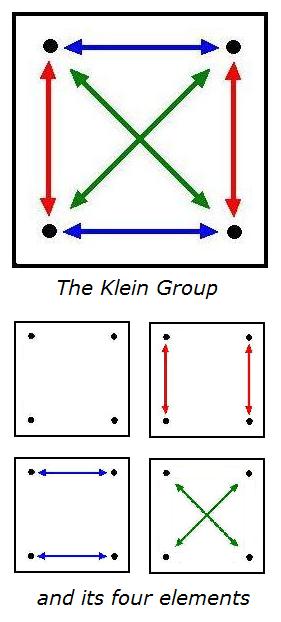
Here is a more explicit figure representing the Klein group:
There is also the logical
diamond of opposition —

A semiotic (as opposed to logical)
diamond has been used to illustrate
remarks by Fredric Jameson,
a Marxist literary theorist:
|
"Introduction to Algirdas Greimas, Module on the Semiotic Square," by Dino Felluga at Purdue University–
The semiotic square has proven to be an influential concept not only in narrative theory but in the ideological criticism of Fredric Jameson, who uses the square as "a virtual map of conceptual closure, or better still, of the closure of ideology itself" ("Foreword"* xv). (For more on Jameson, see the [Purdue University] Jameson module on ideology.) Greimas' schema is useful since it illustrates the full complexity of any given semantic term (seme). Greimas points out that any given seme entails its opposite or "contrary." "Life" (s1) for example is understood in relation to its contrary, "death" (s2). Rather than rest at this simple binary opposition (S), however, Greimas points out that the opposition, "life" and "death," suggests what Greimas terms a contradictory pair (-S), i.e., "not-life" (-s1) and "not-death" (-s2). We would therefore be left with the following semiotic square (Fig. 1): 
As Jameson explains in the Foreword to Greimas' On Meaning, "-s1 and -s2"—which in this example are taken up by "not-death" and "not-life"—"are the simple negatives of the two dominant terms, but include far more than either: thus 'nonwhite' includes more than 'black,' 'nonmale' more than 'female'" (xiv); in our example, not-life would include more than merely death and not-death more than life.
* Jameson, Fredric. "Foreword." On Meaning: Selected Writings in Semiotic Theory. By Algirdas Greimas. Trans. Paul J. Perron and Frank H. Collins. Minneapolis: U of Minnesota P, 1976.
|
— The Gameplayers of Zan, by M.A. Foster
"For every kind of vampire,
there is a kind of cross."
— Thomas Pynchon,
Gravity's Rainbow
Crosses used by semioticians
to baffle their opponents
are illustrated above.
Some other kinds of crosses,
and another kind of opponent:
|
Monday, July 11, 2005
Logos
for St. Benedict's Day Click on either of the logos below for religious meditations– on the left, a Jewish meditation from the Conference of Catholic Bishops; on the right, an Aryan meditation from Stormfront.org.
Both logos represent different embodiments of the "story theory" of truth, as opposed to the "diamond theory" of truth. Both logos claim, in their own ways, to represent the eternal Logos of the Christian religion. I personally prefer the "diamond theory" of truth, represented by the logo below.
See also the previous entry Sunday, July 10, 2005
Mathematics
and Narrative Click on the title for a narrative about
Nikolaos K. Artemiadis,

"First of all, I'd like to
— Remark attributed to Plato
|
||||||||
— Thomas Pynchon in
Gravity’s Rainbow
This entry is continued
from yesterday evening,
from midnight last night,
and from an entry of
February 20 (the date
four years ago of
Hunter Thompson’s death)–
“Emblematizing the Modern“–
|
Emblematizing the Modern
Note that in applications, the vertical axis of the Cross of Descartes often symbolizes the timeless (money, temperature, etc.) while the horizontal axis often symbolizes time. T.S. Eliot:
|
“Selah.”
— The late Hunter Thompson

Yesterday afternoon’s online
New York Times:

Today’s online New York Times:
Footnote

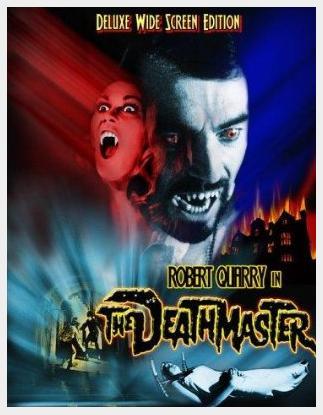
Click poster for details.
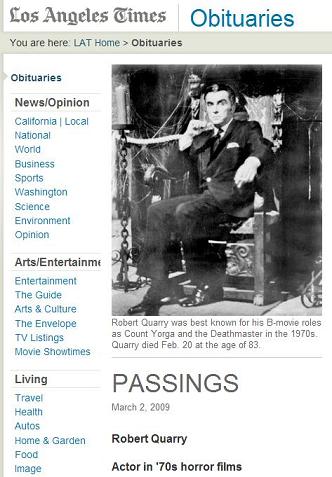
Click image for details.
Related material:
The three entries here on
the date of Quarry’s death:
A Kind of Cross, and

"For every kind of vampire,
there is a kind of cross."
— Thomas Pynchon in
Gravity's Rainbow

Related material:
A memorial service
held at 2 PM today at the
U.S. Space & Rocket Center
in Huntsville, Alabama, and
today's previous entry.

“For every kind of vampire,
there is a kind of cross.”
— Gravity’s Rainbow

The above text on Joyce’s theory of epiphanies:
“It emphasizes the radiance, the effulgence, of the thing itself revealed in a special moment, an unmoving moment, of time. The moment, as in the macrocosmic lyric of Finnegans Wake, may involve all other moments, but it still remains essentially static, and though it may have all time for its subject matter it is essentially timeless.”
— Page 17 of Stephen Hero, by James Joyce, Theodore Spencer, John J. Slocum, and Herbert Cahoon, Edition: 16, New Directions Publishing, 1963
Related epiphanies —


“Joyce knew no Greek.”
— Statement by the prototype
of Buck Mulligan in Ulysses,
Oliver St. John Gogarty,
quoted in the above
New Directions Stephen Hero
“Chrysostomos.”
— Statement in Ulysses
by the prototype
of Stephen Dedalus,
James Augustine Aloysius Joyce
See also the link to
Mardi Gras, 2008,
in yesterday’s entry,
with its text from
the opening of Ulysses:
“He faced about and
blessed gravely thrice
the tower,
the surrounding country
and the awaking mountains.”
Some context:
(Click on images for details.)

and

“In the process of absorbing
the rules of the institutions
we inhabit, we become
who we are.”
— David Brooks, Jewish columnist,
in today’s New York Times
The Prisoner,
Episode One, 1967:
“I… I meant a larger map.”
Readers of the previous entry
who wish to practice their pardes
may contemplate the following:


Christ and the Four Elements
This 1495 image is found in
The Janus Faces of Genius:
The Role of Alchemy
in Newton’s Thought,
by B. J. T. Dobbs,
Cambridge University Press,
2002, p. 85
Related mandalas:
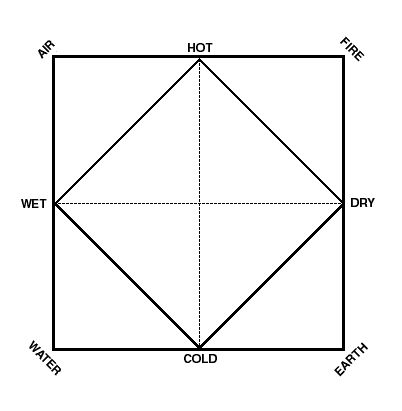
and

For further details,
click on any of the
three mandalas above.
“For every kind of vampire,
there is a kind of cross.”
— Thomas Pynchon, quoted
here on 9/13, 2007
Time of entry: 10:20:55 PM
"And take upon's
the mystery of things
as if we were God's spies"
— King Lear
From Log24 on Aug. 19, 2003
and on Ash Wednesday, 2004:
a reviewer on
An Instance of the Fingerpost::
"Perhaps we are meant to
see the story as a cubist
retelling of the crucifixion."
From Log24 on
Michaelmas 2007:

Google searches suggested by
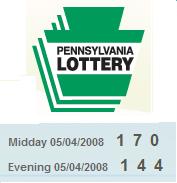
Sunday's PA lottery numbers
(mid-day 170, evening 144)
and by the above
figure of Kate Beckinsale
pointing to an instance of
the number 144 —

Related material:
Beckinsale in another film
(See At the Crossroads,
Log24, Dec. 8, 2006):

"It was only in retrospect
that the silliness
became profound."
— Review of
Faust in Copenhagen
From the conclusion of
Joan Didion's 1970 novel
Play It As It Lays —

"I know what 'nothing' means,
and keep on playing."
From Play It As It Lays,
the paperback edition of 1990
(Farrar, Straus and Giroux) —
|
Page 170:
"By the end of a week she was thinking constantly
170
even one micro-second she would have what she had |
"The page numbers
are generally reliable."
The New York Times,
Thursday, September 13, 2007–
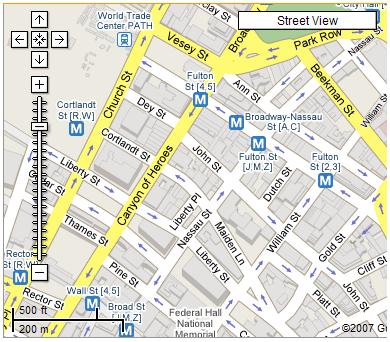
Burt Hasen, Artist Inspired
by Maps, Dies at 85
Burt Hasen, a New York painter who drew inspiration from his experience working with maps as a military technician during World War II, died on Friday [September 7, 2007] in Manhattan. He was 85 and lived in Lower Manhattan….
During the war he served in the Air Force in the Pacific, where his duties involved close study of aerial maps, an activity that lastingly influenced his work. His densely worked canvases often had an overhead perspective….Toward the end of his life, many of his seemingly abstract paintings were based directly, and in detail, on maps….
In 2006 Mr. Hasen, his wife and the other tenants of a five-story building at 7 Dutch Street near the South Street Seaport made news when they organized against their landlord’s attempt to evict them from the rent-regulated lofts they had occupied for more than 30 years. They subsequently had their leases renewed.
“For every kind of vampire,
there is a kind of cross.”
— Gravity’s Rainbow
"For every kind of vampire,
there is a kind of cross."
— Thomas Pynchon

Click on picture for details.
Today is the feast
of St. Thomas Becket.
In his honor, a meditation
on tools and causation:
— Review by H. Allen Orr in
The New York Review of Books,
Vol. 54, No. 1, January 11, 2007
"An odd extension"–
Wolpert's title is, of course,
from Lewis Carroll.
Related material:
"It's a poor sort of memory
that only works backwards."
— Through the Looking-Glass
An event at the Kennedy Center
broadcast on
December 26, 2006
(St. Steven's Day):
(Log24, Aug. 22, 2005):

"At times, bullshit can
only be countered
with superior bullshit."
— Norman Mailer
"The concept of possible worlds dates back to at least Leibniz who in his Théodicée tries to justify the apparent imperfections of the world by claiming that it is optimal among all possible worlds. Voltaire satirized this view in his picaresque novel Candide….
Borges' seminal short story El jardín de senderos que se bifurcan ("The Garden of Forking Paths") is an early example of many worlds in fiction."
"Il faut cultiver notre jardin."
— Voltaire
"We symbolize
logical necessity
with the box  )
)
and logical possibility
with the diamond  )."
)."

"The possibilia that exist,
and out of which
the Universe arose,
are located in
a necessary being…."
— Michael Sudduth,
Notes on
God, Chance, and Necessity
by Keith Ward,
Regius Professor of Divinity,
Christ Church College, Oxford
(the home of Lewis Carroll)
For further details,
click on the
Christ Church diamond.
"For every kind of vampire,
there is a kind of cross."
— Thomas Pynchon

"Also on the card is Adrien Brody ('The Thin Red Line') as a poseur proto-punk who lives in his parents' converted garage and strips at an underground gay club. He takes heat from his former friends– the aforementioned neighborhood toughs– for affecting an English accent and wearing a mohawk…."
— Rob Blackwelder review of Spike Lee's "Summer of Sam" (1999)

"With its white community focus, Summer of Sam is something of a departure for Lee. But with its immaculate script, faultless acting and Lee's own cameo performance, it is a typical Spike Lee film. Plenty of rapid-fire, wise-cracking dialogue and hectic crowd scenes make it fraught with tension from beginning to end. Hectic, inventive, gritty, witty, edgy and provocative, no detail is too small to escape Lee's attention and no issue too large as the film's perceptive dissection of human nature moves effortlessly between humour and horror."

"At another end of the sexual confusion spectrum, there's Vinny's childhood friend, now turned spiky-haired punk rocker, Ritchie (Adrien Brody). Recently he's started dating Ruby (Jennifer Esposito), erstwhile neighborhood tramp. They are both redeemed by their relationship, which at least at first, involves no sex, technically. Where Vinny struggles with his culturally instilled madonna-whore complex, Ritchie's just back from a stint living in the Village, looking for an identity that's distinct from his Italian gotta-be-macho upbringing. Eventually, he gets a gig at CBGB's ('How do you spell that?' wonders Vinny), but in order to make ends meet (and pay for his new guitar), he's dancing and turning tricks at Male World, a decrepit gay club where he performs fellatio with a life-sized dummy on stage, and, you assume, with clients offscreen."
— Cynthia Fuchs revew (title: "Sex and the City")
Susan G. Cole on the
75th Annual Academy Awards,
presented March 23, 2003 —
"I watched Halle Berry wipe her mouth off after Adrien Brody, in the heat of his excitement, laid the lip-lock on her for five full excruciating seconds. She was stunned, and seemed to have no idea what had happened to her. I'll tell you what happened, Halle: it's called sexual assault."


Where's the Oscar
for the mouth-wipe?

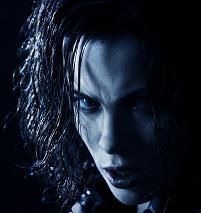
Kate Beckinsale, adapted from
poster for Underworld: Evolution
(DVD release date 6/6/6)
"Appropriating the Button-molder's
words to Peer Gynt, he would say,
'We'll meet at the next crossroads…
and then we'll see–
I won't say more.'"
Rosalind Krauss
in "Grids," 1979:
"If we open any tract– Plastic Art and Pure Plastic Art or The Non-Objective World, for instance– we will find that Mondrian and Malevich are not discussing canvas or pigment or graphite or any other form of matter. They are talking about Being or Mind or Spirit. From their point of view, the grid is a staircase to the Universal, and they are not interested in what happens below in the Concrete.
Or, to take a more up-to-date example…."
"He was looking at
the nine engravings
and at the circle,
checking strange
correspondences
between them."
— The Club Dumas,1993
"And it's whispered that soon
if we all call the tune
Then the piper will lead us
to reason."
— Robert Plant,1971
The nine engravings of
The Club Dumas
(filmed as "The Ninth Gate")
are perhaps more an example
of the concrete than of the
universal.
An example of the universal*–
or, according to Krauss, a
"staircase" to the universal–
is the ninefold square:

"This is the garden of Apollo,
the field of Reason…."
— John Outram, architect
For more on the field
of reason, see
Log24, Oct. 9, 2006.
A reasonable set of
"strange correspondences"
in the garden of Apollo
has been provided by Ezra Brown
in a mathematical essay (pdf).
Unreason is, of course,
more popular.
* The ninefold square is perhaps a "concrete universal" in the sense of Hegel:
"Two determinations found in all philosophy are the concretion of the Idea and the presence of the spirit in the same; my content must at the same time be something concrete, present. This concrete was termed Reason, and for it the more noble of those men contended with the greatest enthusiasm and warmth. Thought was raised like a standard among the nations, liberty of conviction and of conscience in me. They said to mankind, 'In this sign thou shalt conquer,' for they had before their eyes what had been done in the name of the cross alone, what had been made a matter of faith and law and religion– they saw how the sign of the cross had been degraded."
— Hegel, Lectures on the History of Philosophy, "Idea of a Concrete Universal Unity"
"For every kind of vampire,
there is a kind of cross."
— Thomas Pynchon

Related material from March 2004:
Anschaulichkeit (3/16) and
Readings for St. Patrick’s Day.
“For every kind of vampire,
there is a kind of cross.”
— Thomas Pynchon,
Gravity’s Rainbow
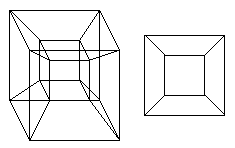
Hypercube and Cube
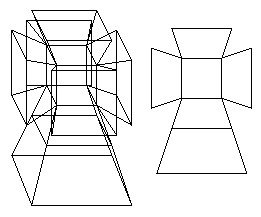
For every kind of vampire,
there is a kind of cross.
— Gravity’s Rainbow
Kate Beckinsale, poster for
Underworld: Evolution
(DVD release date 6/6/6)
evolve:
1641, “to unfold, open out, expand,”
from L. evolvere “unroll,” from ex- “out”
+ volvere “to roll” (see vulva).
— Online Eymology Dictionary
Related material:
Introduction to Multispeech,
All Hallows’ Eve, 2005
Google Maps image
of the isle of Delos,
birthplace of Apollo:

“I faced myself that day with
the nonplused apprehension
of someone who has
come across a vampire
and has no crucifix in hand.”
— Joan Didion, “On Self-Respect,”
in Slouching Towards Bethlehem
“For every kind of vampire,
there is a kind of cross.”
— Thomas Pynchon,
Gravity’s Rainbow

Related material:
From today’s online
Harvard Crimson:

From an Amazon.com review
of McCafferty’s latest book:
— and an entry of April 8
that contains the following
“kind of cross” —
3 PM
Good
Friday

“‘Lestat,’ the maiden Broadway production of Warner Brothers Theater Ventures, is the third vampire musical to open in the last few years, and it seems unlikely to break the solemn curse that has plagued the genre. Directed by Robert Jess Roth from a book by Linda Woolverton, the show admittedly has higher aspirations and (marginally) higher production values than the kitschy ‘Dance of the Vampires’ (2002) and the leaden ‘Dracula: The Musical’ (2004), both major-league flops.” — Ben Brantley
See Log24,
St. Patrick’s Day 2004:
“I faced myself that day with
the nonplused apprehension
of someone who has
come across a vampire
and has no crucifix in hand.”
— Joan Didion, “On Self-Respect,”
in Slouching Towards Bethlehem
“For every kind of vampire,
there is a kind of cross.”
— Thomas Pynchon,
Gravity’s Rainbow

See also
Readings for
St. Patrick's Day
Books:
Finnegans Wake (1939)
Gravity's Rainbow (1978)
Masks of the Illuminati (1981)
Quotations:
"Nature does not know extinction;
all it knows is transformation.
Everything science has taught me,
and continues to teach me,
strengthens my belief in
the continuity of our
spiritual existence
after death."
— Wernher von Braun
"I faced myself that day
with the nonplused apprehension
of someone who has
come across a vampire
and has no crucifix in hand."
— Joan Didion, "On Self-Respect,"
in Slouching Towards Bethlehem
|
"For every kind of vampire, — Thomas Pynchon, Inscribed
In Latin, NORMA Multa renascentur quae iam cecidere, cadentque Many terms will be born again All, all must perish — but, surviving last, "Norma was the latin word for what we now call a carpenter's square. It was used to construct lines which were at right angles to another line, so the created line was said to be 'normal.' The norma was also used as a standard to compare if objects, like a wall, might be erect (perpendicular to the ground) and so those that met the standard were called 'normal' and this use extended to the 'typical' element of any type of set. Eventually normal came to mean anything that 'met the |
"317 is a prime,
not because we think so,
or because our minds are shaped
in one way rather than another,
but because it is so,
because mathematical reality
is built that way."
— G. H. Hardy,
A Mathematician's Apology
Powered by WordPress