See also . . .

Illustration . . .


Metadata —


See also . . .
Illustration . . .
Metadata —
Artnet.com yesterday on "previously unsung or undersung
female artists working in esoteric or occult traditions" —


For those who understand spoken Norwegian.
I do not. The interview apparently gives some
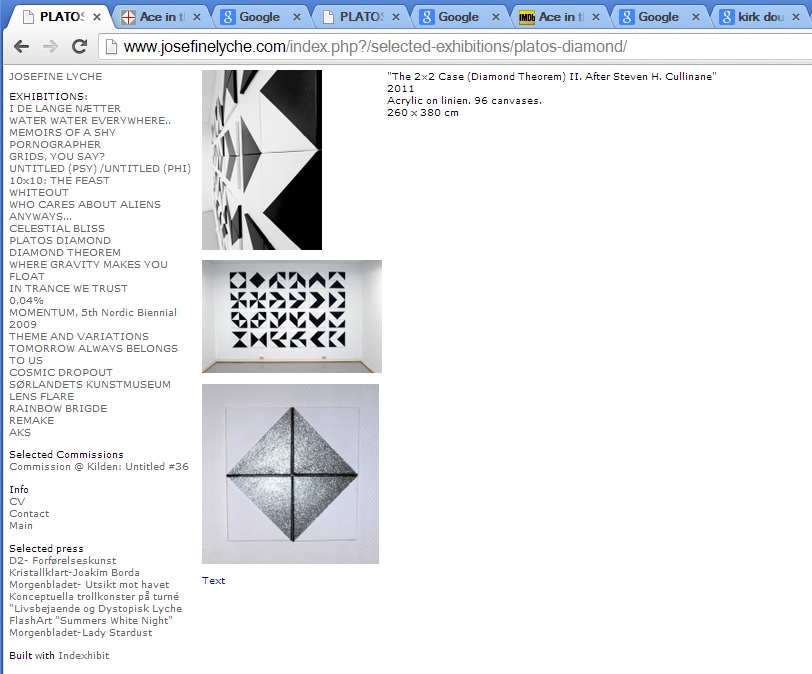
background on Lyche’s large wall version of
“The 2×2 Case (Diamond Theorem) II.
(After Steven H. Cullinane)” 2012
Size: 260 x 380 cm
See also this work as displayed at a Kjærlighet til Oslo page.
(Updated March 30, 2014, to replace dead Kjaerlighet link.)
In memory of the "Thomas Crown Affair" director, who
reportedly died at 97 on Saturday, Jan. 20 —

See as well . . .

marcela 211110

josefine 200815
emily 240113

steven 240115

See as well "Night, Youth, Paris and the Moon" by John Collier.
Book description at Amazon.com, translated by Google —
|
Las matemáticas como herramienta
Mathematics as a tool by Raúl Ibáñez Torres Kindle edition in Spanish, 2023 Although the relationship between mathematics and art can be traced back to ancient times, mainly in geometric and technical aspects, it is with the arrival of the avant-garde and abstract art at the beginning of the 20th century that mathematics takes on greater and different relevance: as a source of inspiration and as a tool for artistic creation. Let us think, for example, of the importance of the fourth dimension for avant-garde movements or, starting with Kandisnky and later Max Bill and concrete art, the vindication of mathematical thinking in artistic creation. An idea that would have a fundamental influence on currents such as constructivism, minimalism, the fluxus movement, conceptual art, systematic art or optical art, among others. Following this approach, this book analyzes, through a variety of examples and activities, how mathematics is present in contemporary art as a creative tool. And it does so through five branches and the study of some of its mathematical topics: geometry (the Pythagorean theorem), topology (the Moebius strip), algebra (algebraic groups and matrices), combinatorics (permutations and combinations) and recreational mathematics (magic and Latin squares). |
From the book ("Cullinane Diamond Theorem" heading and picture of
book's cover added) —

Publisher: Los Libros de La Catarata (October 24, 2023)
Author: Raúl Ibáñez Torres, customarily known as Raúl Ibáñez
(Ibáñez does not mention Cullinane as the author of the above theorem
in his book (except indirectly, quoting Josefine Lyche), but he did credit
him fully in an earlier article, "The Truchet Tiles and the Diamond Puzzle"
(translation by Google).)
About Ibáñez (translated from Amazon.com by Google):
Mathematician, professor of Geometry at the University of the Basque Country
and scientific disseminator. He is part of the Chair of Scientific Culture of the
UPV/EHU and its blog Cuaderno de Cultura Cientifica. He has been a scriptwriter
and presenter of the program “Una de Mates” on the television program Órbita Laika.
He has collaborated since 2005 on the programs Graffiti and La mechanica del caracol
on Radio Euskadi. He has also been a collaborator and co-writer of the documentary
Hilos de tiempo (2020) about the artist Esther Ferrer. For 20 years he directed the
DivulgaMAT portal, Virtual Center for the Dissemination of Mathematics, and was a
member of the dissemination commission of the Royal Spanish Mathematical Society.
Author of several books, including The Secrets of Multiplication (2019) and
The Great Family of Numbers (2021), in the collection Miradas Matemáticas (Catarata).
He has received the V José María Savirón Prize for Scientific Dissemination
(national modality, 2010) and the COSCE Prize for the Dissemination of Science (2011).
From the American Mathematical Society today —
Robert Earl Tubbs (1954-2023)
May 15, 2023
"Tubbs, associate professor of mathematics at
the University of Colorado Boulder, died April 11, 2023,
at the age of 69. He received his PhD in 1981 from
Penn State University under the supervision of
W. Dale Brownawell. His research interests included
number theory, especially transcendental number theory,
the intellectual history of mathematical ideas and mathematics,
and the humanities."
This journal on the dies natalis of Tubbs had the third of three
posts tagged "Space and Form." Those posts dealt with European
cultural history related to Tubbs's interests. The "Space and Form"
posts, along with today's previous Log24 post, suggest a review of
the Nov. 10, 2021 post titled European Culture. An image from that post —

Those who share Cassirer's enthusiasm for myth may regard the
above Josefine Lyche version of my work as a sort of "secret writing,"
to quote a phrase of Cassirer's I find very distasteful. But there is nothing
secret about it, although there is some resemblance to written characters.
This post's title was suggested by a Salinger quote in the European Culture post.

Update on the next day, May 17 —
Further reading in Cassirer's Mythical Thought indicates that in the
passages above, on Schelling, he may be presenting a parody of
Schelling when he writes "a poem hidden behind a wonderful
secret writing." Later, on page 10, he asks, sensibly,
"… is there, perhaps, a means of retaining the question
put forward by Schelling's Philosophie der Mythologie
but of transferring it from the sphere of a philosophy of
the absolute to that of critical philosophy?"
There has reportedly been "an upsurge of interest" in Cassirer —
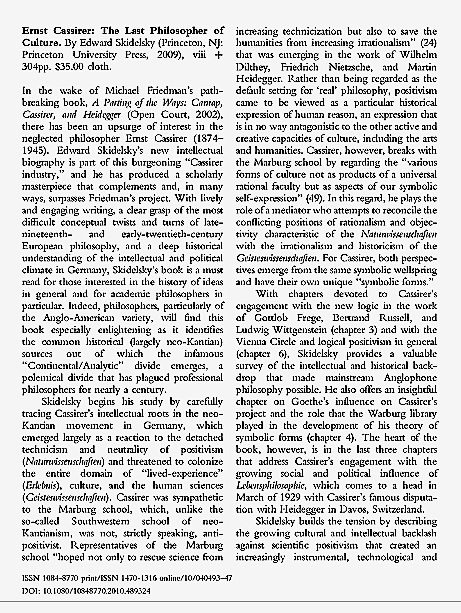
Excerpt of Google Book Search results tonight —

(The search, suggested by a current art exhibition, was for
"Josefine Lyche" + Cullinane . See also a 2017 post titled
"So Set 'Em Up, Jo.")
Mank, Baez, Collins — A trip back to Christmas Eve, 2021.
Related art (via Baez) for Josefine Lyche —


See also Lyche in Log24 posts tagged Star Cube.
|
Alicia — "Gödel never says outright that there is a covenant to which all of mathematics subscribes but you get a clear sense that the hope is there. I know the allure. Some shimmering palimpsest of eternal abidement. But to claim that numbers somehow exist in the Universe with no intelligence to enable them does not require a different sort of mathematics. It requires a different sort of universe." Psychiatrist — "Is there such a universe?"
— McCarthy, Cormac. Stella Maris (p. 180). |
A palimpsest from Oslo artist Josefine Lyche —


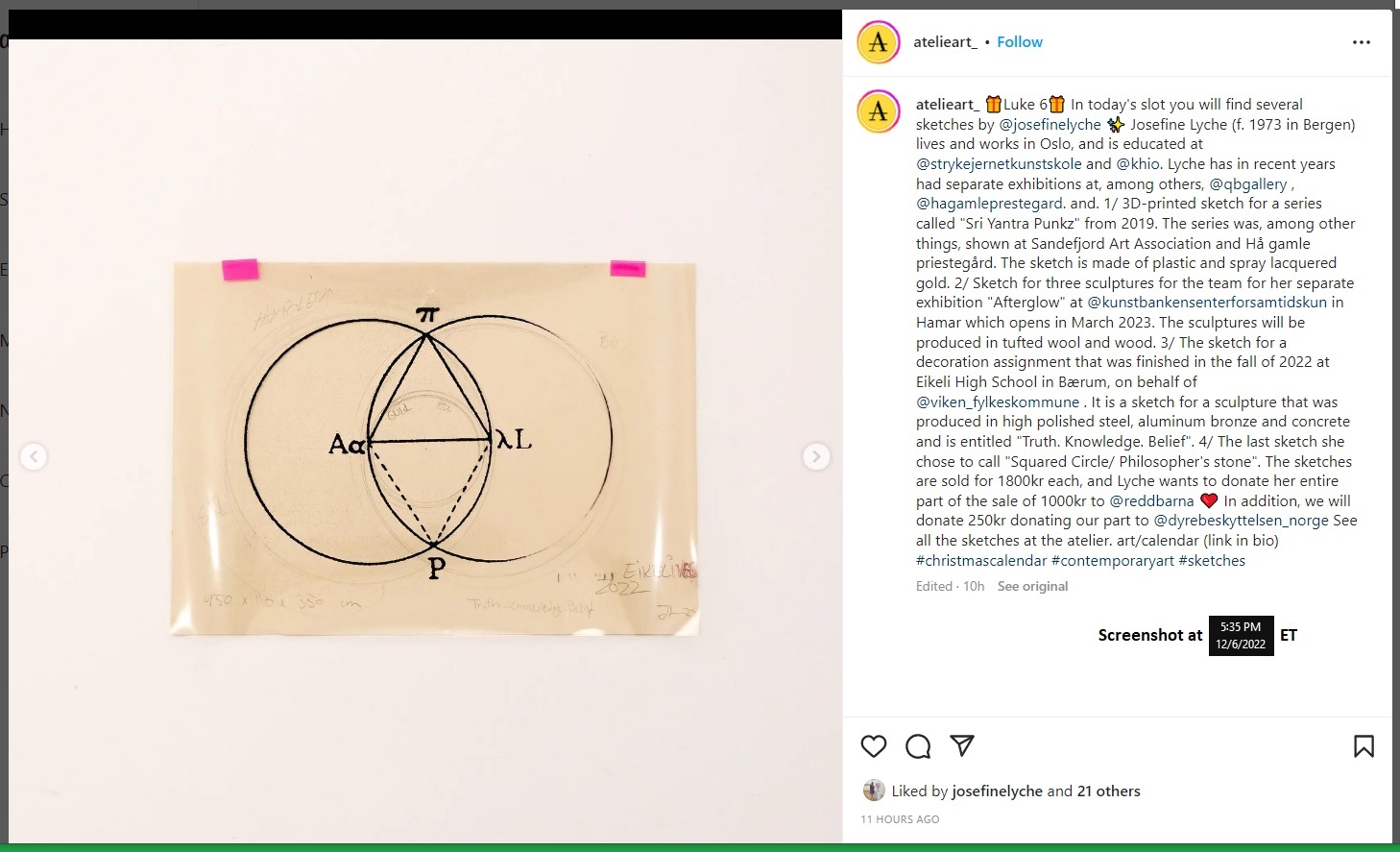
Josefine Lyche, sketch for a sculpture: "Truth, Knowledge, Belief."
The sketch itself appears to be in a transparent plastic envelope,
and the triangle figure from Finnegans Wake is apparently from
the envelope, not from the sketch proper.
See also Epistemology in Norway.


The above art by Steven H. Cullinane is not unrelated to
art by Josefine Lyche. Her work includes sculpted replicas
of the above abstract Platonic solids, as well as replicas of
my own work related to properties of the 4×6 rectangle above.
Symmetries of both the solids and the rectangle may be
viewed as permutations of parts — In the Platonic solids,
the parts are permuted by continuous rotations of space itself.
In the rectangle, the parts are permuted by non-continuous
transformations, as in the I Ching . . . i.e., by concrete illustrations
of change.
"As of 2022, it is the oldest web browser still being maintained,,,,"
"The speed benefits of text-only browsing are most apparent
when using low bandwidth internet connections, or older computer
hardware that may be slow to render image-heavy content."
— Wikipedia [“Older” link added.]
And then there is . . .

See as well the LYNX of Oslo artist Josefine Lyche.
Update of June 30, 2022 —
Lyche, whose art often incorporates mathematical notions,
has not yet, as far as I know, explored the Borromean link
(three rings, linked mutually but not pairwise) in her art.
Remarks by a different math fan, Evelyn Lamb —
"I have had a thing for the Borromean rings for years now.
There’s something so poetic about them. The three rings
are strong together, but they fall apart if any one of them
is removed. Alternatively, the three rings are trapped together
until one of them leaves and sets the others free. I’m kind of
surprised there isn’t a Wisława Szymborska poem or
Tom Stoppard play that explores the metaphorical possibilities
in the Borromean rings." — Scientific American , Sept. 30, 2016.
See also the Lamb date Sept. 30, 2016, as well as work
by Lyche, in Log24 posts tagged Star Cube.
Related material — The Log24 post Borromean Generators.
A new article on Norwegian artist Josefine Lyche was added
to the Norwegian Wikipedia on May the Fourth, 2022.
Meanwhile . . .

USA Today — "Finland shares an 830-mile border with Russia."
Also bordering Russia … Norway. See the art of Josefine Lyche
at the only legal land Russia-Norway border crossing.
Hoisting the Colours —

"I now know that she bursts into laughter when reading Dostoyevsky,
and that she has a weird connection with a retired mathematician."
— Ann Cathrin Andersen in Brygg Magazine on artist Josefine Lyche,
December 9, 2017
"I used her, she used me, but neither one cared." — Bob Seger
An image from the opening of the Netflix series “Locke & Key” —

See also Omega in this journal.

“The key is the cocktail that begins the proceedings.”
– Brian Harley, Mate in Two Moves


Fiction set in Duke Humfrey's Reading Room at
the Bodleian Library, University of Oxford:
|
"I walked quickly through the original, fifteenth-century part of the library, past the rows of Elizabethan reading desks with their three ascending bookshelves and scarred writing surfaces. Between them, Gothic windows directed the reader’s attention up to the coffered ceilings, where bright paint and gilding picked out the details of the university’s crest of three crowns and open book and where its motto, 'God is my illumination,' was proclaimed repeatedly from on high."
— Harkness, Deborah. A Discovery of Witches: |
Related non-fiction about an event on Jan. 26, 2019 —

Meanwhile, elsewhere —

A later ad for the Lyche exhibition —
See as well some posts about the Eddington song —


For the shirt, see Norwegian artist Josefine Lyche in
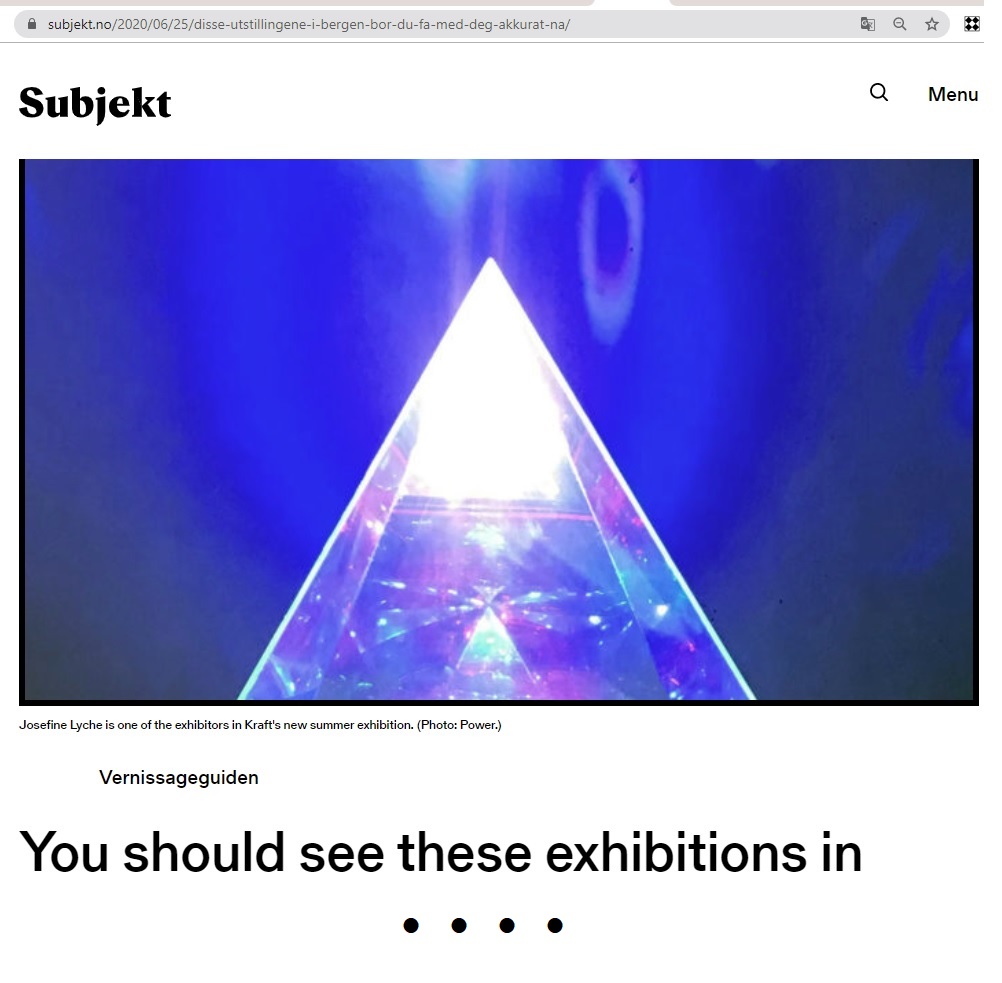
Related material — A pyramid by Lyche and erotic Picasso:

Those who enjoy the occult may be entertained by the number 347 in
“Pablo Picasso. Suite 347.” That number appeared in this journal,
notably, on Christmas Eve 2005 as a page number from the classic
The Club Dumas , a novel by Arturo Perez-Reverte.
“The message was clear: having a finite frame of reference
creates the illusion of a world, but even the reference frame itself
is an illusion. Observers create reality, but observers aren’t real.
There is nothing ontologically distinct about an observer, because
you can always find a frame in which that observer disappears:
the frame of the frame itself, the boundary of the boundary.”
— Amanda Gefter in 2014, quoted here on Mayday 2020.

See as well the previous post.
The title was suggested by the "Crystal Cult" installations
of Oslo artist Josefine Lyche and by a post of May 30 —
|
Thursday, May 30, 2019 Filed under: General — m759 @ 8:02 PM Edit This Jeff Nichols, director of Midnight Special (2016) —
"When asked about the film's similarities to See also Jung's four-diamond figure and the previous post. |
Writers of fiction are, of course, also dabblers in the collective unconscious.
For instance . . .
A 1971 British paperback edition of The Dreaming Jewels,
a story by Theodore Sturgeon (first version published in 1950):

The above book cover, together with the Death Valley location
Zabriskie Point, suggests . . .

Those less enchanted by the collective unconscious may prefer a
different weblog's remarks on the same date as the above Borax post . . .

Foursquare, Inscape, Subway

Foursquare —

Inscape —

Subway —
Art installation, "Crystal Cult" by Josefine Lyche, at an Oslo subway station —

See also today's previous post.

__________________________________________________________________________
See also the previous post.
I prefer the work of Josefine Lyche on the smallest perfect number/universe.
Context —
Lyche's Lynx760 installations and Vigeland's nearby Norwegian clusterfuck.
Paul Valéry, "Introduction to the Method of Leonardo da Vinci,"
La Nouvelle Revue , Paris, Vol. 95 (1895)—
"Regarded thus, the ornamental conception is to the individual arts
what mathematics is to the other sciences. …the objects chosen
and arranged with a view to a particular effect seem as if disengaged
from most of their properties and only reassume them in the effect,
in, that is to say, the mind of the detached spectator. It is thus
by means of an abstraction that the work of art can be constructed,
and is more or less easy to define according as the elements borrowed
from reality for it are more or less complex. Inversely it is by a sort of
induction, by the production of mental images, that all works of art are
appreciated, and this production must equally be more or less active,
more or less tiring, according as it is set in motion by a simple interlacing
on a vase or a broken phrase by Pascal."
— Translated by Thomas McGreevy (Valéry's Selected Writings,
New Directions, 1950)
Related art —

The above cryptic search result indicates that there may
soon be a new Norwegian art installation based on this page
of Eddington (via Log24) —

See also other posts tagged Kummerhenge.

See also yesterday’s Archimedes at Hiroshima and the
above 24 graphic permutations on All Souls’ Day 2010.
For some backstory, see Narrative Line (November 10, 2014).
For Oslo artist Josefine Lyche, excerpts
from a Google image search today —

Material related to Lyche's experience as an adolescent with a ZX Spectrum computer —
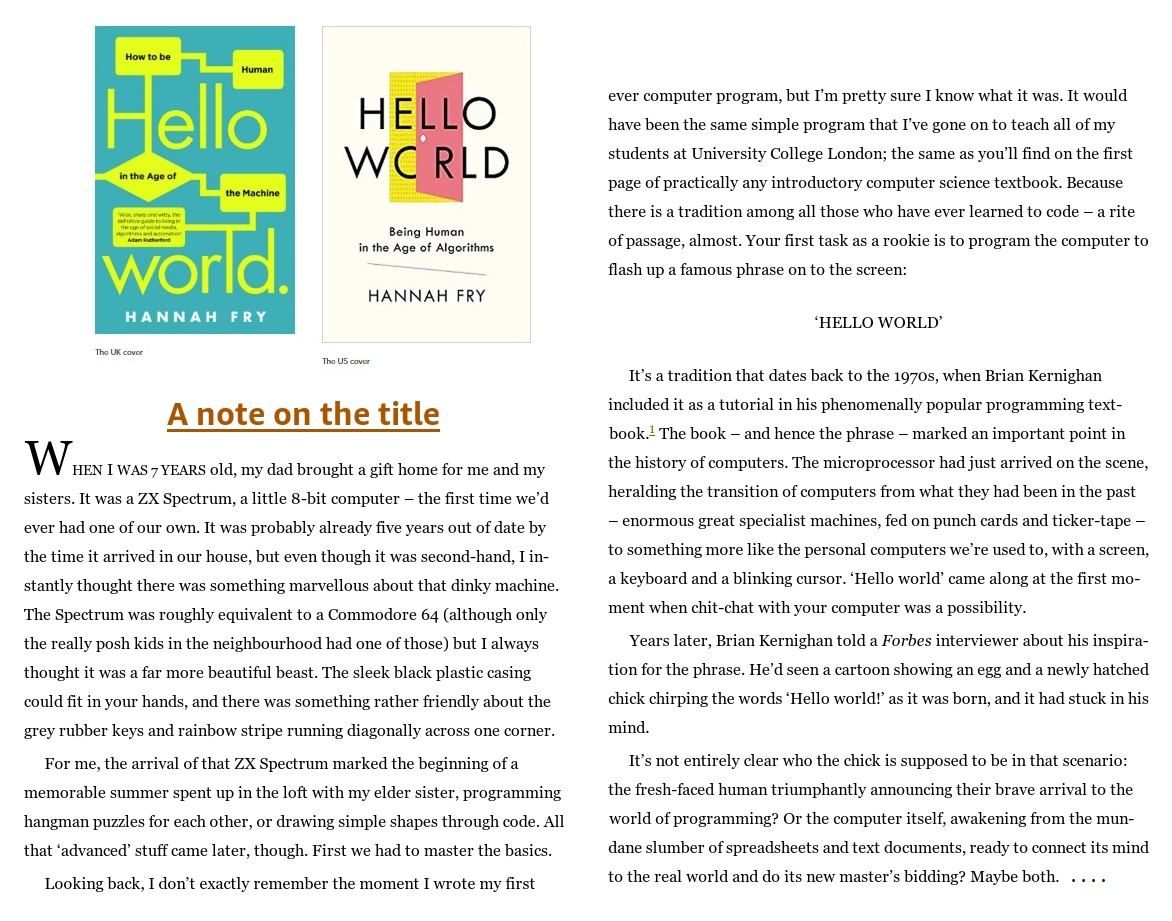
Click "Hello World" for a larger image.
Norwegian artist Josefine Lyche —

Lyche's shirt honors the late Kurt Cobain.
"Here we are now, entertain us."

A Scientific American headline today —
Glittering Diamond Dust in Space
Might Solve a 20-Year-Old Mystery
Related art —
"Never underestimate the power of glitter."
Background: "Diamond Dust" + Glitter in this journal.
A background check of a date from the previous post —
March 12, 2013 — yields . . .
A Wikipedia check of Porter yields . . .
.svg)
This date from Wikimedia — 3 March 2007 — leads to
a post in memory of Myer Feldman, presidential advisor
and theatrical producer.
"It's been dirty for dirty
Down the line . . ."
— Joni Mitchell,
"For the Roses" album (1972)
On the Oslo artist Josefine Lyche —
"Josefine has taken me through beautiful stories,
ranging from the personal to the platonic
explaining the extensive use of geometry in her art.
I now know that she bursts into laughter when reading
Dostoyevsky, and that she has a weird connection
with a retired mathematician."
— Ann Cathrin Andersen,
http://bryggmagasin.no/2017/behind-the-glitter/
Personal —
The Rushkoff Logo

— From a 2016 graphic novel by Douglas Rushkoff.
See also Rushkoff and Talisman in this journal.
Platonic —
Compare and contrast the shifting hexagon logo in the Rushkoff novel above
with the hexagon-inside-a-cube in my "Diamonds and Whirls" note (1984).
"The walls in the back of the room show geometric shapes
that remind us of the logos on a space shuttle. "
— Web page on an Oslo art installation by Josefine Lyche.
See also Subway Art posts.
The translation above was obtained via Google.
The Norwegian original —
"På veggene bakerst i rommer vises geometriske former
som kan minne om logoene på en romferge."
Related logos — Modal Diamond Box in this journal:

Logos for Philosophers
(Suggested by Modal Logic) —

… According to a comment on the latest Instagram
post of Oslo artist Josefine Lyche —
🏰💎.
See also "Castle Rock" in this journal.


"You grab your experiential richness where you find it."
— Roberta Smith, "Postwar Art Gets a Nervy Makeover"
in the online New York Times today

See also “Romancing the Omega” —
Related mathematics — Guitart in this journal —

See also Weyl + Palermo in this journal —


“Show me all the blueprints.”
— Howard Hughes, according to Hollywood
From an old Dick Tracy strip —

This journal in April 2006 —
Cleaning out her studio, Oslo artist Josefine Lyche
has found some frames from an old art-school audition video —
(Click to enlarge.)

* Search for "st.+peter"+eve+adam+"first+words"
“Danes have been called the happiest people.
I wonder how they measure this.”
— Copenhagen designer in today's online New York Times .
A version of this article is to appear in print on March 26, 2017,
in T Magazine with the headline: "Gray Matters."
See also last night's quarter-to-three post as well as
the webpage "Grids, You Say?" by Norwegian artist Josefine Lyche.
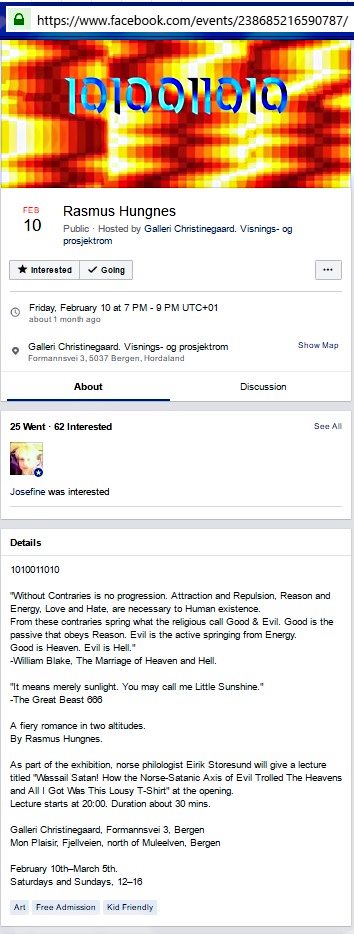
"… and all I got was this lousy sweatshirt" —

Some posts related to the above Rasmus Hungnes exhibition
opening date — Feb. 10, 2017 — are now tagged Bewitchment.
* See Synchronology in this journal.
(Notes for Josefine, continued from December 22, 2013)
From a prequel to The Shining , by Stephen King—
You had to keep an eye on the boiler
because if you didn’t, she would creep on you.
What did that mean, anyway? Or was it just
one of those nonsensical things that sometimes
came to you in dreams, so much gibberish?
Of course there was undoubtedly a boiler
in the basement or somewhere to heat the place,
even summer resorts had to have heat sometimes,
didn’t they (if only to supply hot water)? But creep ?
Would a boiler creep ?
You had to keep an eye on the boiler.
It was like one of those crazy riddles,
why is a mouse when it runs,
when is a raven like a writing desk,
what is a creeping boiler?


A related figure —

Ben Lerner on Judd's art at Marfa —
"as if the installation were waiting to be visited
by an alien or god" — 10:04: A Novel
Oslo artist Josefine Lyche's public Instagram today —

See also Space (May 13, 2015).
A search from the previous post (The Zero Obit) yields
two lines from Wallace Stevens that are echoed as follows…
"That elemental parent, the green night,
Teaching a fusky alphabet."

See also this journal on St. Patrick's Day 2016.
The following page quotes "Raiders of the Lost Crucible,"
a Log24 post from Halloween 2015.

From KUNSTforum.as, a Norwegian art quarterly, issue no. 1 of 2016.
Related posts — See Lyche Eightfold.
A March 10, 2016, Facebook post from KUNSTforum.as,
a Norwegian art quarterly —

Click image above for a view of pages 50-51 of a new KUNSTforum
article showing two photos relevant to my own work — those labeled
"after S. H. Cullinane."
(The phrase "den pensjonerte Oxford-professoren Stephen H. Cullinane"
on page 51 is almost completely wrong. I have never been a professor,
I was never at Oxford, and my first name is Steven, not Stephen.)
For some background on the 15 projective points at the lower left of
the above March 10 Facebook post, see "The Smallest Projective Space."
See "Behind the Glitter" (a recent magazine article
on Oslo artist Josefine Lyche), and the much more
informative web page Contact (from Noplace, Oslo).
From the latter —
"Semiotics is a game of ascribing meaning, or content, to mere surface."
The previous post quoted Holland Cotter's description of
the late Ellsworth Kelly as one who might have admired
"the anonymous role of the Romanesque church artist."
Work of a less anonymous sort was illustrated today by both
The New York Times and The Washington Post —


The Post 's remarks are of particular interest:
|
Philip Kennicott in The Washington Post , Dec. 28, 2015, “Sculpture for a Large Wall” consisted of 104 anodized aluminum panels, colored red, blue, yellow and black, and laid out on four long rows measuring 65 feet. Each panel seemed different from the next, subtle variations on the parallelogram, and yet together they also suggested a kind of language, or code, as if their shapes, colors and repeating patterns spelled out a basic computer language, or proto-digital message. The space in between the panels, and the shadows they cast on the wall, were also part of the effect, creating a contrast between the material substance of the art, and the cascading visual and mental ideas it conveyed. The piece was playful, and serious; present and absent; material and imaginary; visually bold and intellectually diaphanous. Often, with Kelly, you felt as if he offered up some ideal slice of the world, decontextualized almost to the point of absurdity. A single arc sliced out of a circle; a single perfect rectangle; one bold juxtaposition of color or shape. But when he allowed his work to encompass more complexity, to indulge a rhetoric of repetition, rhythmic contrasts, and multiple self-replicating ideas, it began to feel like language, or narrative. And this was always his best mode. |
Compare and contrast a 2010 work by Josefine Lyche —

Lyche's mirrors-on-the-wall installation is titled
"The 2×2 Case (Diamond Theorem)."
It is based on a smaller illustration of my own.
These variations also, as Kennicott said of Kelly's,
"suggested a kind of language, or code."
This may well be the source of their appeal for Lyche.
For me, however, such suggestiveness is irrelevant to the
significance of the variations in a larger purely geometric
context.
This context is of course quite inaccessible to most art
critics. Steve Martin, however, has a phrase that applies
to both Kelly's and Lyche's installations: "wall power."
See a post of Dec. 15, 2010.


Symbol —
Monday, November 7, 2011
|
A Log24 Hanukkah from five years ago (Dec. 5, 2010) —

Related material: Oslo artist Josefine Lyche's
private Instagram photo of her adolescence with
a ZX Spectrum, and Symbols, Local and Global.
"… if your requirement for success is to be like Steve Jobs,
good luck to you."
— "Transformation at Yahoo Foiled by Marissa Mayer’s
Inability to Bet the Farm," New York Times online yesterday
"Design is how it works." — Steve Jobs
Related material: Posts tagged Ambassadors.

(Suggested by the latest Instagram post of Oslo artist Josefine Lyche)


The following is an excerpt from
"Tummelplatz: Exploring playgrounds for creative
collaborations — A qualitative study of generative
dynamics within temporary work contexts,"
by Emily Moren Aanes and Dragana Trifunović.
(Master's thesis, Oslo, 2013).

Related material: Josefine Lyche in this journal.
An eightfold cube appears in this detail
of a photo by Josefine Lyche of her
installation "4D Ambassador" at the
Norwegian Sculpture Biennial 2015 —
(Detail from private Instagram photo.)
Catalog description of installation —

Google Translate version —
In a small bedroom to Foredragssalen populate
Josefine Lyche exhibition with a group sculptures
that are part of the work group 4D Ambassador
(2014-2015). Together they form an installation
where she uses light to amplify the feeling of
stepping into a new dimension, for which the title
suggests, this "ambassadors" for a dimension we
normally do not have access to. "Ambassadors"
physical forms presents nonphysical phenomena.
Lyches works have in recent years been placed
in something one might call an "esoteric direction"
in contemporary art, and defines itself this
sculpture group humorous as "glam-minimalist."
She has in many of his works returned to basic
geometric shapes, with hints to the occult,
"new space-age", mathematics and where
everything in between.
See also Lyche + "4D Ambassador" in this journal and
her website page with a 2012 version of that title.
(The title is a phrase from Oslo artist Josefine Lyche's Instagram page today.)
Note that 6 PM ET is midnight in Oslo.
An image from St. Ursula's Day, 2010 —

Related material:
"Is it a genuine demolition of the walls which seem
to separate mind from mind …. ?"
— Clifford Geertz, conclusion of “The Cerebral Savage:
On the Work of Claude Lévi-Strauss“
Robots pass "wise-men puzzle" to show a degree of self-awareness
New app … discourages self-awareness on social media —
"Self-awareness is a good thing.
Self-awareness is what tells us
'Hey, maybe just give us the highlights reel….'"
From this journal on July 13, Oslo artist Josefine Lyche —

Lyche's shirt honors the late Kurt Cobain.
"Here we are now, entertain us."


Dance scene from the 2015 film "Ex Machina"
(The title was suggested by the novel Weaveworld .)
Recent public selfie by Oslo artist Josefine Lyche —
Lyche's shirt honors the late Kurt Cobain.
Not-so-recent image of Hugo Weaving as
Agent Smith in "The Matrix" —

"Smells like teen spirit."
See also Weaving in the new film "Strangerland."

See an informative essay at noplace.no on the work of
Oslo artist Josefine Lyche in connection with her current
(June 12-21) exhibition, "Contact."
A paragraph from that essay —

See also Lyche in this journal.

Street view in Oslo, August 2014 (thanks to Google):
Vennligst benytt fortau pa andre siden =
Please use the sidewalk on the other side

Take a walk on the wild side… or not.
This post was suggested by a Log24 post, Gaze, of May 21, 2015, and by
an Instagram photo that Oslo artist Josefine Lyche posted today.
The title appears as a joint heading for three reviews
of Norway-related books on the front page of the print
version of today's New York Times Sunday Book Review .

See as well Josefine Lyche in this journal.
Steven Pressfield on April 25, 2012:
What exactly is High Concept?
Let’s start with its opposite, low concept.
Low concept stories are personal,
idiosyncratic, ambiguous, often European.
“Well, it’s a sensitive fable about a Swedish
sardine fisherman whose wife and daughter
find themselves conflicted over … ”
ZZZZZZZZ.
Fans of Oslo artist Josefine Lyche know she has
valiantly struggled to find a high-concept approach
to the diamond theorem. Any such approach must,
unfortunately, reckon with the following low
(i.e., not easily summarized) concept —
The Diamond Theorem Correlation:

From left to right …
http://www.log24.com/log/pix14B/140824-Diamond-Theorem-Correlation-1202w.jpg
http://www.log24.com/log/pix14B/140731-Diamond-Theorem-Correlation-747w.jpg
http://www.log24.com/log/pix14B/140824-Picturing_the_Smallest-1986.gif
http://www.log24.com/log/pix14B/140806-ProjPoints.gif
For some backstory, see ProjPoints.gif and "Symplectic Polarity" in this journal.
"I am trying to introduce a narrative,
something magical and seductive…."
— Oslo artist Josefine Lyche, translated
from the Norwegian by Google
Perhaps something like Arcade Fire or
Taylor Swift? (Click links for related posts.)
Or: Debriefing Josefine
From the CV of Oslo artist Josefine Lyche:
Selected Collections/ Public Commissions:
2016 Jarfjord Grensevaktstasjon,
Jarfjord/Kirkenes, NO (upcoming)
From an Amazon.com customer review of a book on
northern Norway in World War II, Fire and Ice —
"… Hunt doesn't take sides. He approaches
the story as a journalist and documentary maker,
rather than as an academic."
The book, as the author notes, was published in Britain
on October 6, 2014.
A synchronicity check of the publication date yields
a variation on the "Fire and Ice" theme —

____________________________
"Jeg prøver å innføre et narrativ, noe magisk og forførende,
samt erstatte den iboende materialistiske logikken med
esoterisk kosmologi og symbolikk." — Josefine Lyche
(Continued from Jan. 3 and Jan. 5.)
Introduction: "Grids, You Say?" by Josefine Lyche,
and AntiChristmas 2010:

Related material:
Chapter 42 in
A History of Graphic Design ,
by Guity Novin.
See Instantia Crucis and Josefine Lyche's
One-Night-Only exhibition in Oslo Jan. 5.

JOSEFINE LYCHE
ABSOLUTE ALT. VOL. 2
17. april – 23. mai [2015] —
"I kjernen av mitt arbeid er en pågående
utforskning av esoteriske konsepter…."
"At the core of my work is an ongoing
exploration of esoteric concepts…."
See also
http://issuu.com/tmrk/docs/spritenkunsthall_2015_cut .
Related material: Hard Core.
The "Phony Pony" images below by Josefine Lyche
may or may not have been created in response to the link
on "magic" in the previous post to Katy Perry's "Dark Horse" video.

Oslo artist Josefine Lyche has a new Instagram post,
this time on pyramids (the monumental kind).
My response —
Wikipedia's definition of a tetrahedron as a
"triangle-based pyramid" …

… and remarks from a Log24 post of August 14, 2013 :
|
Norway dance (as interpreted by an American)
I prefer a different, Norwegian, interpretation of "the dance of four."
Related material: |
See also some of Burkard Polster's triangle-based pyramids
and a 1983 triangle-based pyramid in a paper that Polster cites —
(Click image below to enlarge.)

Some other illustrations that are particularly relevant
for Lyche, an enthusiast of magic :
From On Art and Magic (May 5, 2011) —
|
|
(Updated at about 7 PM ET on Dec. 3.)
This post is a sequel to Pythagorean Selfie (Sept. 30, 2014)
and October Nine: Lyche at Bodø.
Today’s Instagram photos from Josefine Lyche, still at Bodø:

The figure at left appears to be diving. This suggests a review of posts on
the late film director Tony Scott.
(The phrase is from Don DeLillo and Josefine Lyche.)
See “Complex Grid.”
See as well Bill O’Reilly’s remark, “Do not be a coxcomb,”
and an artist‘s self-portrait:

Grid Designer
Click to enlarge.

See also Apollo in this journal.
“Nine is a very powerful Nordic number.”
— Katherine Neville, who deserves some sort of prize for literature.

— Heidegger, “Hölderlin and the Essence of Poetry,”
translated by Douglas Scott, in Existence and Being ,
Regnery, 1949
Ben Brantley in The New York Times today on a Broadway opening:
“As Christopher navigates his way through an increasingly
unfamiliar landscape, both physical and emotional, the arcs
of his adventures are drawn into being.
So are the shards of sensory overload.”
Arc — See a search for Line at Infinity:

Shard — See Shard and Pythagorean Selfie:

Loren Olson, Harvard ’64, a professor of mathematics
at Norway’s Tromsø University,* died June 22, 2014.
In his memory, a search in this journal for Lie Group.
That search yields a post titled Lie Groups for Holy Week (March 30, 2010).
A quotation related to that post:

* The city of Tromsø hosted some art related to group theory in 2010.
Neither that art nor my own related remarks on group theory are very
relevant to physics (yet).
“Rarely is a TV show as brilliant and as terrible as Selfie .”
— Kevin Fallon on a new ABC TV show that starts tonight at 8 PM ET
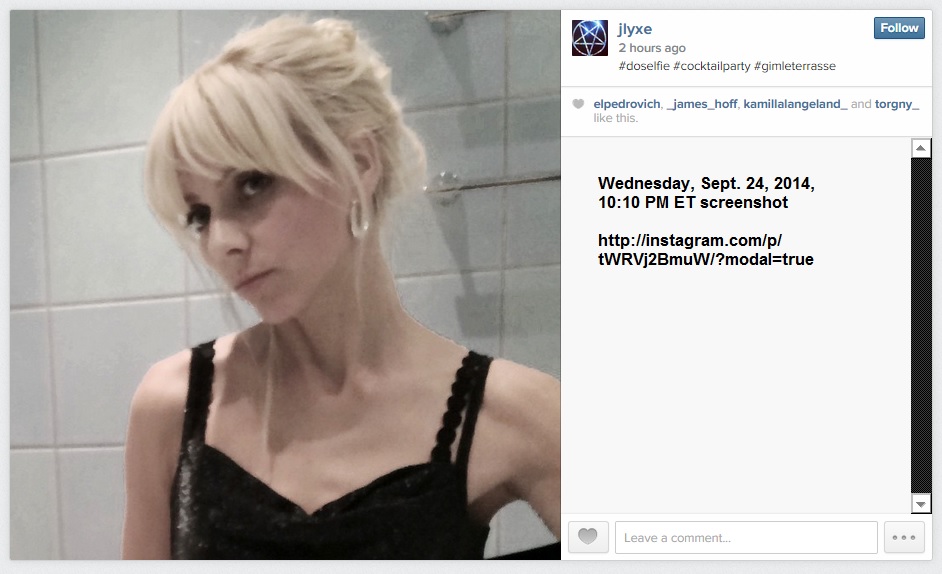
A recent selfie from Josefine Lyche’s Instagram page:

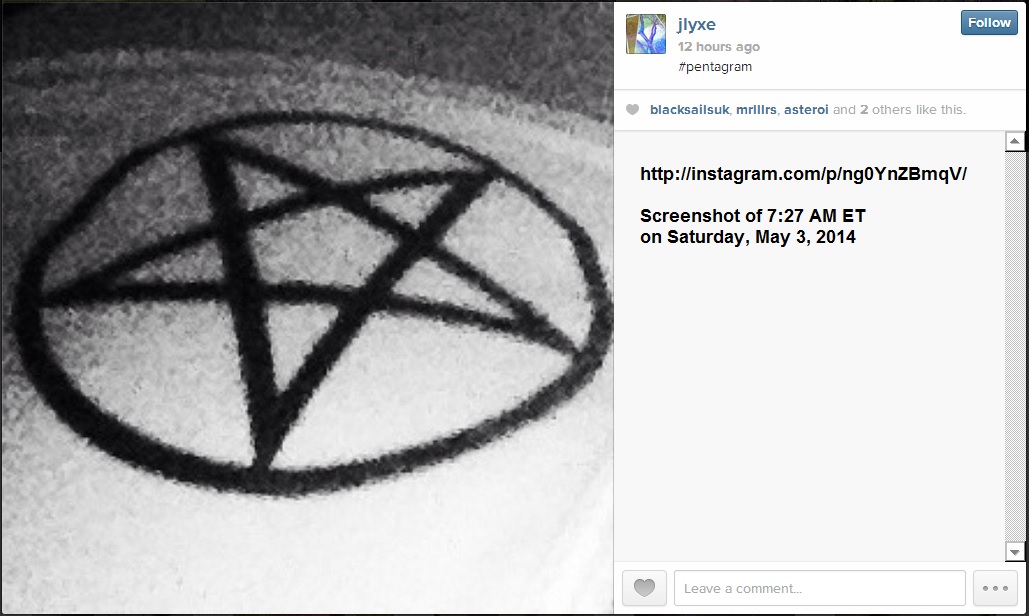
For some remarks related to Lyche’s pentagram, see
Lyche + Mathmagic* and also yesterday’s Michaelmas Mystery.
In today’s previous post, the late Harvey Cohn posed a question that
he said might have been asked by Pythagoras:
“It is an elementary observation that an integral right triangle
has an even area. Suppose the hypotenuse is prime.
Q. How do we determine from the prime value of the hypotenuse
when the area is divisible by 4, 8, 16, or any higher power of 2?
A. We use class fields constructed by means of transcendental
functions, of course!”
— From the preface to Introduction to the Construction of Class Fields ,
by Harvey Cohn (Cambridge University Press, 1985)
Illustration:
For a related song, see Prime Suspect (Dec. 13, 2007).
Footnote of 12:14 AM Oct. 1, 2014 —
* That search yields a link to…

This Lyche webpage’s pentagram indicates an interest in Disney rather than
in Satanism. Other Lyche webpages have been less reassuring.
Related material — Posts tagged Elegantly Packaged.
“. . . the bottom line of the grid is a naked and determined materialism.”
— Rosalind Krauss, quoted by Josefine Lyche
See also http://www.dailymotion.com/video/
x164rmi_britt-ekland-nude-wicker-man-1973_people.
Version from "The Avengers" (2012) —

Version from Josefine Lyche (2009) —
See also this journal on the date that the above Avengers video was uploaded.
“The yarns of seamen have a direct simplicity, the whole meaning
of which lies within the shell of a cracked nut. But Marlow was not
typical (if his propensity to spin yarns be excepted), and to him the
meaning of an episode was not inside like a kernel but outside,
enveloping the tale which brought it out only as a glow brings out a
haze, in the likeness of one of these misty halos that sometimes
are made visible by the spectral illumination of moonshine.”
— Joseph Conrad in Heart of Darkness
Photo of full moon over Oslo last night by Josefine Lyche:

A scene from my film viewing last night:

Some background (click to enlarge):

Note:
The “I, Frankenstein” scene above should not be interpreted as
a carrying of Martin Gardner through a lyche gate. Gardner
is, rather, symbolized by the asterisk in the first image from
the above Google search.
"It was our old friend Pythagoras who discovered
that the pentagram was full of mathematics."
— Narrator, "Donald in Mathmagic Land," Disney, 1959
… and it was Peter J. Cameron who discovered that
mathematics was full of pentagrams.
From Log24 on May 3: Gray Space —

Robert J. Stewart (left) and a pentagram photo posted May 2
by Oslo artist Josefine Lyche. See also Lyche in this journal.
From Log24 on May 13: An Artist's Memorial —

The death mentioned in the above May 13 post occurred on
May 12, the date of a scheduled Black Mass at Harvard.
Related material:


See last night’s pentagram photo and a post from May 13, 2012.
That post links to a little-known video of a 1972 film.
A speech from the film was used by Oslo artist Josefine Lyche as a
voice-over in her 2011 golden-ratio video (with pentagrams) that she
exhibited along with a large, wall-filling copy of some of my own work.
The speech (see video below) is clearly nonsense.
The patterns* Lyche copied are not.

“Who are you, anyway?”
— Question at 00:41 of 15:00, Rainbow Bridge (Part 5 of 9)
at YouTube, addressed to Baron Bingen as “Mr. Rabbit”
* Patterns exhibited again later, apparently without the Lyche pentagram video.
It turns out, by the way, that Lyche created that video by superimposing
audio from the above “Rainbow Bridge” film onto a section of Disney’s 1959
“Donald in Mathmagic Land” (see 7:17 to 8:57 of the 27:33 Disney video).
The title is that of a short story in Dubliners , by James Joyce.
See in that story the phrase “Grey-green eyes.”
See also the tag #greygreengrids on an Oslo artist’s photo today.
From The Ninth Element website:

Cover of a Norwegian author’s forthcoming novel:

For some Norwegian non-fiction, see an Oslo artist’s Instagram page.
Or: Three Shades of Gray
(Continued from previous Gray Space posts.)

Click the above image for some related mathematics.
Those who prefer “magic” approaches to mathematics*
may consult the works of Robert J. Stewart and his
mentor William G. Gray.
Robert J. Stewart (left) and a pentagram photo posted yesterday evening
by Oslo artist Josefine Lyche. See also Lyche in this journal.
* See the April 2014 banners displayed at the websites
of the American Mathematical Society and of the
Mathematical Association of America, as well as
a mathematician’s remarks linked to here last evening.

See also, in this journal, Arcade Fire and Witch Ball.
This post was suggested by remarks today of mathematician
Peter J. Cameron, who seems to enjoy playing the role of
Lord Summerisle (from The Wicker Man , a 1973 horror classic).
Some background for a recent photo
by Josefine Lyche:
The Boys from Uruguay and Witch Ball.
The photo:


See also LYNX 760 , Rubik vs. Abel, and Toying.
Two timely images for Oslo artist Josefine Lyche —

Backstory: Searches for “Blazing World” and for “Josefine + Lyche + Pink”
in this journal.
The image above is by a man, Brian Stauffer. Related material:
An image from today’s NY Times Sunday Book Review —

This image is by a non-man, Kelsey Dake.
The first image above, since it combines Lyche’s enthusiasm for the color
pink and (apparently) for fishnet stockings, seems to me the better picture,
despite its prurient nature.
(Updated through 10 AM ET)
The title is suggested by a new novel (see cover below),
and by an unwritten book by Nabokov —
Related material:
For Josefine Lyche, by fellow artist Nuno Borges:

Related material:
Recent remarks by Lyche and
a recurring image from this journal.


“The name Siri is Norwegian, meaning
‘beautiful woman who leads you to victory.'”
I prefer Josefine.

From New World Encyclopedia —

See also Tetragrammaton in this journal.
For further context, see Solomon's Cube and Oct. 16, 2013.
For Oslo artist Josefine Lyche, who sometimes
seems to think my work resembles that of the
deranged Anthony Hopkins in the film of David
Auburn's play "Proof."
See another artist's images of Hopkins-like work
I just discovered online —
"The Proof," by David Colosi.
In honor of the tenth anniversary of Facebook

Viewed in the Chrome browser, a Facebook post from
January 29, 2014, displays an artist's Mystery Box*…

In the Internet Explorer browser, the mystery is solved:

Further details —

Related material — Lyche + Geometry in this journal.
See also the cat and triangle pictured by David Justice yesterday—
 .
.
* A phrase of filmmaker J.J. Abrams. Click the link
for further details. See also a mystery box
in The New York Times on June 2, 2011.
From The Diamond and the Star , by John Warden*
(London, Shepheard-Walwyn Ltd., June 1, 2009) —
(The quotation is from Kipling's "The Conundrum of the Workshops.")

Answer — Some would say "Yes."
Part I: From a search for "Diamond Star" in this journal —
The Diamond Star

Part II: From the Facebook photos of Oslo artist Josefine Lyche—

* Obituary link, added at 10:45 PM ET Jan. 31 after reading a publisher's note
saying that "The author sadly died before the book was published."
Perhaps sadly, perhaps not.
For Josefine Lyche, artist of High White Noon —
Thursday, October 10, 2013
|
From the New York Times obituary of philanthropist
Fred Kavli, who died on Thursday, November 21—
” In 2005, when Mr. Kavli announced that
he planned to start the prizes, he recalled
skiing in the Norwegian mountains as a boy.
‘At times,’ he told a gathering in New York,
‘the whole sky was aflame with the Northern Lights
shifting and dancing across the sky down to the
white-clad mountaintops. In the stillness and
loneliness of the white mountains, I pondered the
universe, the planet, nature and the wonders of
man. I’m still pondering.’ “
“And we may see the meadow in December, icy white
and crystalline….” — Johnny Mercer, lyrics to Lionel
Hampton and Sonny Burke’s “Midnight Sun”
* Lyche

Josefine Lyche’s large wall version of the twenty-four 2×2 variations
above was apparently offered for sale today in Norway —
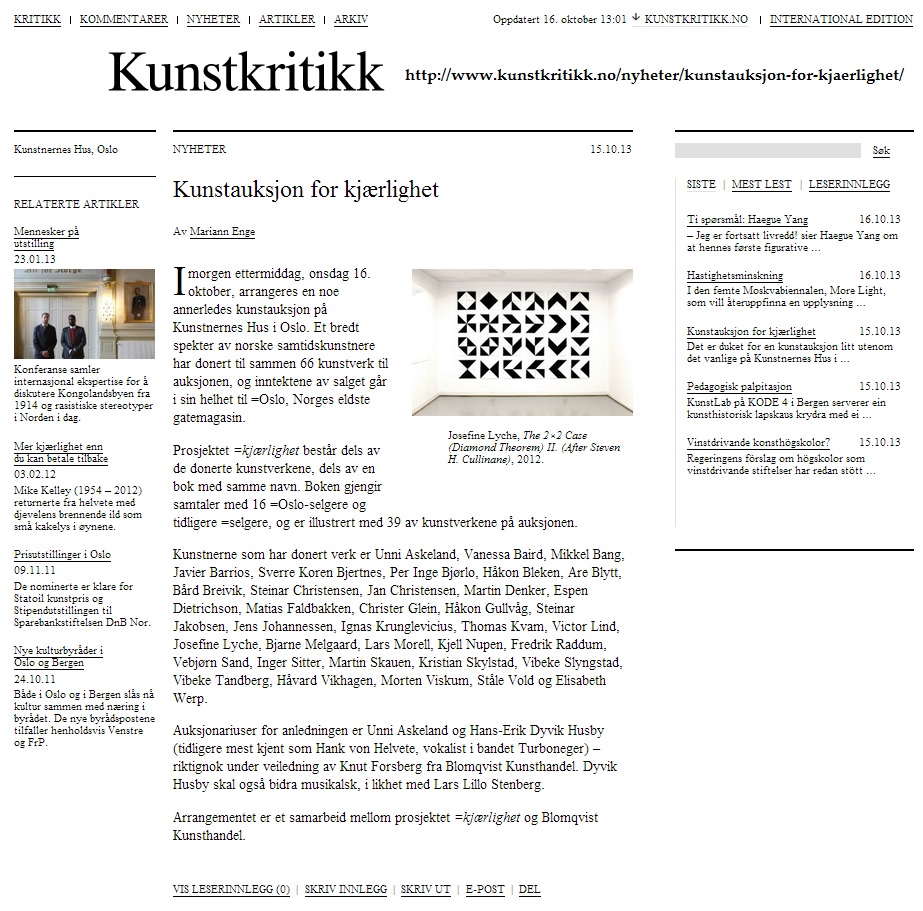
Click image for more details and click here for a translation.
A sequel to last night's "For Baron Samedi" —
Sigils

The music in the trailer for the new film "American Hustle"
is a 1969 tune by Led Zeppelin. This, together with the
magick sigils posted at Facebook yesterday by artist
Josefine Lyche, suggests a review of Zeppelin sigils
from a 1971 album. These are, as shown above on a
record label, the personal symbols of the four musicians
in the band. Two of the symbols may, of course, be
interpreted as representing the Holy Trinity.

Click on the image for a video.
See also Josefine Lyche's "Grids, you say?"
I prefer Lyche's versions of the diagonal
3×3 grid. Her versions have no lettering.
(This post was suggested by a photo of magical sigils
that Lyche posted a few hours ago at Facebook.
The above seems to be another such sigil that may
or may not be intended to function like those posted
today by Lyche.)
From an academic's website:

For Josefine Lyche and Ignotus the Mage,
as well as Rose the Hat and other Zingari shoolerim —
Sabbatha hanti, lodsam hanti, cahanna risone hanti :
words that had been old when the True Knot moved
across Europe in wagons, selling peat turves and trinkets.
They had probably been old when Babylon was young.
The girl was powerful, but the True was all-powerful,
and Rose anticipated no real problem.
— King, Stephen (2013-09-24).
Doctor Sleep: A Novel
(pp. 278-279). Scribner. Kindle Edition.
From a post of November 10, 2008:

Twenty-four Variations on a Theme of Plato,
a version by Barry Sharples based on the earlier
kaleidoscope puzzle version of Steven H. Cullinane
"The king asked, in compensation for his toils
during this strangest of all the nights he had
ever known, that the twenty-four riddle tales
told him by the specter, together with the story
of the night itself, should be made known
over the whole earth and remain eternally
famous among men."
Frame Tale:
"The quad gospellers may own the targum
but any of the Zingari shoolerim may pick a peck
of kindlings yet from the sack of auld hensyne."
Today, beginning at about 11 AM ET, I checked out
the latest news from Oslo artist Josefine Lyche,
often mentioned in these posts.
Lyche's Facebook page has a new cover photo—
geometric diagrams from Order in Space , a 1969
book by Keith Critchlow.
A search for more information on Critchlow yielded
information on his friend the impressive Kathleen Raine,
who reportedly died at 95 on July 6, 2003.
See also references to that date in this journal.
From Raine's obituary in The Guardian :
"When asked how she wished people
to remember her, Kathleen Raine said
she would rather they didn't. Or that
Blake's words be said of her: 'That in
time of trouble, I kept the divine vision.' "

For the late Billy Wilder, director of Ace in the Hole (1951)

Click image for a larger version.
See, too, this morning's quarter-to-three post, and The Vikings (1958)—

The art by Josefine Lyche in the Bodin book shown
above is, as the artist notes, based on my own work.
(Continued from August 28 last year)
Backstory—
Reflections from today's date, August 13, in 2003, that included
the following remark by Aldous Huxley on an artist's work:
"All the turmoil, all the emotions of the scenes
have been digested by the mind into a
grave intellectual whole. It is as though
Bach had written the 1812 Overture."
Related art—
Josefine Lyche, from her 2013 Crackquarelle series:

Steven H. Cullinane, The Story of N ,
from The Misalignment of Mars and Venus series:

See, too, previous posts on The Story of N.
This is the weekend for Comic-Con International in San Diego.

The convention includes an art show. (Click above image to enlarge.)
Related material from Norway…

Suggested nominations for a Kavli Prize:
1. Josefine Lyche's highly imaginative catalog page for
the current Norwegian art exhibition I de lange nætter,
which mentions her interest in sacred geometry
2. Sacred Geometry: Drawing a Metatron Cube
… and from San Diego—
The Kavli Institutes logo:
You say goodbye, I say …
A YouTube video uploaded on March 2, 2012—

This journal on the date of the above video's uploading— March 2, 2012:
"…des carreaux mi-partis de deux couleurs par une ligne diagonale…."
See also Josefine Lyche in Vril Chick and Bowling in Diagon Alley.
Profile picture of "Jo Lyxe" (Josefine Lyche) at Vimeo—

Compare to an image of Vril muse Maria Orsitsch.
From the catalog of a current art exhibition
(25 May – 31 August, 2013) in Norway,
I DE LANGE NÆTTER —
|
Josefine Lyche
Keywords (to help place my artwork in the (See also the original catalog page.) |
Clearly most of this (the non-highlighted parts) was taken
from my webpage Diamond Theory. I suppose I should be
flattered, but I am not thrilled to be associated with the
(apparently fictional) Vril Society.
For some background, see (for instance)
Conspiracy Theories and Secret Societies for Dummies .

Here is the link to an MIT Scratch project from the above comment.
See also a comment by a Random Norwegian Dude:

For related art, see
"4D AMBASSADOR (HYPERCUBE)" for Steven H. Cullinane
by the Norwegian artist Josefine Lyche.
… For the Harvard Arts Weekend:
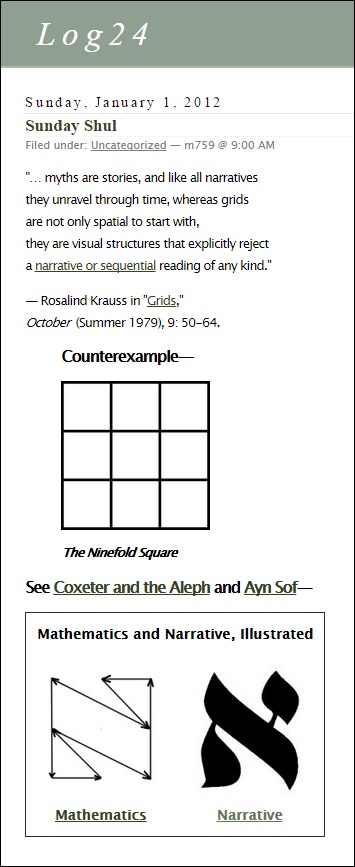
"Grids, You Say?" by Josefine Lyche, with
Lyche's quotation from Rosalind Krauss in October
(Vol. 9, Summer 1979) —
 |
See also last evening's Elevation of the Host, with Vampire Weekend.
"For every kind of vampire, there is a kind of cross." — Gravity's Rainbow
Sistine Chapel Smoke

Tromso Kunsthall Mirrors

Background for the smoke image:
A remark by Michelangelo in a 2007 post, High Concept.
Background for the mirrors image:
Note the publication date— Mar. 10, 2013.
Powered by WordPress




 .
.


 .
.