Friday, July 11, 2014
|

* Author of Jewel Box: Stories ( Erewhon Books, Oct. 24, 2023).
Friday, July 11, 2014
|
* Author of Jewel Box: Stories ( Erewhon Books, Oct. 24, 2023).

"Sharpie, we have condensed six dimensions into four,
then we either work by analogy into six, or we have to use math
that apparently nobody but Jake and my cousin Ed understands.
Unless you can think of some way to project six dimensions into three–
you seem to be smart at such projections."
I closed my eyes and thought hard. "Zebbie, I don't think it can be done.
Maybe Escher could have done it."


“… I realized that to me,
Gödel and Escher and Bach
were only shadows
cast in different directions by
some central solid essence.
I tried to reconstruct
the central object, and
came up with this book.”
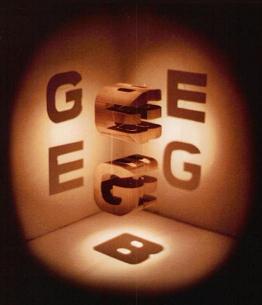
Related images —
Continued from April 18 .
"Working with words to create art
and working with your hands to create art
seem like two separate activities to me."
— Cover artist, The New Yorker , on April 17
See also Alphabet Blocks in this journal
as well as Escher's Verbum.
|
|


The above 1975 book by Robert Greer Cohn, Modes of Art, is
Volume I of a planned three-volume work.
The passage below is from a review of Cohn's Vol. II, Ways of Art —
|
Franklin, Ursula (1987) "Book Review: A Critical Work II. . . . . Those not familiar with the author's epistemology should begin with Appendix A of Ways of Art , a schematic demonstration of his tetrapolar-polypolar-dialectic, especially as it concerns the development of the French novel within the European tradition. But this dialectic, which has antecedents in Kierkegaard, Mallarme and Joyce, underlies all art, because: "this dimensional pulsation, or tetrapolar (and polypolar) higher vibrancy is, in short, the stuff of life: life is vibrant in this more complex way as well as in the more bipolar sense" (7). Cohn shows that "far out enough" the male or linear and the female or circular, the male vertical and the female horizontal dimensions "tend to merge as in relativity theory" (19). Ways of Art shows us the way through a historical becoming of art in its complex dialectic in which the metonymic (horizontal) axis constantly interrelates with the metaphoric (vertical). "Life is the mother, art the father" (vii); hence Cohn's quarrel with most contemporary Feminism, which is pronounced throughout the volume. Firmly grounded in its author's tetra-polypolar epistemology, this beautiful book becomes, however, at no point dryly abstract; it is the mature work of a true humanist who stands in clear and open opposition to the dehumanizing trend of "the quasi-scientific reductionism and abstract gimmickry of a great deal of current academic literary study, bellwethered by the structuralists, post-structuralists, and deconstructionists" (vi). Abundant footnotes constitute a substantial part of Ways of Art , on occasion developing insights almost into essays demonstrating crucial points along the general flow of the tradition from "Obscure Beginnings;' the opening chapter, to our "Contemporaries;' the last. Cohn reminds us that "In the Beginning was the Word;' for the Judaeo-Christian tradition at least, which his study fervently embraces; thus, for example, in Appendix 0 on "The Dance of the Sexes;' he censures "those who live by slogans, camps, and peer-opinion, the countless little bastard cults which characterize an era which has massively veered away from our free and beautiful Greco-Judaeo-Christian tradition" (332). Cohn traces man's way and that of his myths and rituals culminating in his art from that beginning along the lines of Freud, Neumann and Cassirer, and many others, always demonstrating the underlying polypolar dialectical rhythm. Thus in "From Barbarism to Young Culture;' we follow the Celts to Druidic ritual, Hebrew beginnings to the Psalms, Dionysian ritual to Greek tragedy, and thence to the beginnings of French dramatic literature originating in the Quem quaeritis sequence of the medieval Mass. Along the way arises artistic symbolism, for Cohn synonymous with "effective poetry;' to finally "ripen in France as never before" (99). Table I (134) graphs this development from the twelfth to the late nineteenth and early twentieth centuries. The author traces the rise of the artistic vocation from its antecedents in the double function of bard and priest, with the figure of Ronsard at the crossroads of that dying institution and the nascent concept of personal glory. "The Enlightenment Vocation" is exemplified in Montaigne, who humanizes the French cultural elite and points the way to French classicism and, farther down the road, after the moral collapse with the outgoing reign of Louis XIV, toward the Age of Reason. Clearly the most significant figure of the French Enlightenment for all of Western civilization is Rousseau, and Cohn beautifully shows us why this is so. Subsequently, "the nineteenth-century stage of the writer's journey will lead, starting from the crossroads of Rousseau, primarily in these two directions: the imperialistic and visionary prose of Balzac, the equally ambitious poetry of Mallarme", brothers under the skin" (199). And these two paths will then be reconciled in Proust's monumental A la recherche du temps perdu . . . . . |
WIkipedia on the URL suffix ".io" —
"In computer science, "IO" or "I/O" is commonly used
as an abbreviation for input/output, which makes the
.io domain desirable for services that want to be
associated with technology. .io domains are often used
for open source projects, application programming
interfaces ("APIs"), startup companies, browser games,
and other online services."
An association with the Bead Game from a post of April 7, 2018 —
|
Glasperlenspiel passage quoted here in Summa Mythologica —
“"I suddenly realized that in the language, or at any rate A less poetic meditation on the above 4x4x4 design cube —
"I saw that in the alternation between front and back, See also a related remark by Lévi-Strauss in 1955:
"…three different readings become possible: |
The recent use by a startup company of the URL "interality.io" suggests
a fourth reading for the 1955 list of Lévi-Strauss — in and out —
i.e., inner and outer group automorphisms — from a 2011 post
on the birthday of T. S. Eliot :
A transformation:

Click on the picture for details.

Friday, July 11, 2014Spiegel-Spiel des GeviertsFiled under: Uncategorized — m759 @ 12:00 PM See Cube Symbology.
|

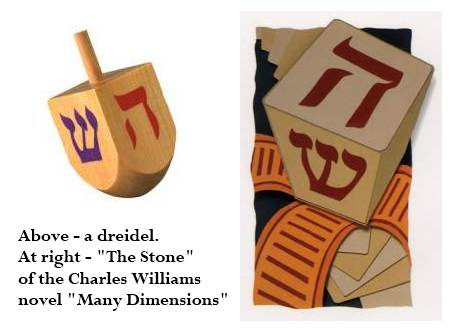
The misleading image at right above is from the cover of
an edition of Charles Williams's classic 1931 novel
Many Dimensions published in 1993 by Wm. B. Eerdmans.
Compare and constrast —
Cover of a book by Douglas Hofstadter


See as well an obituary for Mrs. Wertham from 1987.
Related art —
Friday, July 11, 2014
|
For further details, search the Web for "Wertham Professor" + Eck.

"… Lincoln Plaza Cinemas, the Juilliard String Quartet,
and the Strand Book Store remained oases
for cultural and intellectual stimulation."
— John S. Friedman in The Forward , Jan. 21, 2018
Read more:
https://forward.com/culture/392483/
how-fred-bass-dan-talbot-robert-mann
-shaped-new-york-culture/
From the Oasis in Steven Spielberg's "Ready Player One" (2018) —

I prefer, from a Log24 search for Flux Capacitor …

From "Raiders of the Lost Images" —
"The cube shape of the lost Mother Box,
also known as the Change Engine,
is shared by the Stone in a novel by
Charles Williams, Many Dimensions .
See the Solomon's Cube webpage."
For Tom Hanks and Dan Brown —
From "Raiders of the Lost Images" —
"The cube shape of the lost Mother Box,
also known as the Change Engine,
is shared by the Stone in a novel by
Charles Williams, Many Dimensions .
See the Solomon's Cube webpage."
See as well a Google search for flux philosophy —
https://www.google.com/search?q=flux+philosophy.
The FBI holding cube in "The Blacklist" —

" 'The Front' is not the whole story . . . ."
— Vincent Canby, New York Times film review, 1976,
as quoted in Wikipedia.
See also Solomon's Cube in this journal.

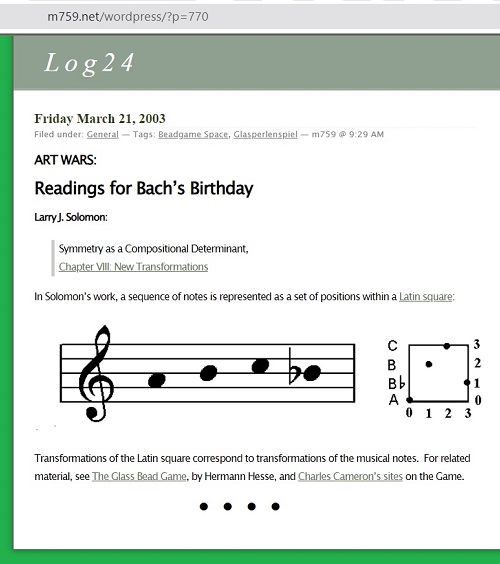
Some may view the above web page as illustrating the
Glasperlenspiel passage quoted here in Summa Mythologica —
“"I suddenly realized that in the language, or at any rate
in the spirit of the Glass Bead Game, everything actually
was all-meaningful, that every symbol and combination of
symbols led not hither and yon, not to single examples,
experiments, and proofs, but into the center, the mystery
and innermost heart of the world, into primal knowledge.
Every transition from major to minor in a sonata, every
transformation of a myth or a religious cult, every classical
or artistic formulation was, I realized in that flashing moment,
if seen with a truly meditative mind, nothing but a direct route
into the interior of the cosmic mystery, where in the alternation
between inhaling and exhaling, between heaven and earth,
between Yin and Yang, holiness is forever being created.”
A less poetic meditation on the above 4x4x4 design cube —
"I saw that in the alternation between front and back,
between top and bottom, between left and right,
symmetry is forever being created."
See also a related remark by Lévi-Strauss in 1955:
"…three different readings become possible:
left to right, top to bottom, front to back."
The above title was suggested by a film trailer quoted here Saturday —
" Jeremy Irons' dry Alfred Pennyworth:
'One misses the days when one's biggest concerns
were exploding wind-up penguins.' "
"Penguin Classics Deluxe Edition" describes, among other books,
an edition of the I Ching published on December 1, 2015.
Excerpt from this journal on that date —
|
Tuesday, December 1, 2015
Verhexung
|
Related material —


Remark on conceptual art quoted in the previous post —
"…he’s giving the concept but not the realization."
A concept — See a note from this date in 1983:
A realization —
Not the best possible realization, but enough for proof of concept .
Another view of the previous post's art space —
More generally, see Solomon's Cube in Log24.
See also a remark from Stack Exchange in yesterday's post Backstory,
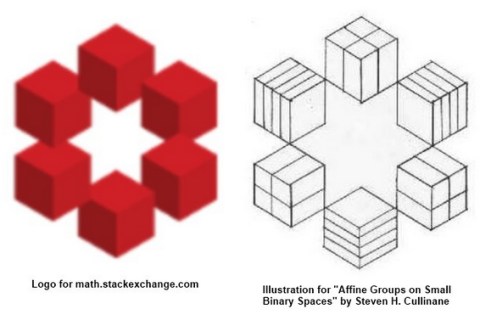
and the Stack Exchange math logo below, which recalls the above
cube arrangement from "Affine groups on small binary spaces" (1984).
"We tell ourselves stories in order to live." — Joan Didion
The New York Times Magazine online today —

"As a former believer and now a nonbeliever, Carrère,
seeking answers, sets out, in The Kingdom , to tell
the story of the storytellers. He is trying to understand
what it takes to be able to tell a story, any story.
And what he finds, once again, is that you have to find
your role in it."
— Wyatt Mason in The New York Times Magazine ,
online March 2, 2017
Like Tom Hanks?
Click image for related posts.
Transformations acting on Solomon's Cube
furnish a model of poetic order.
Some backstory for Hollywood —


See Hanks + Cube in this journal … For instance …
Friday, July 11, 2014
|
The Log24 version (Nov. 9, 2005, and later posts) —
|
VERBUM
|


See also related material in the previous post, Transformers.
Friday, July 11, 2014
|
From an earlier Log24 post —
Friday, July 11, 2014
|
From a post of the next day, July 12, 2014 —

"So there are several different genres and tones
jostling for prominence within Lexicon :
a conspiracy thriller, an almost abstract debate
about what language can do, and an ironic
questioning of some of the things it’s currently used for."
— Graham Sleight in The Washington Post
a year earlier, on July 15, 2013
For the Church of Synchronology, from Log24 on the next day —

From a post titled Circles on the date of Marc Simont's death —

See as well Verhexung in this journal.
The title is that of a large-scale British research project
in mathematics. On a more modest scale …
"Hanks + Cube" in this journal —

“The central poem is the poem of the whole,
The poem of the composition of the whole”
— Wallace Stevens, “A Primitive like an Orb”
The symmetries of the central four squares in any pattern
from the 4×4 version of the diamond theorem extend to
symmetries of the entire pattern. This is true also of the
central eight cubes in the 4×4×4 Solomon’s cube .

A note related to the diamond theorem and to the site
Finite Geometry of the Square and Cube —
The last link in the previous post leads to a post of last October whose
final link leads, in turn, to a 2009 post titled Summa Mythologica .
Some may view the above web page as illustrating the
Glasperlenspiel passage quoted here in Summa Mythologica —
“"I suddenly realized that in the language, or at any rate
in the spirit of the Glass Bead Game, everything actually
was all-meaningful, that every symbol and combination of
symbols led not hither and yon, not to single examples,
experiments, and proofs, but into the center, the mystery
and innermost heart of the world, into primal knowledge.
Every transition from major to minor in a sonata, every
transformation of a myth or a religious cult, every classical
or artistic formulation was, I realized in that flashing moment,
if seen with a truly meditative mind, nothing but a direct route
into the interior of the cosmic mystery, where in the alternation
between inhaling and exhaling, between heaven and earth,
between Yin and Yang, holiness is forever being created.”
A less poetic meditation on the above web page* —
"I saw that in the alternation between front and back,
between top and bottom, between left and right,
symmetry is forever being created."
Update of Sept. 5, 2016 — See also a related remark
by Lévi-Strauss in 1955: "…three different readings
become possible: left to right, top to bottom, front
to back."
* For the underlying mathematics, see a June 21, 1983, research note.
The reference in the previous post to the work of Guitart and
The Road to Universal Logic suggests a fiction involving
the symmetric generation of the simple group of order 168.
See The Diamond Archetype and a fictional account of the road to Hell …

The cover illustration below has been adapted to
replace the flames of PyrE with the eightfold cube.

For related symmetric generation of a much larger group, see Solomon’s Cube.
For Poetry Month
From the home page of Alexandre Borovik:
Book in progress: Shadows of the Truth
This book (to be published soon) can be viewed
as a sequel to Mathematics under the Microscope ,
but with focus shifted on mathematics as it was
experienced by children (well, by children who
became mathematicians). The cover is designed
by Edmund Harriss.

See also Harriss's weblog post of Dec. 27, 2008, on the death
of Harold Pinter: "The Search for the Truth Can Never Stop."
This suggests a review of my own post of Dec. 3, 2012,
"The Revisiting." A figure from that post:

Tom Hanks as Indiana Langdon in Raiders of the Lost Articulation :
An unarticulated (but colored) cube:
A 2x2x2 articulated cube:

A 4x4x4 articulated cube built from subcubes like
the one viewed by Tom Hanks above:


“For me it is a sign that we have fundamentally different
conceptions of the work of the intelligence services.”
— Germany’s Chancellor Angela Merkel in
theguardian.com, Saturday, 12 July 2014, 14.32 EDT
Another sort of service, thanks to Dan Brown and Tom Hanks:
Friday, July 11, 2014 |
A sequel to the 1974 film
Thunderbolt and Lightfoot :
Contingent and Fluky
Some variations on a thunderbolt theme:

These variations also exemplify the larger
Verbum theme:
A search today for Verbum in this journal yielded
a Georgetown University Chomskyite, Professor
David W. Lightfoot.
"Dr. Lightfoot writes mainly on syntactic theory,
language acquisition and historical change, which
he views as intimately related. He argues that
internal language change is contingent and fluky,
takes place in a sequence of bursts, and is best
viewed as the cumulative effect of changes in
individual grammars, where a grammar is a
'language organ' represented in a person's
mind/brain and embodying his/her language
faculty."
Some syntactic work by another contingent and fluky author
is related to the visual patterns illustrated above.
See Tecumseh Fitch in this journal.
For other material related to the large Verbum cube,
see posts for the 18th birthday of Harry Potter.
That birthday was also the upload date for the following:
See esp. the comments section.
“The About page contains detailed descriptions of the project….”
— The Illustris project on constructing a model of the universe
For the mathematics of a simpler traditional Chinese model
of everything, see
Definition: A diamond space — informal phrase denoting
a subspace of AG(6, 2), the six-dimensional affine space
over the two-element Galois field.
The reason for the name:

Click to enlarge.
The second Logos figure in the previous post
summarized affine group actions on partitions
that generate a group of about 1.3 trillion
permutations of a 4x4x4 cube (shown below)—
Click for further details.
(Mathematics and Narrative, continued)
Narrative—
The Ring and The Stone from yesterday’s post, and…
“In Medieval Jewish, Christian and Islamic legends,
the Seal of Solomon was a magical signet ring
said to have been possessed by King Solomon….”
— Wikipedia article, Seal of Solomon
Mathematics—

A fact related to the mathematical
“Solomon’s seal” described above by Bell:

The reference to Edge is as follows—
[3] Edge, W. L., Quadrics over GF(2) and
their relevance for the cubic surface group,
Canadian J. Maths. 11 (1959) ….
(This reference relates Hirschfeld’s remarks
quoted above to the 64-point affine space
illustrated below (via the associated
63-point projective space PG (5, 2)).

In "Contact," Dr. Arroway is shown the key to the Primer—
In this journal, fictional symbologist Robert Langdon is shown a cube—
"Confusion is nothing new." — Song lyric
…. and John Golding, an authority on Cubism who "courted abstraction"—

"Adam in Eden was the father of Descartes." — Wallace Stevens
Fictional symbologist Robert Langdon and a cube—
From a Log24 post, "Eightfold Cube Revisited,"
on the date of Golding's death—

A related quotation—
"… quaternions provide a useful paradigm
for studying the phenomenon of 'triality.'"
— David A. Richter's webpage Zometool Triality
See also quaternions in another Log24 post
from the date of Golding's death— Easter Act.
Gary Gutting, "Arguing About Language," in "The Stone,"
The New York Times philosophy column, yesterday—
There's a sense in which we speak language
and a sense in which, in Mallarmé's famous phrase,
“language itself speaks.”
Famous? A Google Book Search for
"language itself speaks" Mallarmé
yields 2 results, neither helpful.
But a Google Book Search for
"language itself speaks" Heidegger
yields "about 312 results."
A related search yields the following—
Paul Valéry, encountering Un Coup de Dés in Mallarmé’s worksheets in 1897, described the text as tracing the pattern of thought itself:
It seemed to me that I was looking at the form and pattern of a thought, placed for the first time in finite space. Here space itself truly spoke, dreamed, and gave birth to temporal forms….
… there in the same void with them, like some new form of matter arranged in systems or masses or trailing lines, coexisted the Word! (Leonardo 309*)
* The page number is apparently a reference to The Collected Works of Paul Valéry: Leonardo, Poe, Mallarmé , translated by Malcolm Cowley and James R. Lawler, Princeton University Press, 1972. (As a temporal form, "309" might be interpreted as a reference to 3/09, March 9, the date of a webpage on the Void.)
For example—
Background:
Deconstructing Alice
and Symbology.
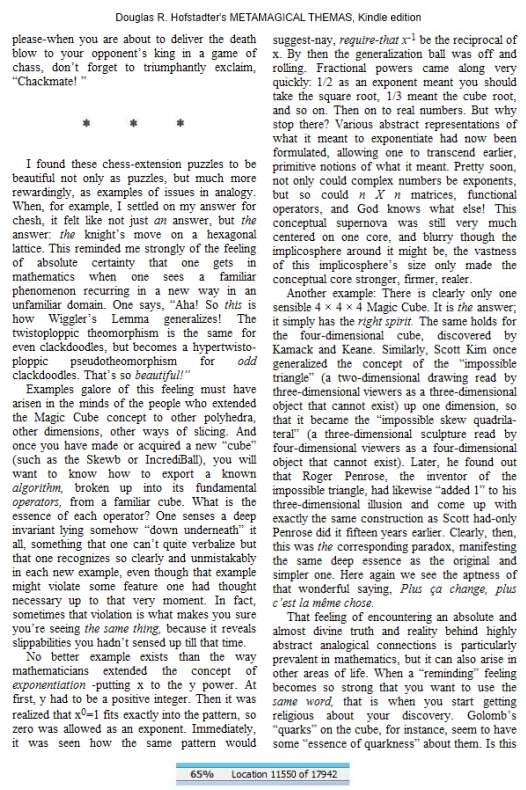
“Examples galore of this feeling must have arisen in the minds of the people who extended the Magic Cube concept to other polyhedra, other dimensions, other ways of slicing. And once you have made or acquired a new ‘cube’… you will want to know how to export a known algorithm , broken up into its fundamental operators , from a familiar cube. What is the essence of each operator? One senses a deep invariant lying somehow ‘down underneath’ it all, something that one can’t quite verbalize but that one recognizes so clearly and unmistakably in each new example, even though that example might violate some feature one had thought necessary up to that very moment. In fact, sometimes that violation is what makes you sure you’re seeing the same thing , because it reveals slippabilities you hadn’t sensed up till that time….
… example: There is clearly only one sensible 4 × 4 × 4 Magic Cube. It is the answer; it simply has the right spirit .”
— Douglas R. Hofstadter, 1985, Metamagical Themas: Questing for the Essence of Mind and Pattern (Kindle edition, locations 11557-11572)
See also Many Dimensions in this journal and Solomon’s Cube.
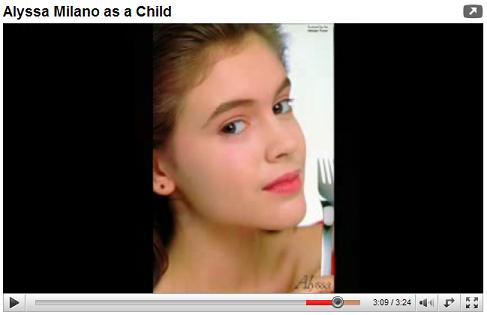
For Alyssa Milano —

(Click here for cheesy Neil Diamond background music.)
For some related philosophical remarks, see Deconstructing Alice
and the new Pythagorean thriller The Thousand.
David Levine's portrait of Arthur Koestler (see Dec. 30, 2009) —


See also this morning's post as well as
Monday's post quoting George David Birkhoff —
"If I were a Leibnizian mystic… I would say that…
God thinks multi-dimensionally — that is,
uses multi-dimensional symbols beyond our grasp."
(Continued from April 23, 2009, and February 13, 2010.)
Paul Valéry as quoted in yesterday’s post:
“The S[elf] is invariant, origin, locus or field, it’s a functional property of consciousness” (Cahiers, 15:170 [2: 315])
The geometric example discussed here yesterday as a Self symbol may seem too small to be really impressive. Here is a larger example from the Chinese, rather than European, tradition. It may be regarded as a way of representing the Galois field GF(64). (“Field” is a rather ambiguous term; here it does not, of course, mean what it did in the Valéry quotation.)
From Geometry of the I Ching—

The above 64 hexagrams may also be regarded as
the finite affine space AG(6,2)— a larger version
of the finite affine space AG(4,2) in yesterday’s post.
That smaller space has a group of 322,560 symmetries.
The larger hexagram space has a group of
1,290,157,424,640 affine symmetries.
From a paper on GL(6,2), the symmetry group
of the corresponding projective space PG(5,2),*
which has 1/64 as many symmetries—

For some narrative in the European tradition
related to this geometry, see Solomon’s Cube.
* Update of July 29, 2011: The “PG(5,2)” above is a correction from an earlier error.
Romancing the
Non-Euclidean Hyperspace
Backstory —
Mere Geometry, Types of Ambiguity,
Dream Time, and Diamond Theory, 1937

For the 1937 grid, see Diamond Theory, 1937.
The grid is, as Mere Geometry points out, a non-Euclidean hyperspace.
For the diamonds of 2010, see Galois Geometry and Solomon’s Cube.
Alyssa is Wonderland
Manohla Dargis in The New York Times yesterday—
“Of course the character of Carroll’s original Alice is evident in each outrageous creation she dreams up in ‘Wonderland’ and in the sequel, ‘Through the Looking-Glass,’ which means that she’s a straight man to her own imagination. (She is Wonderland.)”
From Inside the White Cube—
“The sacramental nature of the space becomes clear, and so does one of the great projective laws of modernism: as modernism gets older, context becomes content. In a peculiar reversal, the object introduced into the gallery ‘frames’ the gallery and its laws.”
From Yogi Berra–
“When you come to a fork in the road, take it.”
Related material: For Baron Samedi and…
Truth, Geometry, Algebra
The following notes are related to A Simple Reflection Group of Order 168.
1. According to H.S.M. Coxeter and Richard J. Trudeau
“There is a pleasantly discursive treatment of Pontius Pilate’s unanswered question ‘What is truth?’.”
— Coxeter, 1987, introduction to Trudeau’s The Non-Euclidean Revolution
1.1 Trudeau’s Diamond Theory of Truth
1.2 Trudeau’s Story Theory of Truth
2. According to Alexandre Borovik and Steven H. Cullinane
2.1 Coxeter Theory according to Borovik
2.1.1 The Geometry–
Mirror Systems in Coxeter Theory
2.1.2 The Algebra–
Coxeter Languages in Coxeter Theory
2.2 Diamond Theory according to Cullinane
2.2.1 The Geometry–
Examples: Eightfold Cube and Solomon’s Cube
2.2.2 The Algebra–
Examples: Cullinane and (rather indirectly related) Gerhard Grams
Summary of the story thus far:
Diamond theory and Coxeter theory are to some extent analogous– both deal with reflection groups and both have a visual (i.e., geometric) side and a verbal (i.e., algebraic) side. Coxeter theory is of course highly developed on both sides. Diamond theory is, on the geometric side, currently restricted to examples in at most three Euclidean (and six binary) dimensions. On the algebraic side, it is woefully underdeveloped. For material related to the algebraic side, search the Web for generators+relations+”characteristic two” (or “2“) and for generators+relations+”GF(2)”. (This last search is the source of the Grams reference in 2.2.2 above.)
From this journal:
Friday December 5, 2008Mirror-Play of
the Fourfold For an excellent commentary View selected pages Play and the Aesthetic Dimension (Mihai I. Spariosu, Related material: – and Theme and Variations. |
Transition to the
Garden of Forking Paths–
(See For Baron Samedi)–
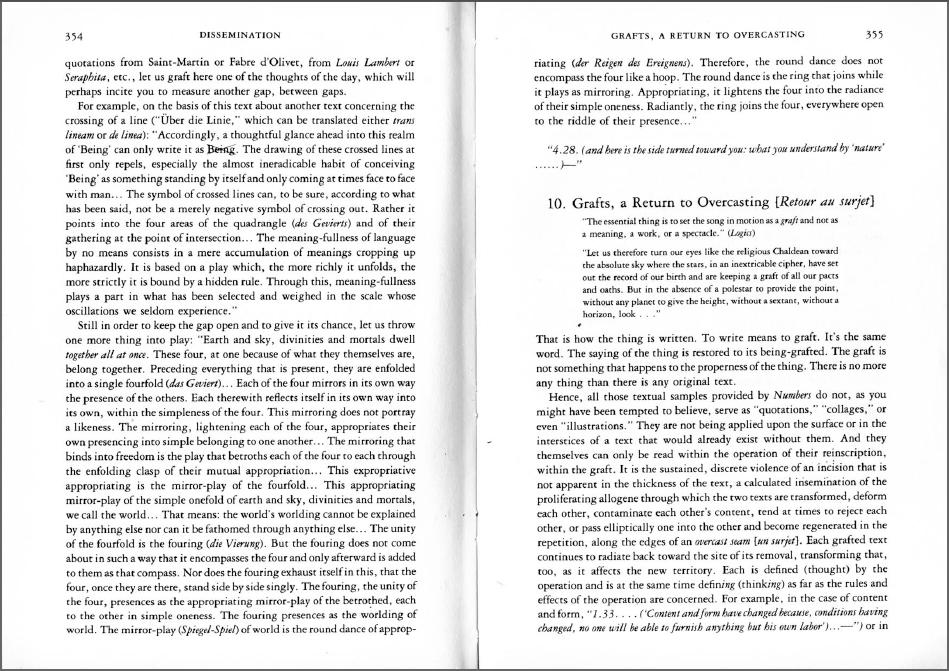
The Found Symbol
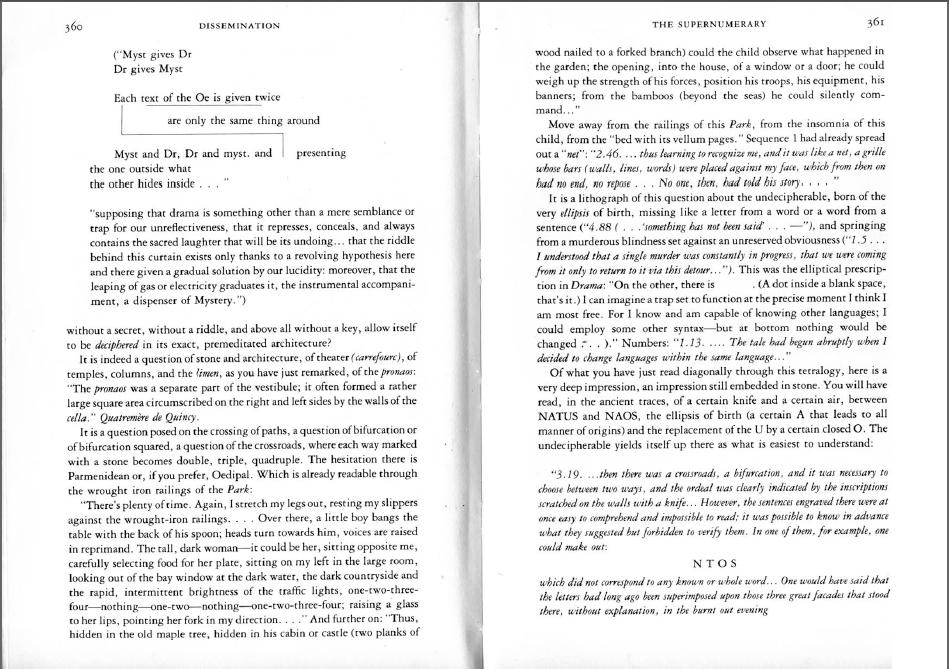
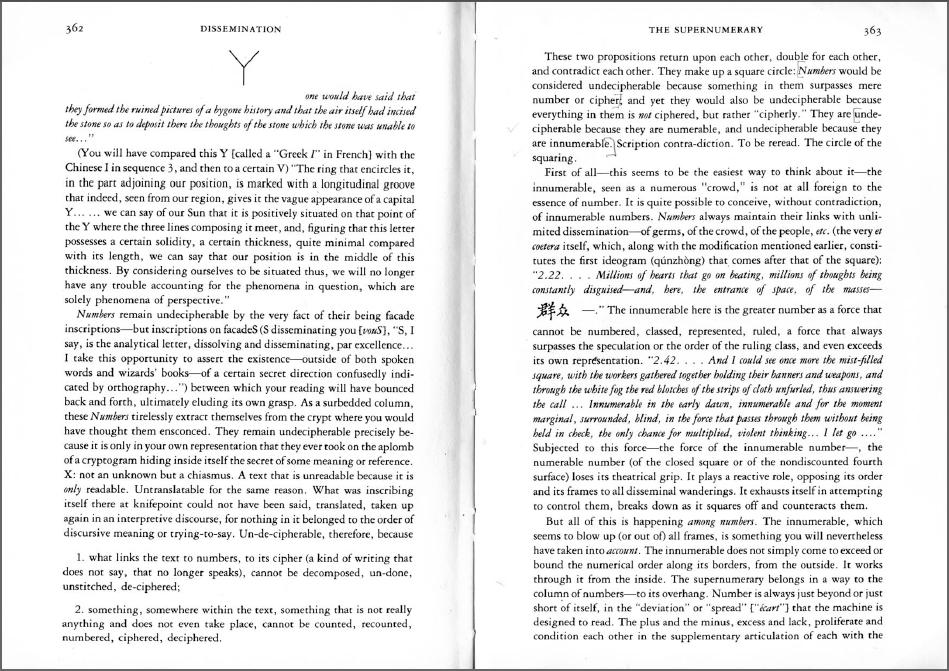
and Dissemination, by Jacques Derrida,
translated by Barbara Johnson,
London, Athlone Press, 1981–
Pages 354-355
On the mirror-play of the fourfold
Pages 356-357
Shaking up a whole culture
Pages 358-359
Cornerstone and crossroads
Pages 360-361
A deep impression embedded in stone
Pages 362-363
A certain Y, a certain V
Pages 364-365
The world is Zeus's play
Page 366
It was necessary to begin again


Annals of Deconstruction —
Click on image for background.

Related material
for Baron Samedi —
The Found Symbol

A graphic novel reviewed in the current Washington Post features Alfred North Whitehead and Bertrand Russell–

Related material:
Whitehead on Fano’s finite projective three-space:
“This is proved by the consideration of a three dimensional geometry in which there are only fifteen points.”
—The Axioms of Projective Geometry , Cambridge University Press, 1906

Further reading:
See Solomon’s Cube and the link at the end of today’s previous entry, then compare and contrast the above portraits of Whitehead and Russell with Charles Williams’s portraits of Sir Giles Tumulty and Lord Arglay in the novel Many Dimensions .

(Cover slightly changed.)
Background —
SAT
Part I:
Part II:
|
|
Part III:
From August 25th —

"Boo, boo, boo,
square root of two."
"… the startling thesis of Mr. Brosterman's new book, 'Inventing Kindergarten' (Harry N. Abrams, $39.95): that everything the giants of modern art and architecture knew about abstraction they learned in kindergarten, thanks to building blocks and other educational toys designed by Friedrich Froebel, a German educator, who coined the term 'kindergarten' in the 1830's."
— "Was Modernism Born
in Toddler Toolboxes?"
by Trip Gabriel, New York Times,
April 10, 1997
Figure 1 —
Concept from 1819:

(Footnotes 1 and 2)
Figure 2 —
The Third Gift, 1837:

Froebel, the inventor of
kindergarten, worked as
an assistant to the
crystallographer Weiss
mentioned in Fig. 1.
(Footnote 3)
Figure 3 —
The Third Gift, 1906:

Figure 4 —
Solomon's Cube,
1981 and 1983:
Figure 5 —
Design Cube, 2006:
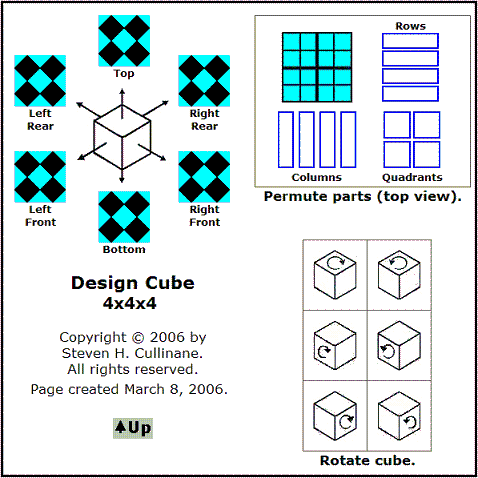
The above screenshot shows a
moveable JavaScript display
of a space of six dimensions
(over the two-element field).
(To see how the display works,
try the Kaleidoscope Puzzle first.)

Greetings.
“The greatest sorcerer (writes Novalis memorably)
would be the one who bewitched himself to the point of
taking his own phantasmagorias for autonomous apparitions.
Would not this be true of us?”
–Jorge Luis Borges, “Avatars of the Tortoise”
“El mayor hechicero (escribe memorablemente Novalis)
sería el que se hechizara hasta el punto de
tomar sus propias fantasmagorías por apariciones autónomas.
¿No sería este nuestro caso?”
–Jorge Luis Borges, “Los Avatares de la Tortuga“
At Midsummer Noon:“In Many Dimensions (1931)
Williams sets before his reader the
mysterious Stone of King Solomon,
an image he probably drew from
a brief description in Waite’s
The Holy Kabbalah (1929) of
a supernatural cubic stone
on which was inscribed
‘the Divine Name.’”
 Related material:
|
| It is not enough to cover the rock with leaves. We must be cured of it by a cure of the ground Or a cure of ourselves, that is equal to a cure Of the ground, a cure beyond forgetfulness. And if we ate the incipient colorings – Wallace Stevens, “The Rock” |
Hofstadter’s cover.
Click on image for details.
Our Judeo-Christian
Heritage –
Lottery
Hermeneutics
Part I: Judeo
| The Lottery 12/9/06 | Mid-day | Evening |
| New York | 036
See |
331
See 3/31— “square crystal” and “the symbolism could not have been more perfect.” |
| Pennsylvania | 602
See 6/02— Walter Benjamin |
111
See 1/11— “Related material:
|
Part II: Christian
| The Lottery 4/3/07 | Mid-day | Evening |
| New York | 115
See 1/15— |
017
See
|
| Pennsylvania | 604
See |
714
See |
Related material:
It is perhaps relevant to
this Holy Week that the
date 6/04 (2006) above
refers to both the Christian
holy day of Pentecost and
to the day of the
facetious baccalaureate
of the Class of 2006 in
the University Chapel
at Princeton.
For further context for the
Log24 remarks of that same
date, see June 1-15, 2006.
Time and Chance
on the 90th Birthday
of Kirk Douglas,
star of
“The Garden of Allah“
| The Lottery 12/9/06 | Mid-day | Evening |
| New York | 036
See |
331
See 3/31— “square crystal” and “the symbolism could not have been more perfect.” |
| Pennsylvania | 602
See 6/02— Walter Benjamin |
111
See 1/11— “Related material: |

(Title of an interview with
the late Paul Halmos, mathematician)
From a 1990 interview:
“What’s the best part of being a mathematician? I’m not a religious man, but it’s almost like being in touch with God when you’re thinking about mathematics. God is keeping secrets from us, and it’s fun to try to learn some of the secrets.”
I personally prefer Annie Dillard on God:
“… if Holy the Firm is matter at its dullest, Aristotle’s materia prima, absolute zero, and since Holy the Firm is in touch with the Absolute at base, then the circle is unbroken. And it is…. Holy the Firm is in short the philosopher’s stone.”
Some other versions of
the philosopher’s stone:


This last has the virtue of
being connected with Halmos
via his remarks during the
“In Touch with God” interview:
See also the remark of Halmos that serves as an epigraph to Theme and Variations.

has also served
at least one interpreter
as a philosopher’s stone,
and is also the original
“Halmos tombstone.”
And now, from
the author of Sphere…
He beomes aware of something else… some other presence.
“Anybody here?” he says.
I am here.
He almost jumps, it is so loud. Or it seems loud. Then he wonders if he has heard anything at all.
“Did you speak?”
No.
How are we communicating? he wonders.
The way everything communicates with everything else.
Which way is that?
Why do you ask if you already know the answer?
— Sphere, by Michael Crichton, Harvard ’64
“… when I went to Princeton things were completely different. This chapel, for instance– I remember when it was just a clearing, cordoned off with sharp sticks. Prayer was compulsory back then, and you couldn’t just fake it by moving your lips; you had to know the words, and really mean them. I’m dating myself, but this was before Jesus Christ.”
— Baccalaureate address at Princeton, Pentecost 2006, reprinted in The New Yorker, edited by David Remnick, Princeton ’81
Related figures:

For further details,
see Solomon’s Cube
and myspace.com/affine.

For further details,
see Jews on Buddhism
and
Adventures in Group Theory.
“In this way we are offered
a formidable lesson
for every Christian community.”
Pope Benedict XVI
on Pentecost,
June 4, 2006,
St. Peter’s Square.
Part I:
The Game
Part II:
Many People
For further details,
see Solomon’s Cube
and myspace.com/affine.
“The rock cannot be broken.
It is the truth.”
— Wallace Stevens
“… we have condensed six dimensions into four, then we either work by analogy into six, or we have to use math that apparently nobody but Jake and my cousin Ed understands. Unless you can think of some way to project six dimensions into three– you seem to be smart at such projections.”
I closed my eyes and thought hard. “Zebbie, I don’t think it can be done. Maybe Escher could have done it.”
The above screenshot shows a
moveable JavaScript display
of a space of six dimensions
(over the 2-element field).
(To see how the display works,
try the Kaleidoscope Puzzle first.)
Compare and contrast:
Solomon’s Cube, the five
Log24 entries ending on 3/14,
and the
American Mathematical Society
on Mathematical Imagery.
Related material:
A more extensive excerpt from
The Number of the Beast, and
Finitegeometry.org Update
(Revised May 21, 2006)
Finitegeometry.org now has permutable JavaScript views of the 2x2x2 and 4x4x4 design cubes. Solomon’s Cube presented a claim that the 4x4x4 design cube retains symmetry under a group of about 1.3 trillion transformations. The JavaScript version at finitegeometry.org/sc/64/view/ lets the reader visually verify this claim. The reader should first try the Diamond 16 Puzzle. The simpler 2x2x2 design cube, with its 1,344 transformations, was described in Diamonds and Whirls; the permutable JavaScript version is at finitegeometry.org/sc/8/view/.
Powered by WordPress