Sunday, March 3, 2024
“You Say Aeon, I Say Aion…”
Saturday, February 1, 2020
Varda at the Brattle, or “Aion: The Prize”

Today's Brattle Theatre films celebrate the work of Agnès Varda.
A search for Varda in this journal in turn suggests a search for
Aion-related posts.
Within that search, the post "Icons" (Sept. 16, 2011) is not unrelated
to yesterday's post "Notes for a Blue Guitar."
All this is, of course, mere dreamlogic .
Monday, January 29, 2024
Self as Imago Dei: Hofstadter vs. Valéry
|
Google search result: Saint Anselm College https://www.anselm.edu › Documents › Brown by M Brown · 2014 · Cited by 14 — Thomas insists that the image of God exists most perfectly in the acts of the soul, for the soul is that which is most perfect in us and so best images God, and … 11 pages |
For a Douglas Hofstadter version of the Imago Dei , see the
"Gödel, Escher, Bach" illustration in the Jan. 15 screenshot below —

Tuesday, June 15, 2010
|
Friday, September 23, 2022
Raiders of the Lost Archive … The Jung Genizah

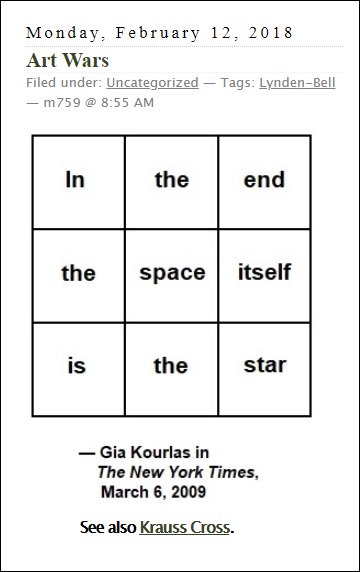
Jung’s four-diamond figure from
Aion — a symbol of the self –

For those who prefer the Ed Wood approach —
Wednesday, April 1, 2020
Books at Perlego


” How small is the evil that may be safely ignored…? “
— “QBass” at Wikipedia, April 1, 2020
Good question.
Monday, February 17, 2020
Universal Beauty
Remarks by Rosalind Krauss in the previous post suggest a look at …

Then there is the universal beauty of oneself :
Jung's Four-Diamond Figure from Aion—

This figure was devised by Jung
to represent the Self.
Monday, July 1, 2019
Inside the Exploded Cube
Metaphysical conceit | literature | Britannica.com
|
This post's title refers to a metaphysical conceit
in the previous post, Desperately Seeking Clarity.
Related material —


The source of the above mystical octahedron —

See also Jung's Imago Dei in this journal.
Sunday, March 31, 2019
Self and Illusion


Thursday, June 23, 2016
Raiders of the Lost Code
From a web page —
Breaking the Code of the Archetypal Self:
An Introductory Overview of the Research Discoveries
Leading to Neo-Jungian Structural Psychoanalysis
Dr. Moore will introduce his research and discoveries
with regard to the deep structures of the Self.
Tracing the foundations in the tradition of Jung’s
affirmation of the collective unconscious, Moore
will present his “decoding of the Diamond Body,”
a mapping of the deep structures of the Great Code
of the psyche. . . .
From the same web site —

Googling "Jung" + "Diamond Body" shows that
Moore's terminology differs from Jung's.
The octahedron that Moore apparently associates
with his "diamond body" was discussed by Jung
in a different context. See selections from Ch. 14
of Jung's Aion : "The Structure and Dynamics of the Self."
Dr. Moore appears as well in the murder-suicide story
of last night's 11:18 PM ET post.
For the relevance of Aion to "deep structures,"
see Jung + Diamond + Structure in this journal
and, more specifically, "Deep Structure."
Thursday, April 21, 2016
The Alchemist’s Chessboard
Material related to the previous post and to Alfred Bester's
1981 followup to The Stars My Destination titled The Deceivers —
|
The Lapis Philosophorum :
"The lapis was thought of as a unity and therefore often stands for the prima materia in general."
"Its discoverer was of the opinion that he had produced the equivalent of the primordial protomatter which exploded into the Universe." And from Bester's The Deceivers : Meta Physics "'… Think of a match. You've got a chemical head of potash, antimony, and stuff, full of energy waiting to be released. Friction does it. But when Meta excites and releases energy, it's like a stick of dynamite compared to a match. It's the chess legend for real.' 'I don't know it.' 'Oh, the story goes that a philosopher invented chess for the amusement of an Indian rajah. The king was so delighted that he told the inventor to name his reward and he'd get it, no matter what. The philosopher asked that one grain of rice be placed on the first square of the chessboard, two on the second, four on the third, and so on to the sixty-fourth.' 'That doesn't sound like much.'" Related material : |
Saturday, May 19, 2012
But Seriously…
Here is a link to a copy of the home page of a Turkish
author quoted here on May 4, 2012… in honor of
archaeologist Crawford Greenewalt Jr., who reportedly
died on that date. Greenewalt was an expert on the
ancient city of Sardis, in what is now western Turkey.
The May 4 quote was about
"Heraclitus’s Aion and His Transformations."
Friday, May 4, 2012
That Krell Lab (continued)
“… Which makes it a gilt-edged priority that one of us
gets into that Krell lab and takes that brain boost.”
— American adaptation of Shakespeare's Tempest , 1956
From "The Onto-theological Origin of Play:
Heraclitus and Plato," by Yücel Dursun, in
Lingua ac Communitas Vol 17 (October 2007)—
"Heraclitus’s Aion and His Transformations
The saying is as follows:
αἰὼν παῖς ἐστι παίζων, πεττεύων·
παιδὸς ἡ βασιληίη
(Aion is a child playing draughts;
the kingship is the child’s)
(Krell 1972: 64).*
* KRELL, David Farrell.
“Towards an Ontology of Play:
Eugen Fink’s Notion of Spiel,”
Research in Phenomemology ,
2, 1972: 63-93.
This is the translation of the fragment in Greek by Krell.
There are many versions of the translation of the fragment….."
See also Child's Play and Froebel's Magic Box.
Update of May 5— For some background
from the date May 4 seven years ago, see
The Fano Plane Revisualized.
For some background on the word "aion,"
see that word in this journal.
Friday, September 16, 2011
Icons
Background: Jung's Aion in this journal discusses this
figure from finite geometry's diamond theorem—

Fig. A
This resembles a figure that served Jung
as a schema of the Self—
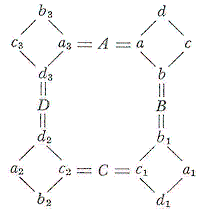
Fig. B
Fig. A, with color variations, serves as the core
of many automatically generated Identicons —
a different sort of self-symbol.
Examples from Sept. 6 at MathOverflow—


A user wanting to custom-tailor his self-symbol should consider
the following from the identicon service Gravatar—
1. User Submissions. "… you hereby do and shall grant to Automattic a worldwide, perpetual, irrevocable, royalty-free and fully-paid, transferable (including rights to sublicense) right to perform the Services (e.g., to use, modify, reproduce, distribute, prepare derivative works of, display, perform, and otherwise fully exercise and exploit all intellectual property, publicity, and moral rights with respect to any User Submissions, and to allow others to do so)."
Sounds rather Faustian.
Saturday, July 10, 2010
Child’s Play

… twó flocks, twó folds—black, white; ' right, wrong; reckon but, reck but, mind
But thése two; wáre of a wórld where bút these ' twó tell, each off the óther….
— "Spelt from Sibyl's Leaves," by Gerard Manley Hopkins

Related material:
Max Black — "Beginners are taught that a set having three members is a single thing, wholly constituted by its members but distinct from them. After this, the theological doctrine of the Trinity as 'three in one' should be child's play." ("The Elusiveness of Sets," Review of Metaphysics, June 1971, p. 615– as quoted by Bill Vallicella)
Edward Gibbon, Decline and Fall of the Roman Empire, Chapter XXI —
Gibbon, discussing the theology of the Trinity, defines perichoresis as
“… the internal connection and spiritual penetration which indissolubly unites the divine persons59 ….
59 … The
or ‘circumincessio,’ is perhaps the deepest and darkest corner of the whole theological abyss.”
”Whoever fights monsters should see to it that in the process he does not become a monster. And when you look long into an abyss, the abyss also looks into you.”
– Friedrich Nietzsche, Beyond Good and Evil, section 146, translated by Walter Kaufmann
Saturday, June 19, 2010
Imago Creationis

In the above view, four of the tesseract's 16
vertices are overlaid by other vertices.
For views that are more complete and
moveable, see Smith's tesseract page.
Four-Part Tesseract Divisions—

The above figure shows how four-part partitions
of the 16 vertices of a tesseract in an infinite
Euclidean space are related to four-part partitions
of the 16 points in a finite Galois space
|
Euclidean spaces versus Galois spaces in a larger context—
Infinite versus Finite The central aim of Western religion —
"Each of us has something to offer the Creator...
the bridging of
                 masculine and feminine,
                      life and death.
It's redemption.... nothing else matters."
-- Martha Cooley in The Archivist  (1998)
The central aim of Western philosophy —
              Dualities of Pythagoras
              as reconstructed by Aristotle:
                 Limited     Unlimited
                     Odd     Even
                    Male     Female
                   Light      Dark
                Straight    Curved
                  ... and so on ....
"Of these dualities, the first is the most important; all the others may be seen as different aspects of this fundamental dichotomy. To establish a rational and consistent relationship between the limited [man, etc.] and the unlimited [the cosmos, etc.] is… the central aim of all Western philosophy." |
Another picture related to philosophy and religion—
Jung's Four-Diamond Figure from Aion—
This figure was devised by Jung
to represent the Self. Compare the
remarks of Paul Valéry on the Self—
|
Flight from Eden: The Origins of Modern Literary Criticism and Theory, by Steven Cassedy, U. of California Press, 1990, pages 156-157—
Valéry saw the mind as essentially a relational system whose operation he attempted to describe in the language of group mathematics. "Every act of understanding is based on a group," he says (C, 1:331). "My specialty— reducing everything to the study of a system closed on itself and finite" (C, 19: 645). The transformation model came into play, too. At each moment of mental life the mind is like a group, or relational system, but since mental life is continuous over time, one "group" undergoes a "transformation" and becomes a different group in the next moment. If the mind is constantly being transformed, how do we account for the continuity of the self? Simple; by invoking the notion of the invariant. And so we find passages like this one: "The S[elf] is invariant, origin, locus or field, it's a functional property of consciousness" (C, 15:170 [2:315]). Just as in transformational geometry, something remains fixed in all the projective transformations of the mind's momentary systems, and that something is the Self (le Moi, or just M, as Valéry notates it so that it will look like an algebraic variable). Transformation theory is all over the place. "Mathematical science… reduced to algebra, that is, to the analysis of the transformations of a purely differential being made up of homogeneous elements, is the most faithful document of the properties of grouping, disjunction, and variation in the mind" (O, 1:36). "Psychology is a theory of transformations, we just need to isolate the invariants and the groups" (C, 1:915). "Man is a system that transforms itself" (C, 2:896). O Paul Valéry, Oeuvres (Paris: Pléiade, 1957-60) C Valéry, Cahiers, 29 vols. (Paris: Centre National de le Recherche Scientifique, 1957-61) |
Note also the remarks of George David Birkhoff at Rice University
in 1940 (pdf) on Galois's theory of groups and the related
"theory of ambiguity" in Galois's testamentary letter—
|
… metaphysical reasoning always relies on the Principle of Sufficient Reason, and… the true meaning of this Principle is to be found in the “Theory of Ambiguity” and in the associated mathematical “Theory of Groups.” If I were a Leibnizian mystic, believing in his “preestablished harmony,” and the “best possible world” so satirized by Voltaire in “Candide,” I would say that the metaphysical importance of the Principle of Sufficient Reason and the cognate Theory of Groups arises from the fact that God thinks multi-dimensionally* whereas men can only think in linear syllogistic series, and the Theory of Groups is the appropriate instrument of thought to remedy our deficiency in this respect. * That is, uses multi-dimensional symbols beyond our grasp. |
Related material:
A medal designed by Leibniz to show how
binary arithmetic mirrors the creation by God
of something (1) from nothing (0).

Another array of 16 strings of 0's and 1's, this time
regarded as coordinates rather than binary numbers—


Some context by a British mathematician —

|
Imago by Wallace Stevens Who can pick up the weight of Britain, Who can move the German load Or say to the French here is France again? Imago. Imago. Imago. It is nothing, no great thing, nor man Of ten brilliancies of battered gold And fortunate stone. It moves its parade Of motions in the mind and heart, A gorgeous fortitude. Medium man In February hears the imagination's hymns And sees its images, its motions And multitudes of motions And feels the imagination's mercies, In a season more than sun and south wind, Something returning from a deeper quarter, A glacier running through delirium, Making this heavy rock a place, Which is not of our lives composed . . . Lightly and lightly, O my land, Move lightly through the air again. |
Tuesday, June 15, 2010
Imago, Imago, Imago
Recommended— an online book—
Flight from Eden: The Origins of Modern Literary Criticism and Theory,
by Steven Cassedy, U. of California Press, 1990.
See in particular
Valéry and the Discourse On His Method.
Pages 156-157—
Valéry saw the mind as essentially a relational system whose operation he attempted to describe in the language of group mathematics. “Every act of understanding is based on a group,” he says (C, 1:331). “My specialty—reducing everything to the study of a system closed on itself and finite” (C, 19: 645). The transformation model came into play, too. At each moment of mental life the mind is like a group, or relational system, but since mental life is continuous over time, one “group” undergoes a “transformation” and becomes a different group in the next moment. If the mind is constantly being transformed, how do we account for the continuity of the self? Simple; by invoking the notion of the invariant. And so we find passages like this one: “The S[elf] is invariant, origin, locus or field, it’s a functional property of consciousness” (C, 15:170 [2: 315]). Just as in transformational geometry, something remains fixed in all the projective transformations of the mind’s momentary systems, and that something is the Self (le Moi, or just M, as Valéry notates it so that it will look like an algebraic variable). Transformation theory is all over the place. “Mathematical science . . . reduced to algebra, that is, to the analysis of the transformations of a purely differential being made up of homogeneous elements, is the most faithful document of the properties of grouping, disjunction, and variation in the mind” (O, 1:36). “Psychology is a theory of transformations, we just need to isolate the invariants and the groups” (C, 1:915). “Man is a system that transforms itself” (C, 2:896).
O Paul Valéry, Oeuvres (Paris: Pléiade, 1957-60)
C Valéry, Cahiers, 29 vols. (Paris: Centre National de le Recherche Scientifique, 1957-61)
Compare Jung’s image in Aion of the Self as a four-diamond figure:
and Cullinane’s purely geometric four-diamond figure:

For a natural group of 322,560 transformations acting on the latter figure, see the diamond theorem.
What remains fixed (globally, not pointwise) under these transformations is the system of points and hyperplanes from the diamond theorem. This system was depicted by artist Josefine Lyche in her installation “Theme and Variations” in Oslo in 2009. Lyche titled this part of her installation “The Smallest Perfect Universe,” a phrase used earlier by Burkard Polster to describe the projective 3-space PG(3,2) that contains these points (at right below) and hyperplanes (at left below).

Although the system of points (at right above) and hyperplanes (at left above) exemplifies Valéry’s notion of invariant, it seems unlikely to be the sort of thing he had in mind as an image of the Self.
Saturday, December 5, 2009
Holiday Book
Time and Chance, continued…
NY Lottery numbers today–
Midday 401, Evening 717
_________________________________________________
From this journal on 4/01, 2009:
The Cruelest Month

"Langdon sensed she was
toying with him…."
___________________________________________
From this journal on 7/17, 2008:
Jung’s four-diamond figure from
Aion — a symbol of the self –
Jung’s Map of the Soul,
by Murray Stein:
“… Jung thinks of the self as undergoing continual transformation during the course of a lifetime…. At the end of his late work Aion, Jung presents a diagram to illustrate the dynamic movements of the self….”
For related dynamic movements,
see the Diamond 16 Puzzle
and the diamond theorem.
Thursday, June 25, 2009
Thursday June 25, 2009
in Four Quartets, the fragments
he had grieved over
in The Waste Land.”
— “Beauty and Desecration,”
Roger Scruton
(link at aldaily.com today)
| “The formula reproduces exactly the essential features of the symbolic process of transformation. It shows the rotation of the mandala, the antithetical play of complementary (or compensatory) processes, then the apocatastasis, i.e., the restoration of an original state of wholeness….”
— Carl G. Jung in Aion
|
one year ago today.
Saturday, March 28, 2009
Saturday March 28, 2009
The Rest
of the Story
Today's previous entry discussed the hermeneutics of the midday NY and PA lottery numbers.
| Lotteries on Reba's birthday, 2009 |
Pennsylvania (No revelation) |
New York (Revelation) |
| Mid-day (No belief) |
No belief, no revelation 726 |
Revelation without belief 378 |
| Evening (Belief) |
Belief without revelation 006 |
Belief and revelation 091 |
Interpretations of the evening numbers–
The PA evening number, 006, may be viewed as a followup to the PA midday 726 (or 7/26, the birthday of Kate Beckinsale and Carl Jung). Here 006 is the prestigious "00" number assigned to Beckinsale.
Clark: Yeah.
Will: Well, I got her number.
How do you like them apples?

The NY evening number, 091, may be viewed as a followup to the NY midday 378 (the number of pages in The Innermost Kernel by Suzanne Gieser, published by Springer, 2005)–
Page 91: The entire page is devoted to the title of the book's Part 3– "The Copenhagen School and Psychology"–

The next page begins: "With the crisis of physics, interest in epistemological and psychological questions grew among many theoretical physicists. This interest was particularly marked in the circle around Niels Bohr."
marked circle
from March 15:
The circle above is
marked with a version of
the classic Chinese symbol
adopted as a personal emblem
by Danish physicist Niels Bohr,
leader of the Copenhagen School.

"Two things of opposite natures seem to depend
On one another, as a man depends
On a woman, day on night, the imagined

On the real. This is the origin of change.
Winter and spring, cold copulars, embrace
And forth the particulars of rapture come."

-- Wallace Stevens,
  "Notes Toward a Supreme Fiction,"
   Canto IV of "It Must Change"

The square above is marked
with a graphic design
related to the four-diamond
figure of Jung's Aion.
Monday, March 9, 2009
Monday March 9, 2009
Humorism

"Always with a
little humor."
— Dr. Yen Lo

From Temperament: A Brief Survey
For other interpretations
of the above shape, see
The Illuminati Diamond.
from Jung's Aion:
As for rotation, see the ambigrams in Dan Brown's Angels & Demons (to appear as a film May 15) and the following figures:

Click on image
for a related puzzle.
For a solution, see
The Diamond Theorem.
A related note on
"Angels & Demons"
director Ron Howard:

Click image for details.
Monday, February 9, 2009
Monday February 9, 2009
The British Academy Awards last night showed two Paul Newman clips:
"Sometimes nothin' can be a real cool hand."
"Boy, I got vision and the rest of the world wears bifocals."
Related material: This journal, September 2008.
 Pennsylvania Lottery 
|
|

Thursday, January 8, 2009
Thursday January 8, 2009
A PBS broadcast of Cyrano de Bergerac was shown yesterday nationally and this evening, a day late, by WNED TV, Buffalo.
From the translation by Anthony Burgess:
Cyrano speaks of falling leaves–
They fall well. With a sort of panache.
They plume down in their last
Loveliness, disguising their fear
Of being dried and pounded to ash
To mix with the common dust.
They go in grace, making their fall appear
Like flying.
ROXANE You’re melancholy today.
CYRANO Never. I’m not the melancholy sort.
ROXANE Very well, then. We’ll let
The leaves of the fall fall while you
Turn the leaves of my gazette.
What’s new at court?
CYRANO … There have been some scandals
To do with witches. A bishop went to heaven,
Or so it’s believed: there’s been as yet no report
Of his arrival….”
Later….
CYRANO … See it there, a white plume
Over the battle– A diamond in the ash
Of the ultimate combustion–
My panache.”
Related material:
Today’s previous entry
and the Epiphany
link to the
four-diamond symbol
in Jung’s Aion
with an epigraph by
Gerard Manley Hopkins:
Tuesday, January 6, 2009
Tuesday January 6, 2009
and Dyson on Jung
The current (Feb. 2009) Notices of the American Mathematical Society has a written version of Freeman Dyson’s 2008 Einstein Lecture, which was to have been given in October but had to be canceled. Dyson paraphrases a mathematician on Carl Jung’s theory of archetypes:
“… we do not need to accept Jung’s theory as true in order to find it illuminating.”
The same is true of Jung’s remarks on synchronicity.
For example —
Yesterday’s entry, “A Wealth of Algebraic Structure,” lists two articles– each, as it happens, related to Jung’s four-diamond figure from Aion as well as to my own Notes on Finite Geometry. The articles were placed online recently by Cambridge University Press on the following dates:
R. T. Curtis’s 1974 article defining his Miracle Octad Generator (MOG) was published online on Oct. 24, 2008.
Curtis’s 1987 article on geometry and algebraic structure in the MOG was published online on Dec. 19, 2008.
On these dates, the entries in this journal discussed…
Oct. 24:
Cube Space, 1984-2003
Material related to that entry:
Dec. 19:
Art and Religion: Inside the White Cube
That entry discusses a book by Mark C. Taylor:
The Picture in Question: Mark Tansey and the Ends of Representation (U. of Chicago Press, 1999).
“What, then, is a frame, and what is frame work?”
One possible answer —
Hermann Weyl on the relativity problem in the context of the 4×4 “frame of reference” found in the above Cambridge University Press articles.
windows of knowledge.”
— Vladimir Nabokov
Thursday, July 17, 2008
Thursday July 17, 2008
|
CHANGE FEW CAN BELIEVE IN |
Continued from June 18.
Jungian Symbols
of the Self —

Compare and contrast:
Jung's four-diamond figure from
Aion — a symbol of the self —
Jung's Map of the Soul,
by Murray Stein:
Wednesday, June 25, 2008
Wednesday June 25, 2008
the Elements
John Baez, Week 266
(June 20, 2008):
“The Renaissance thinkers liked to
organize the four elements using
a chain of analogies running
from light to heavy:
fire : air :: air : water :: water : earth
They also organized them
in a diamond, like this:”

This figure of Baez
is related to a saying
attributed to Heraclitus:

For related thoughts by Jung,
see Aion, which contains the
following diagram:
“The formula reproduces exactly the essential features of the symbolic process of transformation. It shows the rotation of the mandala, the antithetical play of complementary (or compensatory) processes, then the apocatastasis, i.e., the restoration of an original state of wholeness, which the alchemists expressed through the symbol of the uroboros, and finally the formula repeats the ancient alchemical tetrameria, which is implicit in the fourfold structure of unity.”
— Carl Gustav Jung
That the words Maximus of Tyre (second century A.D.) attributed to Heraclitus imply a cycle of the elements (analogous to the rotation in Jung’s diagram) is not a new concept. For further details, see “The Rotation of the Elements,” a 1995 webpage by one “John Opsopaus.”
Related material:
Log24 entries of June 9, 2008, and
“Quintessence: A Glass Bead Game,”
by Charles Cameron.
Thursday, June 21, 2007
Thursday June 21, 2007
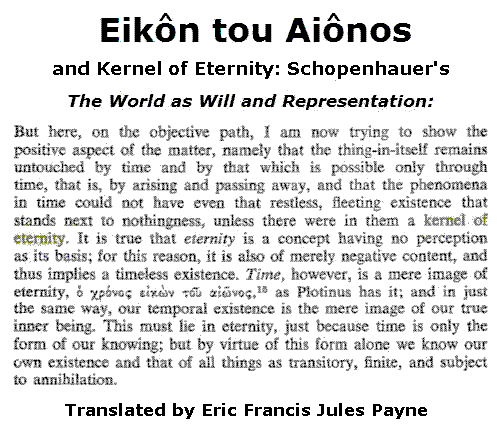
“Ich aber, hier auf dem objektiven Wege, bin jetzt bemüht, das Positive der Sache nachzuweisen, daß nämlich das Ding an sich von der Zeit und Dem, was nur durch sie möglich ist, dem Entstehen und Vergehen, unberührt bleibt, und daß die Erscheinungen in der Zeit sogar jenes rastlos flüchtige, dem Nichts zunächst stehende Dasein nicht haben könnten, wenn nicht in ihnen ein Kern aus der Ewigkeit* wäre. Die Ewigkeit ist freilich ein Begriff, dem keine Anschauung zum Grunde liegt: er ist auch deshalb bloß negativen Inhalts, besagt nämlich ein zeitloses Dasein. Die Zeit ist demnach ein bloßes Bild der Ewigkeit, ho chronos eikôn tou aiônos,** wie es Plotinus*** hat: und ebenso ist unser zeitliches Dasein das bloße Bild unsers Wesens an sich. Dieses muß in der Ewigkeit liegen, eben weil die Zeit nur die Form unsers Erkennens ist: vermöge dieser allein aber erkennen wir unser und aller Dinge Wesen als vergänglich, endlich und der Vernichtung anheimgefallen.”
* “a kernel of eternity“
** “Time is the image of eternity.”
*** “wie es Plotinus hat”–
Actually, not Plotinus, but Plato,
according to Diogenes Laertius.
Related material:
J. N. Darby,
“On the Greek Words for
Eternity and Eternal
(aion and aionios),”
Carl Gustav Jung, Aion,
which contains the following
four-diamond figure,

Wednesday, June 6, 2007
Wednesday June 6, 2007
June 7 in New Zealand.
Today at Cullinane College:
Examination Day

(For the college curriculum,
see the New Zealand
Qualifications Authority.)
If Cullinane College were Hogwarts–
Last-minute exam info:
The Lapis Philosophorum
"The lapis was thought of as a unity and therefore often stands for the prima materia in general."
— Aion, by C. G. Jung"Its discoverer was of the opinion that he had produced the equivalent of the primordial protomatter which exploded into the Universe."
— The Stars My Destination, by Alfred Bester
And from Bester's The Deceivers:
Meta Physics
"'… Think of a match. You've got a chemical head of potash, antimony, and stuff, full of energy waiting to be released. Friction does it. But when Meta excites and releases energy, it's like a stick of dynamite compared to a match. It's the chess legend for real.'
'I don't know it.'
'Oh, the story goes that a philosopher invented chess for the amusement of an Indian rajah. The king was so delighted that he told the inventor to name his reward and he'd get it, no matter what. The philosopher asked that one grain of rice be placed on the first square of the chessboard, two on the second, four on the third, and so on to the sixty-fourth.'
'That doesn't sound like much.'
'So the rajah said. …'"
Related material:
Saturday, August 26, 2006
Saturday August 26, 2006
"Alcatraz, Spanish for pelican, was named Isla de los Alcatraces after the birds that were the island's only inhabitants." —Bay City Guide
Related material
Thomas Kuhn's "Pelican Brief":
"… the Philosopher’s Stone was a psychic rather than a physical product. It symbolized one’s Self…."
"The formula presents a symbol of the self…."
"… Jung presents a diagram to illustrate the dynamic movements of the self…."
…the movement of
a self in the rock…
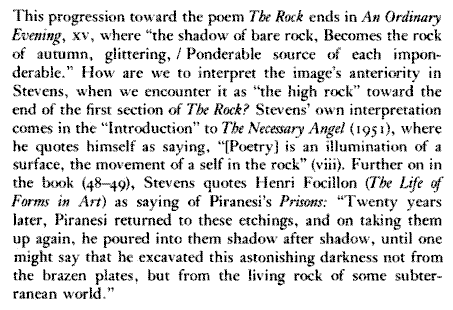
— Wallace Stevens:
The Poems of Our Climate,
by Harold Bloom,
Cornell U. Press, 1977
Thursday, December 8, 2005
Thursday December 8, 2005
— Poem title, Gerard Manley Hopkins
From Jung’s Map of the Soul, by Murray Stein:
“… Jung thinks of the self as undergoing continual transformation during the course of a lifetime…. At the end of his late work Aion, Jung presents a diagram to illustrate the dynamic movements of the self….”

“The formula presents a symbol of the self, for the self is not just a stable quantity or constant form, but is also a dynamic process. In the same way, the ancients saw the imago Dei in man not as a mere imprint, as a sort of lifeless, stereotyped impression, but as an active force…. The four transformations represent a process of restoration or rejuvenation taking place, as it were, inside the self….”
“The formula reproduces exactly the essential features of the symbolic process of transformation. It shows the rotation of the mandala, the antithetical play of complementary (or compensatory) processes, then the apocatastasis, i.e., the restoration of an original state of wholeness, which the alchemists expressed through the symbol of the uroboros, and finally the formula repeats the ancient alchemical tetrameria, which is implicit in the fourfold structure of unity.
What the formula can only hint at, however, is the higher plane that is reached through the process of transformation and integration. The ‘sublimation’ or progress or qualitative change consists in an unfolding of totality into four parts four times, which means nothing less than its becoming conscious. When psychic contents are split up into four aspects, it means that they have been subjected to discrimination by the four orienting functions of consciousness. Only the production of these four aspects makes a total description possible. The process depicted by our formula changes the originally unconscious totality into a conscious one.”
— Jung, Collected Works,
Vol. 9, Part 2, Aion: Researches into the Phenomenology of the Self (1951)
Related material:

“Although ‘wholeness’ seems at first sight to be nothing but an abstract idea (like anima and animus), it is nevertheless empirical in so far as it is anticipated by the psyche in the form of spontaneous or autonomous symbols. These are the quaternity or mandala symbols, which occur not only in the dreams of modern people who have never heard of them, but are widely disseminated in the historical recods of many peoples and many epochs. Their significance as symbols of unity and totality is amply confirmed by history as well as by empirical psychology. What at first looks like an abstract idea stands in reality for something that exists and can be experienced, that demonstrates its a priori presence spontaneously. Wholeness is thus an objective factor that confronts the subject independently of him… Unity and totality stand at the highest point on the scale of objective values because their symbols can no longer be distinguished from the imago Dei. Hence all statements about the God-image apply also to the empirical symbols of totality.”
— Jung, Aion, as quoted in
Carl Jung and Thomas Merton
Saturday, October 29, 2005
Saturday October 29, 2005
Aion
From AP’s “Today in History” for October 29:
In 1967, the counter-culture musical “Hair” opened off-Broadway.
Related material:
Jung on Pisces and Aquarius in Aion
The Da Vinci Code and Symbology at Harvard
“This is the turning point
Funny
But by the end
Bitter and serious and deadly”
— Jill O’Hara singing “The Climax“
in “Hair”
(original cast recording)
Monday, August 22, 2005
Monday August 22, 2005
Part I: Mathematics and Narrative

Apostolos Doxiadis on last month's conference on "mathematics and narrative"–
Doxiadis is describing how talks by two noted mathematicians were related to
"… a sense of a 'general theory bubbling up' at the meeting… a general theory of the deeper relationship of mathematics to narrative…. "
Doxiadis says both talks had "a big hole in the middle."
"Both began by saying something like: 'I believe there is an important connection between story and mathematical thinking. So, my talk has two parts. [In one part] I’ll tell you a few things about proofs. [And in the other part] I’ll tell you about stories.' …. And in both talks it was in fact implied by a variation of the post hoc propter hoc, the principle of consecutiveness implying causality, that the two parts of the lectures were intimately related, the one somehow led directly to the other."
"And the hole?"
"This was exactly at the point of the link… [connecting math and narrative]… There is this very well-known Sidney Harris cartoon… where two huge arrays of formulas on a blackboard are connected by the sentence ‘THEN A MIRACLE OCCURS.’ And one of the two mathematicians standing before it points at this and tells the other: ‘I think you should be more explicit here at step two.’ Both… talks were one half fascinating expositions of lay narratology– in fact, I was exhilarated to hear the two most purely narratological talks at the meeting coming from number theorists!– and one half a discussion of a purely mathematical kind, the two parts separated by a conjunction roughly synonymous to ‘this is very similar to this.’ But the similarity was not clearly explained: the hole, you see, the ‘miracle.’ Of course, both [speakers]… are brilliant men, and honest too, and so they were very clear about the location of the hole, they did not try to fool us by saying that there was no hole where there was one."
"At times, bullshit can only be countered with superior bullshit."
— Norman Mailer
Many Worlds and Possible Worlds in Literature and Art, in Wikipedia:
"The concept of possible worlds dates back to a least Leibniz who in his Théodicée tries to justify the apparent imperfections of the world by claiming that it is optimal among all possible worlds. Voltaire satirized this view in his picaresque novel Candide….
Borges' seminal short story El jardín de senderos que se bifurcan ("The Garden of Forking Paths") is an early example of many worlds in fiction."
Background:
Modal Logic in Wikipedia
Possible Worlds in Wikipedia
Possible-Worlds Theory, by Marie-Laure Ryan
(entry for The Routledge Encyclopedia of Narrative Theory)
'…It is told that, when the Merciful One made the worlds, first of all He created that Stone and gave it to the Divine One whom the Jews call Shekinah, and as she gazed upon it the universes arose and had being.'"
— Many Dimensions, by Charles Williams, 1931 (Eerdmans paperback, April 1979, pp. 43-44)
"The lapis was thought of as a unity and therefore often stands for the prima materia in general."
— Aion, by C. G. Jung, 1951 (Princeton paperback, 1979, p. 236)
"Its discoverer was of the opinion that he had produced the equivalent of the primordial protomatter which exploded into the Universe."
|
"We symbolize
logical necessity with the box  ) )and logical possibility with the diamond  ). ).
"The possibilia that exist,
— Michael Sudduth, |


Thursday, February 17, 2005
Thursday February 17, 2005
"We symbolize logical necessity
with the box )
and logical possibility
with the diamond ).
— Keith Allen Korcz,
(Log24.net, 1/25/05)
And what do we
symbolize by  ?
?
On the Lapis Philosophorum,
the Philosophers' Stone –
"'What is this Stone?' Chloe asked….
'…It is told that, when the Merciful One
made the worlds, first of all He created
that Stone and gave it to the Divine One
whom the Jews call Shekinah,
and as she gazed upon it
the universes arose and had being.'"
– Many Dimensions,
by Charles Williams, 1931
(Eerdmans paperback,
April 1979, pp. 43-44)
"The lapis was thought of as a unity
and therefore often stands for
the prima materia in general."
– Aion, by C. G. Jung, 1951
(Princeton paperback,
1979, p. 236)
"Its discoverer was of the opinion that
he had produced the equivalent of
the primordial protomatter
which exploded into the Universe."
– The Stars My Destination,
by Alfred Bester, 1956
(Vintage hardcover,
July 1996, p. 216)
"The possibilia that exist,
and out of which
the Universe arose,
are located in
a necessary being…."
— Michael Sudduth,
Notes on
God, Chance, and Necessity
by Keith Ward,
Regius Professor of Divinity
at Christ Church College, Oxford
(the home of Lewis Carroll)
See also
The Diamond Archetype.
For more on modal theology, see
Kurt Gödel's Ontological Argument
and
The Ontological Argument
from Anselm to Gödel.
Friday, February 20, 2004
Friday February 20, 2004
The Da Vinci Code
and Symbology at Harvard
The protagonist of the recent bestseller The Da Vinci Code is Robert Langdon, "a professor of Religious Symbology at Harvard University." A prominent part in the novel is played by the well-known Catholic organization Opus Dei. Less well known (indeed, like Langdon, nonexistent) is the academic discipline of "symbology." (For related disciplines that do exist, click here.) What might a course in this subject at Harvard be like?
|
Harvard Crimson, April 10, 2003: While Opus Dei members said that they do not refer to their practices of recruitment as "fishing," the Work’s founder does describe the process of what he calls "winning new apostles" with an aquatic metaphor. Point #978 of The Way invokes a passage in the New Testament in which Jesus tells Peter that he will make him a "fisher of men." The point reads:
|
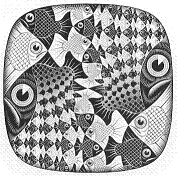

Exercise for Symbology 101:
Describe the symmetry
in each of the pictures above.
Show that the second picture
retains its underlying structural
symmetry under a group of
322,560 transformations.
Having reviewed yesterday's notes
on Gombrich, Gadamer, and Panofsky,
discuss the astrological meaning of
the above symbols in light of
today's date, February 20.
Extra credit:
Relate the above astrological
symbolism to the four-diamond
symbol in Jung's Aion.
Happy metaphors!