Books by George Steiner at
https://openroadmedia.com/contributor/george-steiner —

Related language —


Books by George Steiner at
https://openroadmedia.com/contributor/george-steiner —
Related language —

From "Siri + Wechsler" in this journal —
|
For Little Man Tate —
Related material — Wechsler in this journal and
Mark and Lucille, Bill and Violet, Al and Regina,
|
Related material —


Related illustration from a search in this journal for Wechsler —

|

|
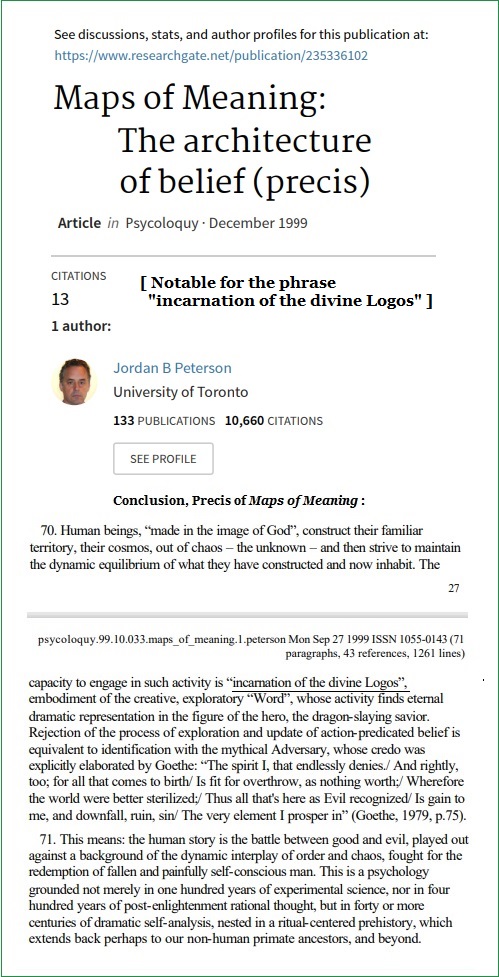
Above: Dr. Harrison Pope, Harvard professor of psychiatry,
demonstrates the use of the Wechsler Adult Intelligence Scale (WAIS)
“block design” subtest.
— From a Log24 search for “Harrison Pope.”

Compare and contrast with —
|
|
|
|
|
|
Related material: Bochner and Carnegie-Mellon.
Alfred Bester fans may also enjoy more
damned confusion from Dan Brown —

(Not to be confused with Gully Foyle .)
This afternoon's online New York Times reports a July 9
death at a memory-care facility —
Requiem for a Wechsler —
"Lighting for the Met is particularly challenging because —
unlike on Broadway, for instance — the shows change
on a weekly or even daily basis. One of Mr. Wechsler’s
accomplishments, Mr. Sardo said, was to develop
accurate records of the lighting schemes for each production,
so that one show could be swapped for another more efficiently.
“Before Gil was involved, there were no reference manuals as to
how that should be done,” Mr. Sardo said.
“Someone kinda remembered how the lighting was supposed to be.”
— Neil Genzlinger
“Perhaps only Shakespeare manages to create at the highest level
both images and people; and even Hamlet looks second-rate
compared with Lear .”
— Iris Murdoch, “Against Dryness,” 1961
Byline from a 2019 post — ‘GLOBE STAFF AND NEW SERVICES’ —

|
|
Above: Dr. Harrison Pope, Harvard professor of psychiatry,
demonstrates the use of the Wechsler Adult Intelligence Scale
“block design” subtest.
— From a Log24 search for “Harrison Pope.”
Related drama — Other posts tagged Plastic Elements.
"Meaning fragments" is a phrase from the previous post.
See Wechsler in this journal.

Related material —
"the liberation of the plastic elements."

From today's online Boston Globe —
See also Wechsler + Siri in this journal and a post from
the date of Dr. Gunderson's death, January 11, 2019 —

The previous post, "Tesserae for a Tesseract," contains the following
passage from a 1987 review of a book about Finnegans Wake —
"Basically, Mr. Bishop sees the text from above
and as a whole — less as a sequential story than
as a box of pied type or tesserae for a mosaic,
materials for a pattern to be made."
A set of 16 of the Wechsler cubes below are tesserae that
may be used to make patterns in the Galois tesseract.
Another Bellevue story —

“History, Stephen said, is a nightmare
from which I am trying to awake.”
— James Joyce, Ulysses
WISC = Wechsler Intelligence Scale for Children
RISC = Reduced Instruction Set Computer or
Rust Inventory of Schizotypal Cognitions
See related material in earlier WISC RISC posts.
See also . . .
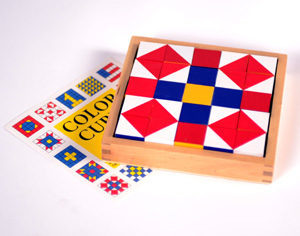
"Many parents ask us about the Block Design section
on the WISC and hope to purchase blocks and exercises
like those used on the WISC test. We explain that doing that
has the potential to invalidate their child's test results.
These Froebel Color Cubes will give you a tool to work with
your child on the skills tested for in the Block Design section
of the WISC in an ethical and appropriate way. These same
skills are applicable to any test of non-verbal reasoning like
the NNAT, Raven's or non-verbal sections of the CogAT or OLSAT. "
For a webpage that is perhaps un ethical and in appropriate,
see Block Designs in Art and Mathematics.
Video starring the CEO of Cambridge Analytica —

Related material from John Rust, now the director of the
Psychometrics Centre at the University of Cambridge —

My own sympathies are with the Mad Men.
See also Rust in the previous post, Cambridge Psychometrics.
He is known for the UK version of the Wechsler Intelligence Scale
for Children.

Raven’s Progressive Matrices intelligence test—

Wechsler Adult Intelligence Scale test—

Related art — (Click images for further details.)
Patterns suggesting those of the Raven test:

Patterns suggesting those of the Wechsler test:

The latter patterns were derived from the former.
Or: The Confessions of Nat Tate
“A convincing lie is, in its own way, a tiny, perfect narrative.”
— William Boyd, “A Short History of the Short Story” (2006)
“A novel written in the first-person singular has certain powerful
narrative advantages, especially when it takes the form of a ‘confession.'”
— William Boyd, “Memoir of a Plagiarist” (1994)


From a Log24 post yesterday —
For Little Man Tate —

Related material — Wechsler in this journal and an earlier Siri Hustvedt
art novel, from 2003 —
Mark and Lucille, Bill and Violet, Al and Regina, etc., etc., etc. —

Amy Adams in the new film “Her” —
“You’re dating an OS? What is that like?”
— Question quoted in a Hollywood Reporter
story on the film’s second trailer
From the same story, by Philiana Ng —
” The trailer is set to Arcade Fire’s
mid-tempo ballad ‘Supersymmetry.’ “
Parts of an answer for Amy —
Nov. 26, 2012, as well as
Dec. 24, 2013, and
The Hollywood Reporter story is from Dec. 3, 2013.
See also that date in this journal.
Quoted in the March 13 post Blackboard Jungle:
"Every morning you take your machete into the jungle
and explore and make observations, and every day
you fall more in love with the richness and splendor
of the place."
— Paul Lockhart, A Mathematician's Lament
More from Lockhart's jungle—
|
Mathematical objects, even if initially inspired by some aspect of reality (e.g., piles of rocks, the disc of the moon), are still nothing more than figments of our imagination. Not only that, but they are created by us and are endowed by us with certain characteristics; that is, they are what we ask them to be…. … in Mathematical Reality, because it is an imaginary place, I actually can have pretty much whatever I want…. The point is that there is no reality to any of this, so there are no rules or restrictions other than the ones we care to impose…. Make up anything you want, so long as it isn’t boring. Of course this is a matter of taste, and tastes change and evolve. Welcome to art history! — Lockhart, Paul (2009-04-01). A Mathematician's Lament: How School Cheats Us Out of Our Most Fascinating and Imaginative Art Form (pp. 100-104). Bellevue Literary Press. Kindle Edition. |
Related material in this journal: Bellevue and Wechsler.
See also Gombrich in this journal and in the following:

Related material (Click for some background.) —

Or: Being There
(A sequel to last night's Lyric Intelligence )
William Deresiewicz reviews Kurt Vonnegut's 1952 novel Player Piano :
The novel’s prescience is chilling. Six years before the left-wing English
sociologist Michael Young published The Rise of the Meritocracy ,
a dystopian satire that coined that now-ubiquitous final word,
Vonnegut was already there.
Related material:
Intelligence Test , Gombrich, and, more generally, Stupidity.
Continued from April 2, 2012.
Some predecessors of the Cullinane design cubes of 1984
that lack the Cullinane cubes' symmetry properties—
Kohs cubes (see 1920 article)
Wechsler cubes (see Wechsler in this journal), and
Horowitz cubes (see links below).

"And when I think about the values
that are important to me today,
I think first about meritocracy."
— Robert Diamond, Colby College '73, now
Chair of the Colby College Board of Trustees, in a
commencement address on Sunday, May 25, 2008
Other remarks on that Sunday —
Related material from Colby—

See also an MAA report on Gouvea from June 6, 2012.
This journal on June 18, 2008—

The Wechsler Cubes story continues with a paper from December 2009…
"Learning effects were assessed for the block design (BD) task,
on the basis of variation in 2 stimulus parameters:
perceptual cohesiveness (PC) and set size uncertainty (U)." —

(Click image for some background.)
The real intelligence test is, of course, the one Wechsler flunked—
investigating the properties of designs made with sixteen
of his cubes instead of nine.
Continuing this afternoon's meditation on Hollywood
endings, recall the ending of the 1966 David Niven
version of Casino Royale—
"Eventually, Jimmy's atomic pill explodes, destroying Casino Royale
along with everyone inside…. Sir James and all of his agents then
appear in heaven, with angel wings and harps and Jimmy Bond is
shown descending into the fires of hell." — Wikipedia
This evening's NY Lottery numbers are 169 and 1243.
An occurence of 169 in this journal on June 18, 2008—
"It's my absolute ambition that you are touched to the core of your being with the content…."
— Julie Taymor on Spider-Man: Turn Off the Dark (Playbill video, undated)
Another ambitious comic-book promotion —
"What Logicomix does that few works in any medium do is to make intellectual passion palpable. That is its greatest strength. And it’s here that its form becomes its substance."
— Judith Roitman, review (pdf, 3.7 MB) of Logicomix: An Epic Search for Truth , in …

The December 2010 AMS Notices cover has excerpts from Logicomix.
Related material:
"In the classical grammarians’ sense of the power of form over 'content' and style over 'substance,' he originated the phrase, 'the medium is the message.'"
— Joseph P. Duggan on Marshall McLuhan at The University Bookman
See also, in this journal, The Medium is the Message, Wechsler, and Blockheads .
Tangled Up In Red
| CHANGE FEW CAN BELIEVE IN |
See Siri Hustvedt on the name "Wechsler"
and see the tag "permutahedron" in this journal.

Related material:
Frame Tales, as well as
The Sacred Day of Kali,
this morning's
New York Times obituaries,
and
Mental Health Month, 2003:
|
|
|
|
|
|
Continued…

… from June 11, 2008.
Werner, Kimberly;
Kimberly, Werner.

Happy Feast of
St. Mary Magdalene.

The Kohs Block Design
Intelligence Test
Samuel Calmin Kohs, the designer (but not the originator) of the above intelligence test, would likely disapprove of the "Aryan Youth types" mentioned in passing by a film reviewer in today's New York Times. (See below.) The Aryan Youth would also likely disapprove of Dr. Kohs.

1. Wechsler Cubes (intelligence testing cubes derived from the Kohs cubes shown above). See…
Harvard psychiatry and…
The Montessori Method;
The Crimson Passion;
The Lottery Covenant.
2. Wechsler Cubes of a different sort (Log24, May 25, 2008)
3. Manohla Dargis in today's New York Times:
"… 'Momma’s Man' is a touchingly true film, part weepie, part comedy, about the agonies of navigating that slippery slope called adulthood. It was written and directed by Azazel Jacobs, a native New Yorker who has set his modestly scaled movie with a heart the size of the Ritz in the same downtown warren where he was raised. Being a child of the avant-garde as well as an A student, he cast his parents, the filmmaker Ken Jacobs and the artist Flo Jacobs, as the puzzled progenitors of his centerpiece, a wayward son of bohemia….
In American movies, growing up tends to be a job for either Aryan Youth types or the oddballs and outsiders…."
"… I think that the deeper opportunity, the greater opportunity film can offer us is as an exercise of the mind. But an exercise, I hate to use the word, I won't say 'soul,' I won't say 'soul' and I won't say 'spirit,' but that it can really put our deepest psychological existence through stuff. It can be a powerful exercise. It can make us think, but I don't mean think about this and think about that. The very, very process of powerful thinking, in a way that it can afford, is I think very, very valuable. I basically think that the mind is not complete yet, that we are working on creating the mind. Okay. And that the higher function of art for me is its contribution to the making of mind."
— Interview with Ken Jacobs, UC Berkeley, October 1999
5. For Dargis's "Aryan Youth types"–
From a Manohla Dargis
New York Times film review
of April 4, 2007
(Spy Wednesday) —

See also, from August 1, 2008
(anniversary of Hitler's
opening the 1936 Olympics) —
For Sarah Silverman —
and the 9/9/03 entry

Doonesbury,
August 21-22, 2008:

| CHANGE FEW CAN BELIEVE IN |
Page 67 —
“… Bill and Violet were married. The wedding was held in the Bowery loft on June 16th, the same day Joyce’s Jewish Ulysses had wandered around Dublin. A few minutes before the exchange of vows, I noted that Violet’s last name, Blom, was only an o away from Bloom, and that meaningless link led me to reflect on Bill’s name, Wechsler, which carries the German root for change, changing, and making change. Blooming and changing, I thought.”
For Hustvedt’s discussion of Wechsler’s art– sculptured cubes, which she calls “tightly orchestrated semantic bombs” (p. 169)– see Log24, May 25, 2008.
(after David Wechsler,
1896-1981, chief
psychologist at Bellevue)
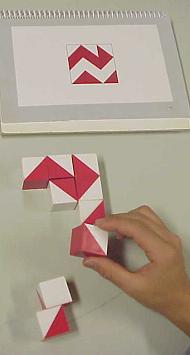
These cubes are used to
make 3×3 patterns for
psychological testing.
Related 3×3 patterns appear
in “nine-patch” quilt blocks
and in the following–
| Don Park at docuverse.com, Jan. 19, 2007: “How to draw an Identicon
A 9-block is a small quilt using only 3 types of patches, out of 16 available, in 9 positions. Using the identicon code, 3 patches are selected: one for center position, one for 4 sides, and one for 4 corners. Positions and Rotations For center position, only a symmetric patch is selected (patch 1, 5, 9, and 16). For corner and side positions, patch is rotated by 90 degree moving clock-wise starting from top-left position and top position respectively.” |
| From a weblog by Scott Sherrill-Mix:
“… Don Park came up with the original idea for representing users with geometric shapes….” Claire | 20-Dec-07 at 9:35 pm | Permalink “This reminds me of a flash demo by Jarred Tarbell |
| Jared Tarbell at levitated.net, May 15, 2002:
“The nine block is a common design pattern among quilters. Its construction methods and primitive building shapes are simple, yet produce millions of interesting variations.  Figure A. Four 9 block patterns,
arbitrarily assembled, show the grid composition of the block. Each block is composed of 9 squares, arranged in a 3 x 3 grid. Each square is composed of one of 16 primitive shapes. Shapes are arranged such that the block is radially symmetric. Color is modified and assigned arbitrarily to each new block.
The basic building blocks of the nine block are limited to 16 unique geometric shapes. Each shape is allowed to rotate in 90 degree increments. Only 4 shapes are allowed in the center position to maintain radial symmetry.
 Figure B. The 16 possible shapes allowed |
Such designs become of mathematical interest when their size is increased slightly, from square arrays of nine blocks to square arrays of sixteen. See Block Designs in Art and Mathematics.
(This entry was suggested by examples of 4×4 Identicons in use at Secret Blogging Seminar.)
Hermann Hesse's 1943 The Glass Bead Game (Picador paperback, Dec. 6, 2002, pp. 139-140)–
"For the present, the Master showed him a bulky memorandum, a proposal he had received from an organist– one of the innumerable proposals which the directorate of the Game regularly had to examine. Usually these were suggestions for the admission of new material to the Archives. One man, for example, had made a meticulous study of the history of the madrigal and discovered in the development of the style a curved that he had expressed both musically and mathematically, so that it could be included in the vocabulary of the Game. Another had examined the rhythmic structure of Julius Caesar's Latin and discovered the most striking congruences with the results of well-known studies of the intervals in Byzantine hymns. Or again some fanatic had once more unearthed some new cabala hidden in the musical notation of the fifteenth century. Then there were the tempestuous letters from abstruse experimenters who could arrive at the most astounding conclusions from, say, a comparison of the horoscopes of Goethe and Spinoza; such letters often included pretty and seemingly enlightening geometric drawings in several colors."
From Siri Hustvedt, author of Mysteries of the Rectangle: Essays on Painting (Princeton Architectural Press, 2005)– What I Loved: A Novel (Picador paperback, March 1, 2004, page 168)–
A description of the work of Bill Wechsler, a fictional artist:
"Bill worked long hours on a series of autonomous pieces about numbers. Like O's Journey, the works took place inside glass cubes, but these were twice as large– about two feet square. He drew his inspiration from sources as varied as the Cabbala, physics, baseball box scores, and stock market reports. He painted, cut, sculpted, distorted, and broke the numerical signs in each work until they became unrecognizable. He included figures, objects, books, windows, and always the written word for the number. It was rambunctious art, thick with allusion– to voids, blanks, holes, to monotheism and the individual, the the dialectic and yin-yang, to the Trinity, the three fates, and three wishes, to the golden rectangle, to seven heavens, the seven lower orders of the sephiroth, the nine Muses, the nine circles of Hell, the nine worlds of Norse mythology, but also to popular references like A Better Marriage in Five Easy Lessons and Thinner Thighs in Seven Days. Twelve-step programs were referred to in both cube one and cube two. A miniature copy of a book called The Six Mistakes Parents Make Most Often lay at the bottom of cube six. Puns appeared, usually well disguised– one, won; two, too, and Tuesday; four, for, forth; ate, eight. Bill was partial to rhymes as well, both in images and words. In cube nine, the geometric figure for a line had been painted on one glass wall. In cube three, a tiny man wearing the black-and-white prison garb of cartoons and dragging a leg iron has
— End of page 168 —
opened the door to his cell. The hidden rhyme is "free." Looking closely through the walls of the cube, one can see the parallel rhyme in another language: the German word drei is scratched into one glass wall. Lying at the bottom of the same box is a tiny black-and-white photograph cut from a book that shows the entrance to Auschwitz: ARBEIT MACHT FREI. With every number, the arbitrary dance of associations worked togethere to create a tiny mental landscape that ranged in tone from wish-fulfillment dream to nightmare. Although dense, the effect of the cubes wasn't visually disorienting. Each object, painting, drawing, bit of text, or sculpted figure found its rightful place under the glass according to the necessary, if mad, logic of numerical, pictorial, and verbal connection– and the colors of each were startling. Every number had been given a thematic hue. Bill had been interested in Goethe's color wheel and in Alfred Jensen's use of it in his thick, hallucinatory paintings of numbers. He had assigned each number a color. Like Goethe, he included black and white, although he didn't bother with the poet's meanings. Zero and one were white. Two was blue. Three was red, four was yellow, and he mixed colors: pale blue for five, purples in six, oranges in seven, greens in eight, and blacks and grays in nine. Although other colors and omnipresent newsprint always intruded on the basic scheme, the myriad shades of a single color dominated each cube.
The number pieces were the work of a man at the top of his form. An organic extension of everything Bill had done before, these knots of symbols had an explosive effect. The longer I looked at them, the more the miniature constructions seemed on the brink of bursting from internal pressure. They were tightly orchestrated semantic bombs through which Bill laid bare the arbitrary roots of meaning itself– that peculiar social contract generated by little squiggles, dashes, lines, and loops on a page."
|
From 2002:
Above: Dr. Harrison Pope, Harvard professor of psychiatry, demonstrates the use of the Wechsler Adult Intelligence Scale "block design" subtest. |
|
ZZ
Figures from the
Poem by Eugen Jost:
Mit Zeichen und Zahlen
Numbers and Names,
With numbers and names English translation A related poem:
Alphabets
From time to time
But if a savage
— Hermann Hesse (1943), |
God is in…
The Details
From an entry for Aug. 19, 2003 on
conciseness, simplicity, and objectivity:
Above: Dr. Harrison Pope, Harvard professor of psychiatry, demonstrates the use of the Wechsler Adult Intelligence Scale "block design" subtest. Another Harvard psychiatrist, Armand Nicholi, is in the news lately with his book The Question of God: C.S. Lewis and Sigmund Freud Debate God, Love, Sex, and the Meaning of Life.
For the meaning of the Old-Testament logos above, see the remarks of Plato on the immortality of the soul at For the meaning of the New-Testament logos above, see the remarks of R. P. Langlands at |
On Harvard and psychiatry: see
The Crimson Passion:
A Drama at Mardi Gras
(February 24, 2004)
This is a reductio ad absurdum of the Harvard philosophy so eloquently described by Alston Chase in his study of Harvard and the making of the Unabomber, Ted Kaczynski. Kaczynski's time at Harvard overlapped slightly with mine, so I may have seen him in Cambridge at some point. Chase writes that at Harvard, the Unabomber "absorbed the message of positivism, which demanded value-neutral reasoning and preached that (as Kaczynski would later express it in his journal) 'there is no logical justification for morality.'" I was less impressed by Harvard positivism, although I did benefit from a course in symbolic logic from Quine. At that time– the early 60's– little remained at Harvard of what Robert Stone has called "our secret culture," that of the founding Puritans– exemplified by Cotton and Increase Mather.
From Robert Stone, A Flag for Sunrise:
"Our secret culture is as frivolous as a willow on a tombstone. It's a wonderful thing– or it was. It was strong and dreadful, it was majestic and ruthless. It was a stranger to pity. And it's not for sale, ladies and gentlemen."
Some traces of that culture:
|
A web page
|
A contemporary
Click on pictures for details. |
A more appealing view of faith was offered by PBS on Wednesday night, the beginning of this year's High Holy Days:
|
Armand Nicholi: But how can you believe something that you don't think is true, I mean, certainly, an intelligent person can't embrace something that they don't think is true — that there's something about us that would object to that.
Jeremy Fraiberg: Well, the answer is, they probably do believe it's true. Armand Nicholi: But how do they get there? See, that's why both Freud and Lewis was very interested in that one basic question. Is there an intelligence beyond the universe? And how do we answer that question? And how do we arrive at the answer of that question? Michael Shermer: Well, in a way this is an empirical question, right? Either there is or there isn't. Armand Nicholi: Exactly. Michael Shermer: And either we can figure it out or we can't, and therefore, you just take the leap of faith or you don't. Armand Nicholi: Yeah, now how can we figure it out? Winifred Gallagher: I think something that was perhaps not as common in their day as is common now — this idea that we're acting as if belief and unbelief were two really radically black and white different things, and I think for most people, there's a very — it's a very fuzzy line, so that — Margaret Klenck: It's always a struggle. Winifred Gallagher: Rather than — I think there's some days I believe, and some days I don't believe so much, or maybe some days I don't believe at all. Doug Holladay: Some hours. Winifred Gallagher: It's a, it's a process. And I think for me the big developmental step in my spiritual life was that — in some way that I can't understand or explain that God is right here right now all the time, everywhere. Armand Nicholi: How do you experience that? Winifred Gallagher: I experience it through a glass darkly, I experience it in little bursts. I think my understanding of it is that it's, it's always true, and sometimes I can see it and sometimes I can't. Or sometimes I remember that it's true, and then everything is in Technicolor. And then most of the time it's not, and I have to go on faith until the next time I can perhaps see it again. I think of a divine reality, an ultimate reality, uh, would be my definition of God. |
|
|
|
Gallagher seemed to be the only participant in the PBS discussion that came close to the Montessori ideals of conciseness, simplicity, and objectivity. Dr. Montessori intended these as ideals for teachers, but they seem also to be excellent religious values. Just as the willow-tombstone seems suited to Geoffrey Hill's style, the Pythagorean sangaku pictured above seems appropriate to the admirable Gallagher.
Intelligence Test
From my August 31, 2002, entry quoting Dr. Maria Montessori on conciseness, simplicity, and objectivity:
|
|
Above: Dr. Harrison Pope, Harvard professor of psychiatry, demonstrates the use of the Wechsler Adult Intelligence Scale "block design" subtest.
Another Harvard psychiatrist, Armand Nicholi, is in the news lately with his book The Question of God: C.S. Lewis and Sigmund Freud Debate God, Love, Sex, and the Meaning of Life.
|
Pope |
Nicholi |
|
Old |
New |
For the meaning of the Old-Testament logos above, see the remarks of Plato on the immortality of the soul at
For the meaning of the New-Testament logos above, see the remarks of R. P. Langlands at
The Institute for Advanced Study.
For the meaning of life, see
The Gospel According to Jill St. John,

whose birthday is today.
Mental Health Month:
The Lottery Covenant
Here are the evening lottery numbers for Pennsylvania, the Keystone state, drawn on Monday, May 19, 2003:
401 and 1993.
This, by the sort of logic beloved of theologians, suggests we find out the significance of the divine date 4/01/1993.
It turns out that April 1, 1993, was the date of the New York opening of the Stephen Sondheim retrospective “Putting It Together.”
For material related to puzzles, games, Sondheim, and Mental Health Month, see
Notes on
Literary and Philosophical Puzzles.
The figures below illustrate some recurrent themes in these notes.
|
|
|
“Not games. Puzzles. Big difference. That’s a whole other matter. All art — symphonies, architecture, novels — it’s all puzzles. The fitting together of notes, the fitting together of words have by their very nature a puzzle aspect. It’s the creation of form out of chaos. And I believe in form.”
— Stephen Sondheim, in Stephen Schiff,
“Deconstructing Sondheim,”
The New Yorker, March 8, 1993, p. 76
THE MONTESSORI METHOD: CHAPTER VI
“Let all thy words be counted.”
Dante, Inf., canto X.
CONCISENESS, SIMPLICITY, OBJECTIVITY.
…Dante gives excellent advice to teachers when he says, “Let thy words be counted.” The more carefully we cut away useless words, the more perfect will become the lesson….
Another characteristic quality of the lesson… is its simplicity. It must be stripped of all that is not absolute truth…. The carefully chosen words must be the most simple it is possible to find, and must refer to the truth.
The third quality of the lesson is its objectivity. The lesson must be presented in such a way that the personality of the teacher shall disappear. There shall remain in evidence only the object to which she wishes to call the attention of the child….
|
|
Above: Dr. Harrison Pope, Harvard professor of psychiatry, demonstrates the use of the Wechsler Adult Intelligence Scale “block design” subtest.
Mathematicians mean something different by the phrase “block design.”
A University of London site on mathematical design theory includes a link to my diamond theory site, which discusses the mathematics of the sorts of visual designs that Professor Pope is demonstrating. For an introduction to the subject that is, I hope, concise, simple, and objective, see my diamond 16 puzzle.
Powered by WordPress


