Log24

Sunday, August 18, 2024

“Like a Kernel”

Filed under: General — Tags: — m759 @ 1:40 pm

“The yarns of seamen have a direct simplicity,
the whole meaning of which lies within the shell
of a cracked nut. But Marlow was not typical
(if his propensity to spin yarns be excepted),
and to him the meaning of an episode was
not inside like a kernel but outside,
enveloping the tale which brought it out only
as a glow brings out a haze, in the likeness of
one of these misty halos that sometimes
are made visible by the spectral illumination of
moonshine.”

— Joseph Conrad in Heart of Darkness

“By groping toward the light we are made to realize
how deep the darkness is around us.”

— Arthur Koestler, The Call Girls: A Tragi-Comedy,
Random House, 1973, page 118

From an obituary of Alain Delon, who reportedly died today . . .

"He starred in the 1976 French best picture winner, 'Mr. Klein,' as a wartime German art dealer threatened by being mistaken for a Jewish man with the same name."

— Anita Gates in The New York Times

See as well Felix Christian  Klein  in this  journal.

And then there is being mistaken for a fictional archaeologist
with the same name.

Monday, February 5, 2024

Quantum Kernel  Incarnate

Filed under: General — Tags: , , — m759 @ 9:44 am

The "quantum kernel" of Koen Thas is a version of the incidence
structure — the Cremona-Richmond configuration — discussed
in the previous post, Doily  vs. Inscape .

That post's inscape  is, as noted there, an incarnation  of the
abstract incidence structure.  More generally, see incarnation
in this journal . . . In particular, from Michaelmas last year, 
Annals of Mathematical Theology.

A somewhat more sophisticated "incarnation" example
related to the "inscape" concept —

"The hint half guessed, the gift half understood, is Incarnation."

— T. S. Eliot in Four Quartets

See also Numberland  in this journal.

Saturday, February 3, 2024

For Academic Decepticons:  The Kernel Trick

Filed under: General — Tags: , — m759 @ 1:36 pm

For the meaning of the title, see the Dec. 27, 2023,  posts —
now tagged "Kernel Trick."

This  post was suggested by a Dec. 27, 2023,  A. O. Scott 
New York Times  essay —

For The Spell of A.O.  see "Bullshit" 
in a Log24 search for "A. O. Scott."

Wednesday, December 27, 2023

Quantum Kernels

Filed under: General — Tags: , , — m759 @ 3:19 pm

The previous post displayed a use of the phrase "quantum kernel"
by Prof. Dr. Koen Thas of Ghent University. Here is an example of
a rather different, and more widely known, meaning of the phrase —

Synchronology check (approximate) — Also from May 2023 —

Der Schlußstein des Gewölbes.

Wednesday, May 3, 2023

Kernels

Filed under: General — Tags: , — m759 @ 10:37 am

Continued from yesterday's "Kernel" —

The ACM (Association for Computing Machinery) 
has a news release today on an expert on "kernels,"
in the sense that they are used in AI —

"Schölkopf [link added] is recognized for his
widely used research in machine learning,
advancing both mathematical foundations and
a broad range of applications in science and
industry."

From Schölkopf in 2002 —

Tuesday, May 2, 2023

Kernel

Filed under: General — Tags: , — m759 @ 9:32 pm

From a post of September 24, 2011 —

Weyl on coordinate systems,
Cassirer on the kernel of being,
and A Study in Art Education.

Friday, February 3, 2017

Hard Kernel

Filed under: General — m759 @ 11:13 am

Kamuf, 'Remains to be Seen,' Los Angeles Review of Books

Hermeneutics —

The above quote occurs in a search called up by clicking on the image
of Amy Adams in the noon post on Groundhog Day (yesterday).

For a "universal message" see the final post of Groundhog Day.
For an "unintelligible secret," see today's previous post.

See also kernel  in this journal.

Sunday, December 7, 2014

The Kernel Conundrum

Filed under: General — m759 @ 11:09 am

See a Log24 search for kernel .

From that search, an image for cypher enthusiasts :

Robert De Niro as Louis Cyphre in 'Angel Heart'

Thursday, September 5, 2013

Kernel and Glow

Filed under: General — Tags: — m759 @ 11:01 am

"The yarns of seamen have a direct simplicity, the whole meaning
of which lies within the shell of a cracked nut. But Marlow was not
typical (if his propensity to spin yarns be excepted), and to him the
meaning of an episode was not inside like a kernel but outside,
enveloping the tale which brought it out only as a glow brings out a
haze, in the likeness of one of these misty halos that sometimes
are made visible by the spectral illumination of moonshine."

— Joseph Conrad in Heart of Darkness

Kernel — See Nocciolo.

Glow — See Moonshine and Moonshine II.

See also Cold Open (Jan. 29, 2011) and
Where Entertainment is God (Aug. 25, 2013).

Sunday, November 18, 2012

Kernel

Filed under: General — m759 @ 5:24 am

(Continued)

Rachel Dodes in The Wall Street Journal
on All Souls' Day, 2012—

"In one of the first lines uttered by Daniel Day-Lewis, playing Abraham Lincoln in the new Steven Spielberg film opening Nov. 9, he says, 'I could be bounded in a nutshell, and count myself a king of infinite space— were it not that I have bad dreams.'

The line was ripped straight from 'Hamlet,' by Lincoln's favorite writer, William Shakespeare. Tony Kushner, the Pulitzer Prize-winning playwright ('Angels in America') who wrote the script for the film, says that Shakespeare, much like Lincoln, 'had extraordinary mastery over the darkest parts of the human spirit.'"

The above quotation omits Shakespeare's words prefacing the nutshell part— "O God."

These same words in a different tongue—  "Hey Ram"— have often been quoted as the last words of Gandhi. (See yesterday's noon post.)

"… for the Highest Essence (brahman ),
which is the core of the world, is identical
with the Highest Self (ātman ), the kernel
of man's existence."

— Heinrich Zimmer, Myths and Symbols
in Indian Art and Civilization
, Pantheon
Books, 1946, page 142 

Related material: A post linked to here on Friday night
that itself links to a different Shakespeare speech.

Saturday, November 26, 2011

Innermost Kernel (continued*)

Filed under: General — Tags: , — m759 @ 12:00 pm

A search on the word "innermost" in a PDF copy of a book
by Suzanne Gieser on Jung and Pauli yields no definite meaning
for the book's title, The Innermost Kernel  (Springer, 2005).

The author does, however, devote a section (pp. 36-41) to the
influence of Schopenhauer on Jung and Pauli, and that section at least
suggests that the historical  origin of her title is in Schopenhauer's
reformulation of Kant's "Ding an sich."

The Innermost Kernel , p. 37—

"… an expression of an underlying invisible world,
the one that forms the innermost essence of reality,
the thing-in-itself. This is the will, a blind existence
that forms an omnipresent entity beyond time, space
and individuality." *

* Arthur Schopenhauer, "Über die Vierfache Wurzel
  des Satzes vom zureichenden Grunde" (1813),
  Kleinere Schriften, SämtlicheWerke III 
  (Stuttgart, 1962), 805–806.

* See also Mann on Schopenhauer and an "innermost kernel."

Friday, November 25, 2011

The Innermost Kernel and Physics

Filed under: General — Tags: , — m759 @ 12:00 pm

"Letzen Endes wird also der Materiebegriff in beiden Fällen auf Mathematik zurückgefürt. Der innerste Kern alles Stofflichen ist für uns wie für Plato eine Form, nicht irgendein materieller Inhalt."

"In the final analysis, in both cases [Plato and modern physics] the notion of matter is essentially a mathematical concept. The most fundamental kernel of all that is material is for us, as well as for Plato, a [mathematical] form, and not some material content."

— W. Heisenberg, "Platons Vorstellungen von den kleinsten Bausteinen der Materie und die Elementarteilchen der modernen Physik," Im Umkreis der Kunst. Eine Festschrift für Emil Preetorius , Wiesbaden 1953, pp. 137-140, as cited by Luc Brisson and F. Walter Meyerstein in Inventing the Universe , SUNY Press, 1995.

See also remarks by Pauli in For All Hallows Day.

Update of 1 PM

Related material —

IMAGE- Schopenhauer, 'innermost kernel,' and atman

"Zweiteilung und Symmetrieverminderung, das ist des Pudels Kern. Zweiteilung ist ein sehr altes Attribut des Teufels."

—Pauli to Heisenberg

Here "the poodle's kernel" is a reference to Faust , where the devil appears as a poodle.

On Schopenhauer's later years—

"In Frankfurt he spent the remaining years of his life, living quietly in two rooms with his pipe and his flute but with no friends or companions except a small poodle, the only creature to which Schopenhauer ever seems to have felt any real attachment. He named the dog Atman, a term taken from the pessimistic religion of India, in which Schopenhauer had become more and more interested in his later years."

— Robert F. Davidson, "Pessimism: Arthur Schopenhauer" in Philosophies Men Live By , New York, The Dryden Press, 1952

Innermost Kernel

Filed under: General — Tags: , — m759 @ 5:01 am

Thomas Mann on an innermost kernel—

http://www.log24.com/log/pix11C/111125-Mann-InnermostKernel.jpg

"Denn um zu wiederholen, was ich anfangs sagte:
in dem Geheimnis der Einheit von Ich und Welt,
Sein und Geschehen, in der Durchschauung des
scheinbar Objectiven und Akzidentellen als
Veranstaltung der Seele glaube ich den innersten Kern
der analytischen Lehre zu erkennen." (GW IX 488)

See also previous quotations here of the phrase "innermost kernel."

Saturday, September 24, 2011

Kernels of Being

Filed under: General,Geometry — Tags: — m759 @ 10:29 pm

For the Pope in Germany—

"We wish to see Jesus. For somehow we know, we suspect, we intuit, that if we see Jesus we will see what Meister Eckhart might call “The Divine Kernel of Being”— that Divine Spark of God’s essence, God’s imago Dei, the image in which we are created. We seem to know that in seeing Jesus we just might find something essential about ourselves."

—The Reverend Kirk Alan Kubicek, St. Peter’s at Ellicott Mills, Maryland, weblog post of Saturday, March 28, 2009, on a sermon for Sunday, March 29, 2009

See also this journal in March 2009.

Related non-theology—

Weyl on coordinate systems, Cassirer on the kernel of being, and A Study in Art Education.

Tuesday, September 29, 2026

Grok on Heptads

Filed under: General — Tags: — m759 @ 9:28 pm

The statement as written cannot be correct: \(\mathrm{GL}(3,2)\) has order \(168\) and is isomorphic to \(\mathrm{PSL}(2,7)\), while \(A_8\) has order \(20160\). The classical isomorphism that Conwell’s heptads establish is \[ \mathrm{GL}(4,2)\simeq\mathrm{SL}(4,2)\simeq A_8. \] (The two linear groups coincide because the multiplicative group of \(\mathbb{F}_2\) is trivial.) The same construction simultaneously realises \(\mathrm{O}^+(6,2)\simeq S_8\). The Klein correspondence identifies the \(35\) lines of \(\mathrm{PG}(3,2)\) with the points of a hyperbolic quadric \(Q^+(5,2)\) in \(\mathrm{PG}(5,2)\). The complementary set consists of the \(28\) points of \(\mathrm{PG}(5,2)\) that lie off the quadric. A *Conwell heptad* (also called a maximal exterior set) with respect to a fixed copy of \(Q^+(5,2)\) is a set of seven of these exterior points such that the line joining any two of them is skew to the quadric. There are exactly eight such heptads. They satisfy two elementary incidence relations: – any two heptads meet in a unique point, – every exterior point lies in exactly two heptads. Consequently the \(28\) exterior points may be labelled by the \(2\)-subsets of an \(8\)-element set \(\{1,\dots,8\}\). The collineation group of \(\mathrm{PG}(3,2)\) is \(\mathrm{PGL}(4,2)=\mathrm{GL}(4,2)\). Via the Klein correspondence this group becomes the group of linear transformations of the underlying \(6\)-dimensional \(\mathbb{F}_2\)-space that preserve the quadratic form defining \(Q^+(5,2)\). That orthogonal group therefore permutes the eight Conwell heptads. Conwell exhibited six explicit generators of \(\mathrm{GL}(4,2)\) and computed the permutations they induce on the heptads; each generator is a product of two disjoint transpositions (hence even). These six even permutations generate the whole of \(A_8\). Since \[ |\mathrm{GL}(4,2)|=20160=|A_8|, \] the resulting homomorphism \(\mathrm{GL}(4,2)\to A_8\) is an isomorphism. (The same eight objects, viewed as a set of linear complexes in \(\mathrm{PG}(3,2)\), were later reconstructed directly by Edge; both authors used the action on the octad of heptads to identify the groups geometrically.) The labelling of exterior points by pairs also makes the isomorphism visible combinatorially: the lines skew to the quadric become the triples of pairs that form a triangle on eight letters, recovering the well-known model of the \(15_4\)-configuration of \(\mathrm{PG}(3,2)\) inside the complete graph \(K_8\). The statement as written cannot be correct: \(\mathrm{GL}(3,2)\) has order \(168\) and is isomorphic to \(\mathrm{PSL}(2,7)\), while \(A_8\) has order \(20160\). The classical isomorphism that Conwell’s heptads establish is \[ \mathrm{GL}(4,2)\simeq\mathrm{SL}(4,2)\simeq A_8. \] (The two linear groups coincide because the multiplicative group of \(\mathbb{F}_2\) is trivial.) The same construction simultaneously realises \(\mathrm{O}^+(6,2)\simeq S_8\). The Klein correspondence identifies the \(35\) lines of \(\mathrm{PG}(3,2)\) with the points of a hyperbolic quadric \(Q^+(5,2)\) in \(\mathrm{PG}(5,2)\). The complementary set consists of the \(28\) points of \(\mathrm{PG}(5,2)\) that lie off the quadric. A *Conwell heptad* (also called a maximal exterior set) with respect to a fixed copy of \(Q^+(5,2)\) is a set of seven of these exterior points such that the line joining any two of them is skew to the quadric. There are exactly eight such heptads. They satisfy two elementary incidence relations: – any two heptads meet in a unique point, – every exterior point lies in exactly two heptads. Consequently the \(28\) exterior points may be labelled by the \(2\)-subsets of an \(8\)-element set \(\{1,\dots,8\}\). The collineation group of \(\mathrm{PG}(3,2)\) is \(\mathrm{PGL}(4,2)=\mathrm{GL}(4,2)\). Via the Klein correspondence this group becomes the group of linear transformations of the underlying \(6\)-dimensional \(\mathbb{F}_2\)-space that preserve the quadratic form defining \(Q^+(5,2)\). That orthogonal group therefore permutes the eight Conwell heptads. Conwell exhibited six explicit generators of \(\mathrm{GL}(4,2)\) and computed the permutations they induce on the heptads; each generator is a product of two disjoint transpositions (hence even). These six even permutations generate the whole of \(A_8\). Since \[ |\mathrm{GL}(4,2)|=20160=|A_8|, \] the resulting homomorphism \(\mathrm{GL}(4,2)\to A_8\) is an isomorphism. (The same eight objects, viewed as a set of linear complexes in \(\mathrm{PG}(3,2)\), were later reconstructed directly by Edge; both authors used the action on the octad of heptads to identify the groups geometrically.) The labelling of exterior points by pairs also makes the isomorphism visible combinatorially: the lines skew to the quadric become the triples of pairs that form a triangle on eight letters, recovering the well-known model of the \(15_4\)-configuration of \(\mathrm{PG}(3,2)\) inside the complete graph \(K_8\).

## Grok on heptads – by Grok 4.6, Sept. 29. 2026


The Klein correspondence identifies the \(35\) lines of \(\mathrm{PG}(3,2)\) with the points of a hyperbolic quadric \(Q^+(5,2)\) in \(\mathrm{PG}(5,2)\). The complementary set consists of the \(28\) points of \(\mathrm{PG}(5,2)\) that lie off the quadric. A *Conwell heptad* (also called a maximal exterior set) with respect to a fixed copy of \(Q^+(5,2)\) is a set of seven of these exterior points such that the line joining any two of them is skew to the quadric. There are exactly eight such heptads. They satisfy two elementary incidence relations:

– any two heptads meet in a unique point,
– every exterior point lies in exactly two heptads.

Consequently the \(28\) exterior points may be labelled by the \(2\)-subsets of an \(8\)-element set \(\{1,\dots,8\}\).

The collineation group of \(\mathrm{PG}(3,2)\) is \(\mathrm{PGL}(4,2)=\mathrm{GL}(4,2)\). Via the Klein correspondence this group becomes the group of linear transformations of the underlying \(6\)-dimensional \(\mathbb{F}_2\)-space that preserve the quadratic form defining \(Q^+(5,2)\). That orthogonal group therefore permutes the eight Conwell heptads. Conwell exhibited six explicit generators of \(\mathrm{GL}(4,2)\) and computed the permutations they induce on the heptads; each generator is a product of two disjoint transpositions (hence even). These six even permutations generate the whole of \(A_8\). Since
\[
|\mathrm{GL}(4,2)|=20160=|A_8|,
\]
the resulting homomorphism \(\mathrm{GL}(4,2)\to A_8\) is an isomorphism.

(The same eight objects, viewed as a set of linear complexes in \(\mathrm{PG}(3,2)\), were later reconstructed directly by Edge; both authors used the action on the octad of heptads to identify the groups geometrically.)

The labelling of exterior points by pairs also makes the isomorphism visible combinatorially: the lines skew to the quadric become the triples of pairs that form a triangle on eight letters, recovering the well-known model of the \(15_4\)-configuration of \(\mathrm{PG}(3,2)\) inside the complete graph \(K_8\).

## Grok on the Klein correspondence – by Grok 4.6, Sept. 29. 2026

The Klein correspondence is a dictionary between the line geometry of a 3-dimensional projective space and the point geometry of a hyperbolic quadric in 5-dimensional projective space. It is the special case \(k=2\), \(n=4\) of the Plücker embedding of a Grassmannian, and it is the geometric reason the groups \(\mathrm{PGL}(4)\) and \(\mathrm{PO}^+(6)\) are essentially the same. Over \(\mathbb{F}_2\) it is also the stage on which Conwell’s heptads live.

A concrete model of \(\mathrm{PG}(3,2)\): 15 points (red) and 35 lines, drawn as a tetrahedron with midpoints, face-centres and the overall centre. Each of the 15 planes is a Fano plane.

## The algebraic origin

Let \(V\) be a 4-dimensional vector space over a field \(K\). A line of \(\mathrm{PG}(3,K)=\mathbb{P}(V)\) is a 2-dimensional subspace \(U\subset V\). The exterior square \(\bigwedge^2 V\) is 6-dimensional, so
\[
\mathbb{P}(\bigwedge^2 V)\simeq\mathrm{PG}(5,K).
\]
Sending \(U=\langle u,v\rangle\) to the decomposable bivector \([u\wedge v]\) is well-defined (changing basis of \(U\) only rescales the wedge product). The image consists exactly of those points of \(\mathrm{PG}(5,K)\) whose Plücker coordinates
\[
p_{ij}=u_iv_j-u_jv_i
\]
satisfy the single quadratic relation
\[
p_{12}p_{34}+p_{13}p_{42}+p_{14}p_{23}=0
\]
(or an equivalent pairing of the six coordinates). That hypersurface is the **Klein quadric** \(Q^+(5,K)\). It is a non-singular hyperbolic quadric: in suitable coordinates its equation is
\[
X_0X_1+X_2X_3+X_4X_5=0.
\]
The associated bilinear form \(B\) has the geometric meaning
\[
B\bigl(p(\ell),p(m)\bigr)=\det(u,v,w,z)
\]
when \(\ell=\langle u,v\rangle\) and \(m=\langle w,z\rangle\). Hence
\[
\text{two lines of \(\mathrm{PG}(3)\) meet}\quad\Longleftrightarrow\quad\text{their Klein points are orthogonal (the joining line lies on \(Q\))}.
\]
That is the fundamental incidence translation.

## The geometric dictionary

The Klein quadric is ruled by two families of maximal totally singular planes (generators), traditionally called **Latin** (or \(\alpha\)) and **Greek** (or \(\beta\)) planes. They reconstruct \(\mathrm{PG}(3)\) as follows.

| object in \(\mathrm{PG}(3)\) | image on the Klein quadric \(Q^+(5)\) |
|—|—|
| line | point of \(Q\) |
| two intersecting lines | two points of \(Q\) joined by a line of \(Q\) |
| two skew lines | two points of \(Q\) whose joining line is a secant (not on \(Q\)) |
| all lines through a fixed point | a Latin plane on \(Q\) |
| all lines in a fixed plane | a Greek plane on \(Q\) |
| a pencil (all lines through a point in a plane) | a line of \(Q\) |
| a regulus | a conic section of \(Q\) |
| a line spread | an ovoid of \(Q\) |

Two generators of the **same** family always meet in a point; two generators of **opposite** families are either disjoint or meet in a line. A point-plane flag in \(\mathrm{PG}(3)\) therefore appears as a pair of opposite generators intersecting in a line of \(Q\); that line represents the three lines of the flag.

This is also why the Dynkin diagrams \(A_3\) and \(D_3\) are identical: the building of points/lines/planes of \(\mathrm{PG}(3)\) is the same geometry as the building of the two families of generators and the points of \(Q^+(5)\).

## The smallest case: \(\mathrm{PG}(3,2)\) and \(Q^+(5,2)\)

Over \(\mathbb{F}_2\) the numbers become completely explicit.

– \(\mathrm{PG}(3,2)\) has 15 points, 35 lines, 15 planes.
– \(\mathrm{PG}(5,2)\) has 63 points.
– The Klein quadric \(Q^+(5,2)\) has 35 points (one for each line) and two families of 15 planes each.

The 28 points of \(\mathrm{PG}(5,2)\) that lie **off** the quadric, together with the 56 lines that miss the quadric entirely, form a \((28_6,56_3)\)-configuration that is isomorphic to the combinatorial Grassmannian \(G_2(8)\) (the 2-subsets of an 8-set, with triples of pairs that form a triangle as lines). That is where Conwell’s heptads appear.

A **Conwell heptad** is a set of seven exterior points such that the line joining any two of them is skew to \(Q\). There are exactly eight such heptads:

– any two meet in one point,
– every exterior point lies in exactly two heptads.

Labelling the heptads by \(\{1,\dots,8\}\) therefore labels the 28 exterior points by the 2-subsets of an 8-set. The orthogonal group of the Klein quadric permutes the eight heptads. The connected component (or the kernel of the spinor norm, depending on the exact convention) acts as \(A_8\), which is how one sees
\[
\mathrm{SL}(4,2)\simeq A_8,\qquad\mathrm{O}^+(6,2)\simeq S_8
\]
geometrically rather than by counting orders. A correlation of \(\mathrm{PG}(3,2)\) (which swaps points and planes) corresponds to an orthogonal transformation that **swaps** the two families of generators; that is why the full group of collineations and correlations is \(S_8\).

## What the correspondence is good for

Once lines of 3-space are points of a 5-space quadric, many classical constructions become linear-algebraic.

– A **linear line complex** in \(\mathrm{PG}(3)\) is the intersection of \(Q\) with a hyperplane; the special (singular) complexes are those whose hyperplane is tangent to \(Q\).
– A **spread** of \(\mathrm{PG}(3,q)\) (a partition of the point set by \(q^2+1\) lines) maps to an **ovoid** of \(Q^+(5,q)\). Over \(\mathbb{F}_2\) every spread is regular and every ovoid of \(Q^+(5,2)\) is classical.
– A **regulus** becomes a conic on \(Q\); the opposite regulus is the other ruling of the same hyperbolic quadric \(Q^+(3)\) cut out inside \(Q^+(5)\).
– Cameron–Liebler line classes become tight sets on the Klein quadric.

Over \(\mathbb{C}\) the same picture is the compactified space of (complexified) lines, and is the starting point of twistor theory: Minkowski space sits inside the Klein quadric as a real slice, and \(\alpha\)- and \(\beta\)-planes become the two families of totally null planes. The finite geometry over \(\mathbb{F}_2\) is a complete toy model of that incidence structure.

## Group-theoretic shadow

The correspondence intertwines the natural actions:
\[
\mathrm{PGL}(4,K)\;\longrightarrow\;\mathrm{PGO}^+(6,K).
\]
Over finite fields the precise isomorphisms are
\[
\mathrm{PGL}(4,q)\simeq\mathrm{PGO}^+(6,q)
\]
up to the usual issues of determinants, spinor norms and field automorphisms. For \(q=2\) everything collapses to the single isomorphism already used for Conwell’s argument: the collineation group of \(\mathrm{PG}(3,2)\) is \(A_8\), and the full group of collineations and correlations is \(S_8\).

In short: the Klein correspondence is the statement that “the set of lines of a 3-space is itself a 4-dimensional quadric hypersurface”, together with a precise translation of every incidence relation into orthogonality on that quadric. Over \(\mathbb{F}_2\) the 28 points off the quadric organise themselves into eight heptads, and those eight objects are the eight letters of \(A_8\).

Gemini Notebook Source Guide
for the above remarks by Grok 4.6 —

The text explores a fascinating geometric bridge known as the Klein correspondence, which seamlessly translates the lines of a three-dimensional space into the points of a hyperbolic quadric inside a five-dimensional space. By focusing on the specific finite geometry of PG(3,2), the author demonstrates how points situated entirely off this quadric can be neatly arranged into Conwell heptads. These special sets of points interact through precise rules that allow mathematicians to label them using subsets of an eight-element set. Ultimately, this elegant framework reveals a deep structural link, showing how the symmetries of these geometric shapes naturally give rise to the alternating group A_8.


Saturday, April 18, 2026

Blazon Revisited

Filed under: General — Tags: — m759 @ 11:54 am
 

Friday, March 29, 2019

The Blazon World*

Filed under: General — m759 @ 4:59 pm Edit This

“At that instant he saw, in one blaze of light,
an image of unutterable conviction,
the reason why the artist works and lives
and has his being — the reward he seeks —
the only reward he really cares about,
without which there is nothing. It is to snare
the spirits of mankind in nets of magic,
to make his life prevail through his creation,
to wreak the vision of his life, the rude and painful
substance of his own experience, into the congruence
of blazing and enchanted images that are themselves
the core of life, the essential pattern whence
all other things proceed, the kernel of eternity.”

— Thomas Wolfe, Of Time and the River

* Title suggested by that of a Siri Hustvedt novel.
   See also Blazon in this journal.

Saturday, January 3, 2026

The Plugin

Filed under: General — Tags: , — m759 @ 5:04 pm

Sunday, July 6, 2025

The Importance of Answering Earnestly

Filed under: General — m759 @ 12:47 pm

Max Eastman, 1931 — The Literary Mind —

Compare and contrast —

“At that instant he saw, in one blaze of light,
an image of unutterable conviction,
the reason why the artist works and lives
and has his being — the reward he seeks —
the only reward he really cares about,
without which there is nothing. It is to snare
the spirits of mankind in nets of magic,
to make his life prevail through his creation,
to wreak the vision of his life, the rude and painful
substance of his own experience, into the congruence
of blazing and enchanted images that are themselves
the core of life, the essential pattern whence
all other things proceed, the kernel of eternity.”

— Thomas Wolfe, Of Time and the River

— From http://m759.net/wordpress/?s=Wolfe+kernel.

Sunday, May 11, 2025

No-Ownership Theory: “Der innerste Kern”

Filed under: General — Tags: , , , — m759 @ 10:45 pm

Related material . . .

Mann on Freud, Schopenhauer, and 'the Will'

"Denn um zu wiederholen, was ich anfangs sagte:
in dem Geheimnis der Einheit von Ich und Welt,
Sein und Geschehen, in der Durchschauung des
scheinbar Objectiven und Akzidentellen als
Veranstaltung der Seele glaube ich den innersten Kern
der analytischen Lehre zu erkennen." (GW IX 488)

Sunday, November 10, 2024

Numberland: The Talladega Craftsman

Filed under: General — Tags: , — m759 @ 8:42 am
 

Monday, October 17, 2011

The Craftsman

Filed under: General — m759 @ 5:24 am Edit This

A follow-up to yesterday's Sunday School—

(Click on images for some background.)

IMAGE- Dennis Ritchie, Amy Adams (Talladega Nights), and the Inferno operating system

http://www.log24.com/log/pix11C/111017-InfernoOS-500w.jpg


Backstory—  "Plan 9 is an operating system kernel …."

Meditation— "How can you tell the craftsman from the craft?"
                          (Apologies to William Butler Yeats.)

From Summer Solstice 2023 —

Related tunes — "Hot Rod Lincoln" and
"Junk in the Trunk" (Planet Booty, YouTube, Feb. 27, 2019)

Tuesday, September 24, 2024

Art Theorists’ Plaything … Or Something More Serious?

Filed under: General — Tags: , , — m759 @ 3:07 am

The Klein Group: The four elements in four colors, with black points representing the identity

This figure from a post of April 29, 2008 is related to remarks
by art theorist Rosalind Krauss in tonight's previous post.

Related language —

"Kernel" in mathematics and "Innerste Kern." elsewhere.

Related philosophy —

"Die Philosophie ist ein Kampf gegen die Verhexung
unsres Verstandes durch die Mittel unserer Sprache."

— Wittgenstein, Philosophical Investigations  (1953),  Section 109

Saturday, May 25, 2024

The Faustus Square:*  Casting the Die

Filed under: General — Tags: — m759 @ 2:24 am

* See also The Faustus Square  in the May 18 post "The Godfather's Art."

Monday, May 20, 2024

The Writer Plugin, for James Joyce

Filed under: General — Tags: , , — m759 @ 3:17 pm

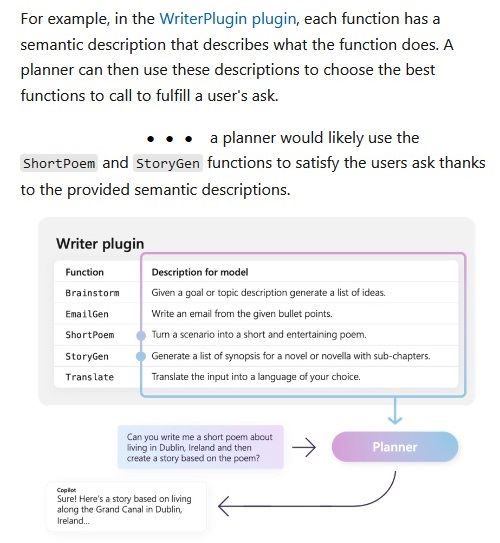
Illustration of "translate the input into
a language of your choice" —

Tuesday, December 12, 2023

If It’s Tuesday…

Filed under: General — Tags: — m759 @ 2:10 pm

Continued .

“The yarns of seamen have a direct simplicity,
the whole meaning of which lies within the shell
of a cracked nut. But Marlow was not typical
(if his propensity to spin yarns be excepted),
and to him the meaning of an episode was
not inside like a kernel but outside,
enveloping the tale which brought it out only
as a glow brings out a haze, in the likeness of
one of these misty halos that sometimes
are made visible by the spectral illumination of
moonshine.”

— Joseph Conrad in Heart of Darkness

“By groping toward the light we are made to realize
how deep the darkness is around us.”

— Arthur Koestler, The Call Girls: A Tragi-Comedy,
Random House, 1973, page 118

Sunday, July 2, 2023

Thomas Mann of Zurich vs. Walter Tevis of Lexington

Filed under: General — Tags: , , , — m759 @ 4:41 am

Mann on Freud, Schopenhauer, and 'the Will'

"Denn um zu wiederholen, was ich anfangs sagte:
in dem Geheimnis der Einheit von Ich und Welt,
Sein und Geschehen, in der Durchschauung des
scheinbar Objectiven und Akzidentellen als
Veranstaltung der Seele glaube ich den innersten Kern
der analytischen Lehre zu erkennen." (GW IX 488)

Thomas Mann died in Zurich on 12 Aug., 1955.

"The author left his works in his will
to the Thomas Mann archive at the ETH Zurich.
"

Related meditation from Lexington, Kentucky, on
the date of Mann's death —


Or not.

Related literature —

The Queen's Gambit 
by Walter Tevis

Wednesday, May 17, 2023

British Combinatorics 2023

Filed under: General — Tags: — m759 @ 12:35 pm

"Martin told us about his work on machine learning…."

— Peter J. Cameron reports on last week's (May 10 and 11)
London Combinatorics Colloquia 2023.

Related material — Boolean Functions in this journal and in a book
from May 16, 2011 . . .

Some historical background on machine learning —

https://tripleampersand.org/kernelled-connections-perceptron-diagram/ .

Wednesday, June 15, 2022

For 6/15

Filed under: General — m759 @ 7:39 am

Musical accompaniment, suggested by an Instagram post
of Kate Beckinsale today —

♪  Jump to the left, turn to the right
     Lookin' upstairs, lookin' behind.  ♪

The musical accompaniment suggests a search in this journal
for "Reservoir." From that search, some remarks of perhaps
greater philosophical interest —

Saturday, February 12, 2022

Das Geheimnis der Einheit

Filed under: General — Tags: , , — m759 @ 11:13 pm

Thomas Mann on "the mystery of the unity" —

Mann on Schopenhauer: Psychoanalysis and 'The Will'

"Denn um zu wiederholen, was ich anfangs sagte:
in dem Geheimnis der Einheit von Ich und Welt,
Sein und Geschehen, in der Durchschauung des
scheinbar Objectiven und Akzidentellen als
Veranstaltung der Seele glaube ich den innersten Kern
der analytischen Lehre zu erkennen." (GW IX 488)

An Einheit-Geheimnis  that is perhaps* more closely related
to pure mathematics** —

"What is the nature of the original unity
that throws itself apart in this separation,
and in what sense are the separated ones
here as the essence of the abyss? 

Here it cannot be a question of any kind of 'dialectic,' 
but only of the essence of the ground
(that is, of truth) itself." [Tr. by Google]

" Welcher Art ist die ursprüngliche Einheit,
daß sie sich in diese Scheidung auseinanderwirft,
und in welchem Sinn sind die Geschiedenen
hier als Wesung der Ab-gründigkeit gerade einig?
Hier kann es sich nicht um irgend eine »Dialektik«
handeln, sondern nur um die Wesung des Grundes
(der Wahrheit also) selbst."

— Heidegger 

* Or perhaps not .

** For a relevant Scheidung , see Eightfold Cube.

Saturday, September 25, 2021

“Warm Enough for Ya?”

Filed under: General — Tags: — m759 @ 1:46 am

The title indicates that this is a companion-post to
"Cold Enough for Ya?" (Friday, Sept. 24, 2021).

The above article summary links to an interview with 
Oxford philosopher Amia Srinivasan.  See also
Srinivasan in this  journal.

For those who prefer more rigor in their reading  —

Monday, August 16, 2021

In a Nutshell: The Core of Everything

Filed under: General — Tags: — m759 @ 11:32 am

“The great Confucius guided China spiritually for over 2,000 years.
The main doctrine is ' 仁 ' pronounced 'ren', meaning two people,
i.e., human relationship. Modern science has been highly competitive.
I think an injection of the human element will make our subject more
healthy and enjoyable." 

— Geometer Shiing-Shen Chern in a Wikipedia article

See the "ren" character in Wiktionary.  See as well . . .

"The development of ren  ( 仁 )  in early Chinese philosophy,"
By Robin Elliott Curtis, U. of B.C. Master's thesis, 2016 —

Thus, we can conclude that several different forms of
the character ren , were in existence during the
Warring States period. This shows that etymological analyses
focusing exclusively on the combination of 人 and 二 are inadequate.
It should also serve as a warning against “
character fetishization,”
or giving “exaggerated status to Chinese characters in the interpretation
of Chinese language, thought, and culture.” 46

46  Edward McDonald 2009, p. 1194.

McDonald, Edward. 2009. “Getting over the Walls of
Discourse: 'Character Fetishization' in Chinese Studies.”
The Journal of Asian Studies  68 (4): 1189 – 1213.

Wikipedia article on Ren  in Confucianism:

人 + 二  =  仁  (Rén)
man on left two on right,
the relationship between two human beings,
means co-humanity. Originally the character
was just written as丨二  [citation needed] 
representing yin yang,
the vertical line is yang
(bright, traditionally masculine, heaven, odd numbers),
the two horizontal lines are yin
(dark, traditionally feminine, earth, even numbers),
仁 is the core of everything. 

"The core of everything" . . . Citation needed ?

Older Posts »

Powered by WordPress