

From the Feast of St. Nicholas, 2022 —

"Does the phrase 'vinegar and brown paper'
mean anything to you?"
See also other posts tagged Up the Hill.
(See earlier posts referring to that theory.)

Catching up to Pullman's Oct. 3 remark . . .
See Log24 posts now tagged October 1-2-3.
Beloved professor dies unexpectedly
"Wesson also said Cottier had 'an encyclopedic
knowledge of everything historical and archaeological,'
and that he lectured straight from memory using
storytelling as a teaching method.
'He was absolutely the best lecturer that I've ever had,
spellbinding,' Wesson said. 'He would tell the most
amazing narratives, and the one thing that I could say,
that I've said to a couple of people today, is he was the
closest thing to a real Indiana Jones that there ever will be.
He lived an extraordinary life, just absolutely unusual
in every way and was unafraid of anything. He was the
most fearless person that I've ever met.'"
See also Pawn Sacrifice (June 28, 2015).

At right above, a possible image of Queen Isabella I
of Castile, attributed to Gerard David.
At left above, a Hollywood version.
Happy birthday to Chris Wallace and Hugh Jackman.

Related material: The Foot Configuration
and Jews Telling Stories.
See also the epigraph to this morning's post Deconstruction —
" … Had they deceived us
Or deceived themselves, the quiet-voiced elders,
Bequeathing us merely a receipt for deceit?"
— Four Quartets
This year's Black Friday Prize for Literature went to…

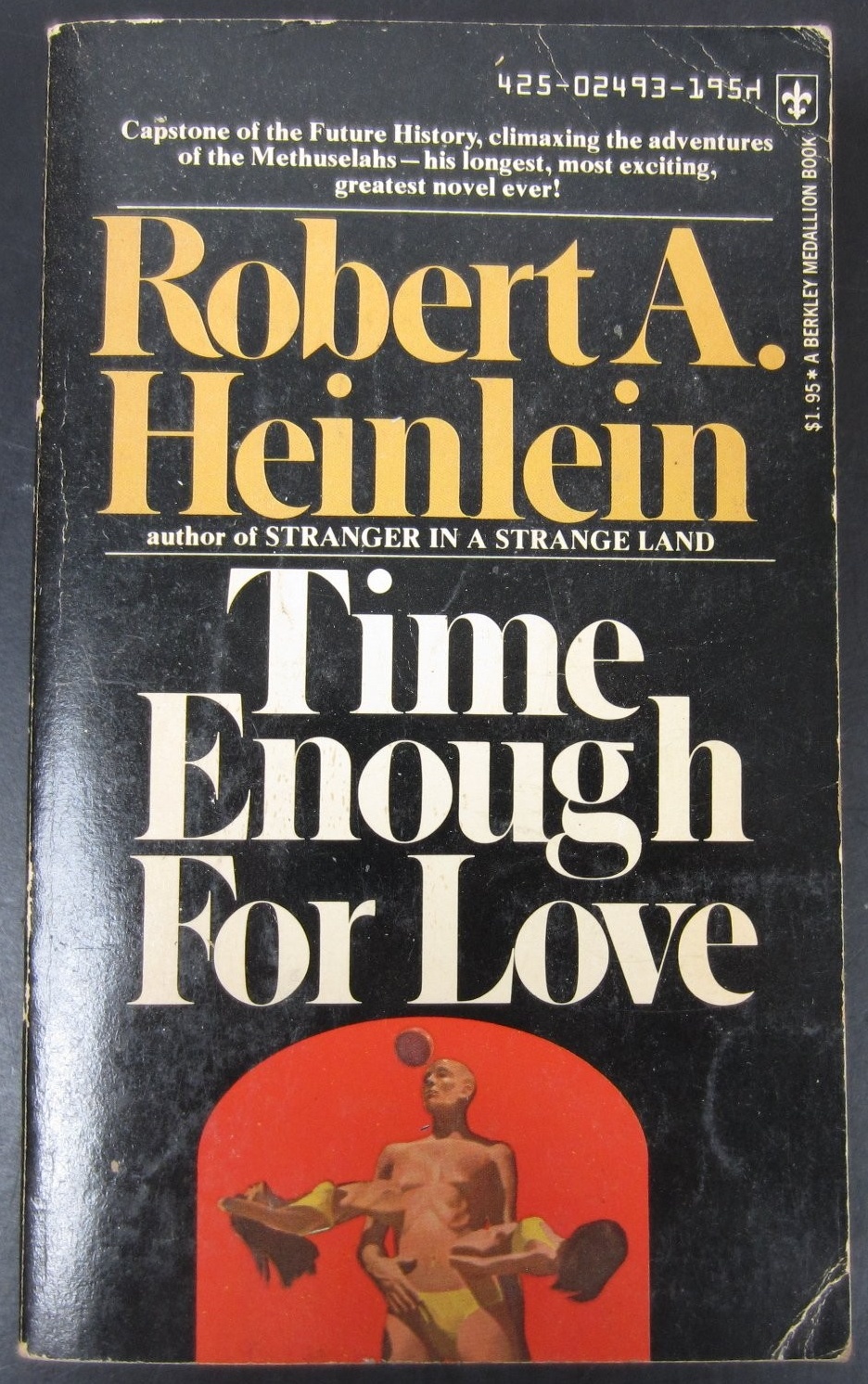
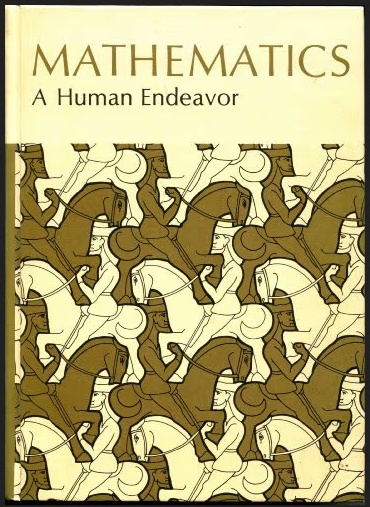
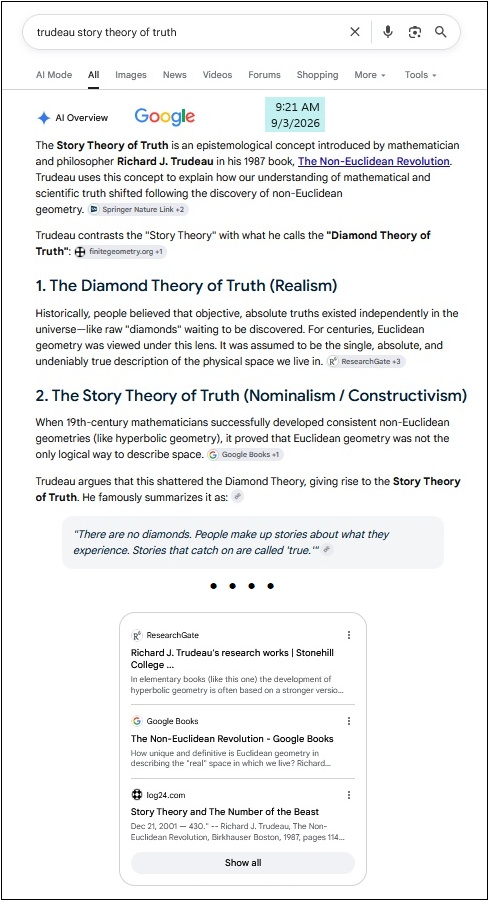
Trudeau's "Story Theory of Truth" and "Diamond Theory of Truth"
may be illustrated by two books I encountered during 1974 . . .
261001-Heinlein-1974-pbk-Time_Enough_for_Love.jpg
261001-Jacobs-Mathematics_a_Human_Endeavor.jpg
"If you have built castles in the air,
your work need not be lost;
that is where they should be.
Now put the foundations under them.”
— Henry David Thoreau
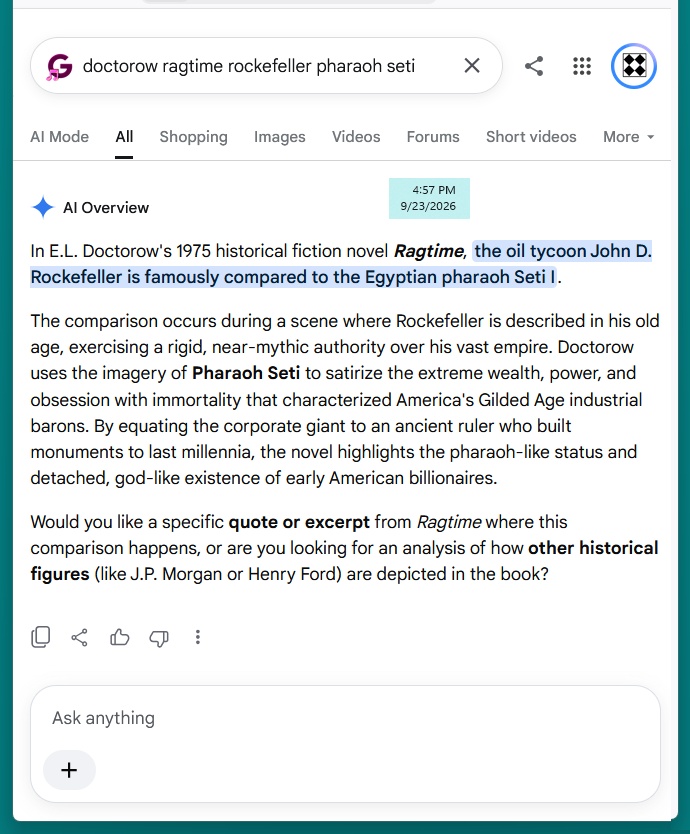
260923-John_D_Rockefeller-as-Pharaoh-in-Ragtime.jpg
Related art . .
|
Google AI Mode, April 28, 2026 —
"An equilateral triangle subdivided into n 2 congruent triangles Refutation (Posted April 29, 2026) —
Correction —
Those who prefer Richard Trudeau's "Story Theory of Truth" Walk like an Egyptian.
|
Revised and corrected (September 23, 2026 @ 18:03:12).
Google AI Mode, April 28, 2026 —
"An equilateral triangle subdivided into n 2 congruent triangles
has a central sub-triangle if and only if n is a multiple of 3
(n ≡ 0 (mod 3))."
Refutation —

Correction —
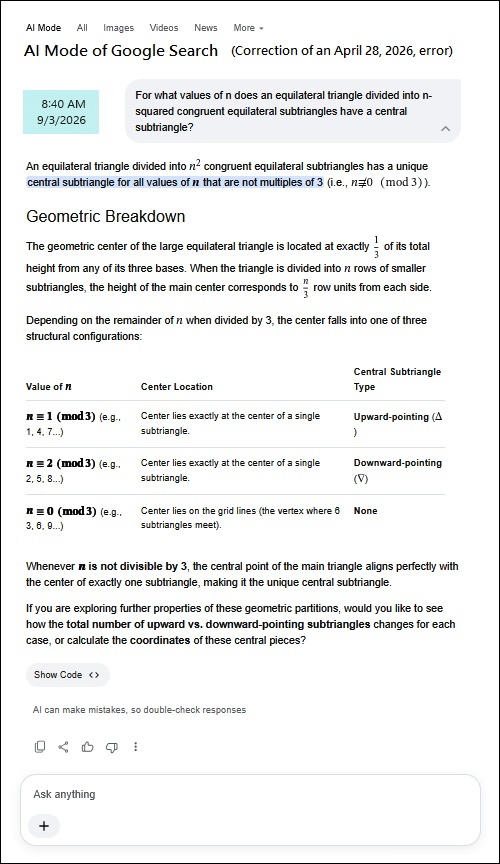
Those who prefer Richard Trudeau's "Story Theory of Truth"
may, if they like, tell a tale titled "The AI and the Pyramid."
Walk like an Egyptian.
260409-Oct_8_2019-Kummer_at_Noon.jpg

For those who prefer Trudeau's "Story Theory of Truth" —
260409-All_Souls_Hootenanny-poster-Oct_8_2019.jpg

Related cultural artifacts . . .
This journal on All Souls' Day 2025 —

260409-Greetings-from-Derry-sign.jpg

http://m759.net/wordpress/?s="six+dimensions+into+three"
The above link is for fans of Richard J. Trudeau's "Story Theory of Truth."
And then from pure mathematics, there is the reduction from eight dimensions
into six of Diamond Theory, in passing from the eight-dimensional affine space
over the two-element Galois field to the six-dimensional affine space used in
Diamond Theory to represent the five-dimensional projective space PG(5,2).
See other posts tagged Klein Space.

For fans of the "story theory of truth" —
An example of artificial stupidity:

The phrases "midpoints of opposite faces" and "essentially
creating a smaller cube" are hallucinated bullshit.
The above AI description was created by inanely parroting
verbiage from the Wikipedia article "Diamond cubic" —
which it credits as a source. (See wider view of search.)
That article contains neither the word "theorem" nor the
phrase "unit cube " from the search-request prompt.
AI, like humans, is likely to fall victim to the notorious
"story theory of truth" purveyed by Richard J. Trudeau.
A real "diamond shape formed within a unit cube" is the
octahedron, one of the five classical Platonic solids.
Fans of the opposing "diamond theory of truth" rejected by
Trudeau may prefer . . .
(Log24, July 1, 2019).
|
Cullinane Diamond Theorem Research Report by https://you.com/?chatMode=research on March 3, 2024 Overview of the Cullinane Diamond Theorem The Cullinane Diamond Theorem is a mathematical concept developed by Steven H. Cullinane that explores the symmetrical properties of certain geometric patterns. It is particularly concerned with the structure of finite projective geometry as it relates to the 35 square patterns found in R. T. Curtis's Miracle Octad Generator (MOG). The theorem asserts that every G-image of a diamond figure D possesses some form of ordinary or color-interchange symmetry. Symmetry and Group Theory The theorem is deeply rooted in group theory, with G being isomorphic to the affine group A on the linear 4-space over the finite field GF(2). This group has a significant order of 322,560 and underlies the symmetry of both the diamond-theorem figures and the square patterns of the MOG . The 35 structures of the 840 G-images of D are isomorphic to the 35 lines in the 3-dimensional projective space over GF(2), which explains the symmetry of the line diagrams and the two-color patterns. The Diamond Theorem in Various Dimensions The diamond theorem can be applied to different cases, such as the 4×4, 2×2, and even 3-dimensional cubes like the 2x2x2 and 4x4x4 cubes. The generalized statement of the theorem involves inscribing a white diamond in a black square and dividing it into four quadrants, each with a diagonal split into black and white halves. Algebraic Implications The theorem has algebraic implications, such as the ability to express every 4-coloring as a sum of three 2-colorings. This algebraic formulation is useful for demonstrating that certain four-colored graphic images can form a ring under multiplication. There is also an infinite family of such 'diamond' rings, isomorphic to rings of matrices over GF(4). Philosophical and Cultural Context Steven H. Cullinane has also explored the philosophical implications of the diamond theorem, referring to it in the context of Plato's Meno dialogue and opposing it to the 'Story Theory of truth' as discussed by Richard J. Trudeau. The theorem is seen as a correct statement of the relation between geometry and the physical universe. Clarification on Cullinan Diamonds It is important to note that the Cullinane Diamond Theorem is unrelated to the Cullinan diamond, which is a famous large gemstone discovered in South Africa and now part of the British Crown Jewels. The Cullinan diamond has its own historical and cultural significance, with its various cut shapes and ownership history. In summary, the Cullinane Diamond Theorem is a mathematical concept that reveals the symmetrical properties of certain geometric patterns, with applications in group theory and algebra. It also has philosophical implications, drawing connections to classical ideas about truth and geometry. |

Instagram ad for You.com AI in research mode
"Show me ALL your sources, babe."
— Line adapted from Leonardo DiCaprio
"Stories are the only way people can absorb information
in any depth" — Stephen Lussier, retired De Beers executive
Related story — De Beer's Consolidated Mine
“Nothing Lasts Forever” will screen at Berlinale
on February 12th at 9 pm at Cubix 7, February 17th
at 9 pm at Cubix 5 and 6, and February 18th at 6 pm
at Cubix 5 and 6. — https://moveablefest.com

See as well "Story Theory of Truth" in this journal.
A post of May 26, 2005, displays, if not the sword,
a place for it —
"The beautiful in mathematics resides in contradiction.
Incommensurability, logoi alogoi, was the first splendor
in mathematics." — Simone Weil, Oeuvres Choisies,
éd. Quarto , Gallimard, 1999, p. 100

Logos Alogos by S. H. Cullinane
"To a mathematician, mathematical entities have their own existence,
they habitate spaces created by their intention. They do things,
things happen to them, they relate to one another. We can imagine
on their behalf all sorts of stories, providing they don't contradict
what we know of them. The drama of the diagonal, of the square…"
— Dennis Guedj, abstract of "The Drama of Mathematics," a talk
to be given this July at the Mykonos conference on mathematics and
narrative. For the drama of the diagonal of the square, see
John Horgan in Scientific American magazine on October 8, 2019 —
"In the early 1990s, I came to suspect that the quest
for a unified theory is religious rather than scientific.
Physicists want to show that all things came from
one thing: a force, or essence, or membrane
wriggling in eleven dimensions, or something that
manifests perfect mathematical symmetry. In their
search for this primordial symmetry, however,
physicists have gone off the deep end . . . ."
Other approaches —
See "Story Theory of Truth" in this journal and, from the November 2019
Notices of the American Mathematical Society . . .
|
More fundamental than the label of mathematician is that of human. And as humans, we’re hardwired to use stories to make sense of our world (story-receivers) and to share that understanding with others (storytellers) [2]. Thus, the framing of any communication answers the key question, what is the story we wish to share? Mathematics papers are not just collections of truths but narratives woven together, each participating in and adding to the great story of mathematics itself. The first endeavor for constructing a good talk is recognizing and choosing just one storyline, tailoring it to the audience at hand. Should the focus be on a result about the underlying structures of group actions? . . . .
[2] Gottschall, J. , The Storytelling Animal , — "Giving Good Talks," by Satyan L. Devadoss |
"Before time began, there was the Cube." — Optimus Prime
The previous post suggests . . .
|
Jim Holt reviewing Edward Rothstein's Emblems of Mind: The Inner Life of Music and Mathematics in The New Yorker of June 5, 1995: "The fugues of Bach, the symphonies of Haydn, the sonatas of Mozart: these were explorations of ideal form, unprofaned by extramusical associations. Such 'absolute music,' as it came to be called, had sloughed off its motley cultural trappings. It had got in touch with its essence. Which is why, as Walter Pater famously put it, 'all art constantly aspires towards the condition of music.' The only art that can rival music for sheer etheriality is mathematics. A century or so after the advent of absolute music, mathematics also succeeded in detaching itself from the world. The decisive event was the invention of strange, non-Euclidean geometries, which put paid to the notion that the mathematician was exclusively, or even primarily, concerned with the scientific universe. 'Pure' mathematics came to be seen by those who practiced it as a free invention of the imagination, gloriously indifferent to practical affairs– a quest for beauty as well as truth." [Links added.] |

A line for James McAvoy —
"Pardon me boy, is this the Transylvania Station?"

See as well Worlds Out of Nothing , by Jeremy Gray.
For fans of the story theory of truth:
A "tale as old as time . . ."
— Song lyric, Beauty and the Beast
Nicholas Hoult as X-Men "Beast" Hank McCoy —

See also the previous post, "Equals Tolkien?"
Related material: The real McCoy —

Earlier posts have discussed the "story theory of truth"
versus the "diamond theory of truth," as defined by
Richard Trudeau in his 1987 book The Non-Euclidean Revolution.
In a New York Times opinion piece for tomorrow's print edition,*
novelist Dara Horn touched on what might be called
"the space theory of truth."
When they return to synagogue, mourners will be greeted
with more ancient words: “May God comfort you
among the mourners of Zion and Jerusalem.”
In that verse, the word used for God is hamakom —
literally, “the place.” May the place comfort you.
[Link added.]
The Source —

See Dara Horn in this journal, as well as Makom.
* "A version of this article appears in print on ,
on Page A23 of the New York edition with the headline:
American Jews Know This Story."
Yesterday's online LA Times had an obituary for a
traveling salesman:
"Besides writing and teaching, Borg was a frequent speaker,
usually racking up 100,000 frequent flier miles a year.
He and Crossan, along with their wives, led annual tours
to Turkey to follow the path of the Apostle Paul and to give
a sense of his world. They also led tours to Ireland to
showcase a different brand of Christianity."
Borg and Crossan were members of the Jesus Seminar.
For Crossan, see remarks on "The Story Theory of Truth."
See also, from the date of Borg's death, a different salesman joke.
Some backstory —


"What we do may be small, but it has
a certain character of permanence."
— G. H. Hardy in A Mathematician's Apology
“For every kind of vampire, there is a kind of cross.” — Gravity’s Rainbow
“I don’t write exclusively on Jewish themes or about Jewish characters.
My collection of short stories, Strange Attractors , contained nine pieces,
five of which were, to some degree, Jewish, and this ratio has provided me
with a precise mathematical answer (for me, still the best kind of answer)
to the question of whether I am a Jewish writer. I am five-ninths a Jewish writer.”
— Rebecca Goldstein, “Against Logic”
Midrashim for Rebecca:
The Diamond Theory vs. the Story Theory (of truth)
Story Theory and the Number of the Beast
The Palm Sunday post “Gray Space”
For those who prefer the diamond theory of truth,
a “precise mathematical” view of a Gray code —

For those who prefer the story theory of truth,
Thursday with the Nashes —
The actors who portrayed Mr. and Mrs. John Nash in
‘A Beautiful Mind’ now portray Mr. and Mrs. Noah…

On The Blazing World , a new novel —
“Hustvedt uses fragment-stories, frame narratives, and unreliable
narrators to talk about the ways in which brilliant women across
history have been silenced, forgotten, and appropriated by men.
This is a narrative suspicious of narratives, a story that
demonstrates how damaging stories can be.”
— Review by Amal El-Mohtar
The protagonist of Hustvedt’s novel is named Harriet Burden.
A midrash for Darren Aronofsky, director of The Fountain* and Noah—
Part I: The Burden of Proof —

Part II: The Story of Noam —

* See The Fountain in “The Story Theory of Truth,” Columbus Day, 2013
New! Improved!

"Euclid's edifice loomed in my consciousness
as a marvel among sciences, unique in its
clarity and unquestionable validity."
—Richard J. Trudeau in
The Non-Euclidean Revolution (First published in 1986)
Readers of this journal will be aware that Springer's new page
advertising Trudeau's book, pictured above, is a bait-and-switch
operation. In the chapter advertised, Trudeau promotes what he
calls "the Diamond Theory of Truth" as a setup for his real goal,
which he calls "the Story Theory of Truth."
For an earlier use of the phrase "Diamond Theory" in
connection with geometry, see a publication from 1977.
For clergymen who embrace Trudeau's
"Story Theory of Truth" (see last evening's
7:20 PM post on geometry and A Wrinkle in Time )…
Here are two meditations suggested by
yesterday evening's New York Lottery :
1. Page 141 in Philosophies of India—

2. Post 4658 in this journal— A Wrinkle in Dimensions.
A review of two theories of truth described
by a clergyman, Richard J. Trudeau, in
The Non-Euclidean Revolution—
"But, I asked, is there a difference
between fiction and nonfiction?
'Not much,' she said, shrugging."
— New Yorker profile of tesseract
author Madeleine L'Engle
(Click image for some background.)

See also the links on a webpage at finitegeometry.org.
Readings—
An 1978 counterexample to Richard J. Trudeau's
1987 "Story Theory of truth" is now online.
From math16.com—
Quotations on Realism
|
The story of the diamond mine continues
(see Coordinated Steps and Organizing the Mine Workers)—
From The Search for Invariants (June 20, 2011):
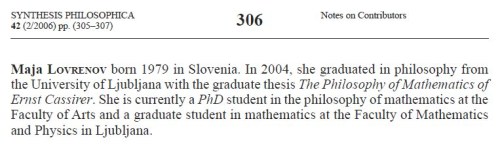
The conclusion of Maja Lovrenov's
"The Role of Invariance in Cassirer’s Interpretation of the Theory of Relativity"—
"… physical theories prove to be theories of invariants
with regard to certain groups of transformations and
it is exactly the invariance that secures the objectivity
of a physical theory."
— SYNTHESIS PHILOSOPHICA 42 (2/2006), pp. 233–241
Related material from Sunday's New York Times travel section—
Powered by WordPress