
Saturday, November 4, 2023
Plan 9 from New Haven . . .
Comments Off on Plan 9 from New Haven . . .
Wednesday, November 11, 2020
An Ordinary Evening in New Haven


Prof. Coleman Silk introducing freshmen to academic values
“The communication
of the dead is tongued with fire
beyond the language of the living.”
— T. S. Eliot, Four Quartets
Comments Off on An Ordinary Evening in New Haven
Tuesday, October 8, 2019
An Ordinary Day in New Haven

This journal on the date of Coe's death —

Related material: Today's noon post and a post from August 7, 2006.
Comments Off on An Ordinary Day in New Haven
Thursday, February 2, 2017
An Object for New Haven
The title was suggested by a Wallace Stevens poem.
See "The Thing and I" in this journal. See also
Words and Objects according to Whorf —

— Page 240 of Language, Thought, and Reality , MIT, 1956,
in the article "Languages and Logic," reprinted from
Technol. Rev. , 43: 250-252, 266, 268, 272 (April 1941)
Comments Off on An Object for New Haven
Friday, January 15, 2016
An Ordinary Morning in New Haven

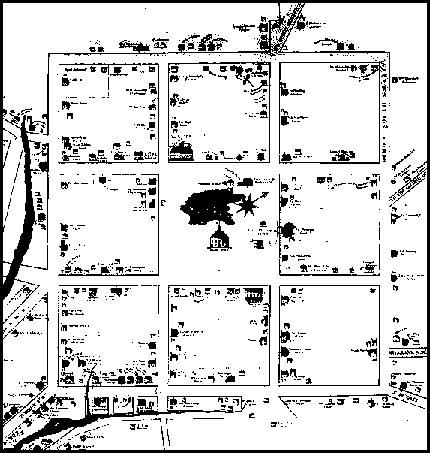
Click the above image for a web page on the question
"Why was New Haven divided into nine squares?".
Comments Off on An Ordinary Morning in New Haven
Friday, September 18, 2015


Sunday, January 1, 2023
Alpha
Wallace Stevens —
"Reality is the beginning not the end,
Naked Alpha, not the hierophant Omega,
Of dense investiture, with luminous vassals."
— “An Ordinary Evening in New Haven” VI

Comments Off on Alpha
Monday, August 2, 2021
Savage Stevens
http://www.wallacestevens.com/concordance/
savage
Your query matched 15 lines
An Ordinary Evening in New Haven (iv)
Stanza: 61; Line Number: 7
They only know a savage assuagement cries
Stanza: 62; Line Number: 8
With a savage voice; and in that cry they hear
Stanza: 64; Line Number: 10
In a savage and subtle and simple harmony,
Credences of Summer (vii)
Stanza: 101; Line Number: 11
The object, grips it in savage scrutiny,
Examination of the Hero in a Time of War (ii)
Stanza: 26; Line Number: 12
And rainbow sortilege, the savage weapon
Exposition of the Contents of a Cab (OP)
Line Number: 12
And savage blooms;
From the Journal of Crispin (II) (OP)
Stanza: 114; Line Number: 20
Into a savage color he goes on.
Gubbinal
Line Number: 9
That savage of fire,
Less and Less Human, O Savage Spirit
Title
Less and Less Human, O Savage Spirit
Page from a Tale
Line Number: 20
They looked back at Hans’ look with savage faces.
Sunday Morning (vii)
Stanza: 95; Line Number: 5
Naked among them, like a savage source.
The Comedian as the Letter C, ii: Concerning the Thunderstorms of Yucatan
Stanza: 14; Line Number: 14
Into a savage color he went on.
The Man with the Blue Guitar (iii)
Stanza: 29; Line Number: 9
To bang it from a savage blue,
The Pediment of Appearance
Line Number: 10
The savage transparence. They go crying
The World as Meditation
Line Number: 6
Whose mere savage presence awakens the world in which she dwells.
_________________________________________________________________________
Online Concordance to Wallace Stevens’s Poetry
Comments Off on Savage Stevens
Monday, July 19, 2021
Interior/Exterior . . .
Or: Dreaming of Dinner-Party-Gate
|
An Ordinary Evening in New Haven, XXII
Professor Eucalyptus said, “The search
For an interior made exterior
With the Inhalations of original cold
Not the predicate of bright origin.
The cold and earliness and bright origin
That it is wholly an inner light, that it shines — Wallace Stevens |
For those who prefer not-so-sleepy bosoms, here are two
interior/exterior design notes suggested by the previous post —
Interior:

Exterior:

Comments Off on Interior/Exterior . . .
Monday, July 5, 2021
Do Hillbillies Dream of Dinner Parties?
The title was suggested by a New Yorker photo caption
about Yale on June 19, 2021 —
"Amy Chua, a celebrity professor at the top-ranked
law school in the country, is at the center of a
campus-wide fracas known as 'Dinner Party-gate.' "
Other recent Yale material —

Remarks related to New Haven and geometry —
.jpg)
Comments Off on Do Hillbillies Dream of Dinner Parties?
Thursday, April 15, 2021
A Pythagorean Letter*
See other posts now tagged Yale Weekend.
That weekend, Sat. Nov. 23 — Sun. Nov. 24, 2013,
saw the death of Yale professor Sam See
in a New Haven Jail.
Related literary remarks:
Search "Merve Emre" + "Sam See."
* Vide Log24 references.
Comments Off on A Pythagorean Letter*
Friday, November 13, 2020
Raiders of the Lost Dorm Room
“That really is, really, I think, the Island of the Misfit Toys at that point.
You have crossed the Rubicon, you jumped on the crazy train and
you’re headed into the cliffs that guard the flat earth at that time, brother,”
said Rep. Denver Riggleman, a Republican congressman from Virginia,
in an interview."
— Jon Ward, political correspondent, Yahoo News , Nov. 12, 2020
The instinct for heaven had its counterpart:
The instinct for earth, for New Haven, for his room,
The gay tournamonde as of a single world
In which he is and as and is are one.
— Wallace Stevens, "An Ordinary Evening in New Haven"
Related material for comedians —

See as well Sallows in this journal.
“There exists a considerable literature
devoted to the Lo shu , much of it infected
with the kind of crypto-mystic twaddle
met with in Feng Shui.”
— Lee C. F. Sallows, Geometric Magic Squares ,
Dover Publications, 2013, page 121
Comments Off on Raiders of the Lost Dorm Room
Sunday, January 5, 2020
The Vulgate of Experience
"The eye’s plain version is a thing apart,
The vulgate of experience."
— Wallace Stevens, opening lines of
"An Ordinary Evening in New Haven"
Real architectural detail from a New Year's
Netflix fiction —

Click for context.
See as well a similar architectural detail in
a Log24 post of June 21, 2010.
Comments Off on The Vulgate of Experience
Wednesday, November 13, 2019
Starlight Like Intuition
See the title phrase, by Delmore Schwartz, in this journal.
See also . . .
|
From Daniel Rockmore's CV — BOOKS, FILMS, EXHIBITS . . . . Concinnitas , a fine art print project with Parasol Press, Yale Art Gallery, and Bernard Jacobson Galleries. Openings at AnneMarie Verna Gallery (Zurich, SZ, Dec. 2014), Elizabeth Leach Gallery (Portland, OR, Jan. 2015), Greg Kucera Gallery (Seattle, WA, Jan. 2015), Yale Art Gallery (New Haven, CT, Jan. 2015). . . . . |
. . . and Concinnitas in this journal … as well as — related to a formula
from the Concinnitas project — "Thirteen??" by David Mumford.
Comments Off on Starlight Like Intuition
Saturday, November 2, 2019
Plan 9 Continues.
"So, after summer, in the autumn air,
Comes the cold volume of forgotten ghosts,
But soothingly, with pleasant instruments,
So that this cold, a children's tale of ice,
Seems like a sheen of heat romanticized."
— Wallace Stevens,
"An Ordinary Evening in New Haven"

The German title of "The Recruit" (released Jan. 31, 2003)
is "Der Einsatz." Its MacGuffin is "'Ice 9."
Comments Off on Plan 9 Continues.
Wednesday, October 9, 2019
Philosophical Infanticide
From Wallace Stevens —
"Reality is the beginning not the end,
Naked Alpha, not the hierophant Omega,
Of dense investiture, with luminous vassals."
— “An Ordinary Evening in New Haven” VI
From The Point magazine yesterday, October 8, 2019 —
Parricide: On Irad Kimhi's Thinking and Being .
Book review by Steven Methven.
The conclusion:
"Parricide is nothing that the philosopher need fear . . . .
What sustains can be no threat. Perhaps what the
unique genesis of this extraordinary work suggests is that
the true threat to philosophy is infanticide."
This remark suggests revisiting a post from Monday —
|
Monday, October 7, 2019
Berlekamp Garden vs. Kinder Garten
|
Comments Off on Philosophical Infanticide
Monday, October 7, 2019
Lenz
Or: Je repars .
From Wallace Stevens —
"Reality is the beginning not the end,
Naked Alpha, not the hierophant Omega,
Of dense investiture, with luminous vassals."
— “An Ordinary Evening in New Haven” VI
Mathematician Hanfried Lenz reportedly died in Berlin on June 1, 2013.
This journal that weekend —

Comments Off on Lenz
Friday, August 9, 2019
The Next Thing

From posts tagged The Next Thing —
|
… an apt illustration can be found on the cover of
See also Stevens's use of the phrase "heaven-haven"
… Todo lo sé por el lucero puro – Rubén Darío
An academic work from 2003 discusses Stevens's "Notes" Note that "perfect" means "complete, finished, done." |
Comments Off on The Next Thing
Thursday, January 11, 2018
The Bourne Report
From the Hannah Goldfield link in today's 7 AM ET
post "In the Bag" —
"… the bride . . . . is a daughter of Gaylord Bourne and
Carl Goldfield of New Haven."
— Wedding story, New York Times , Oct. 18, 2015
A search indicates that Bourne may be the person of that name
associated with Achievement First charter schools.
Here is a related story from today's online New York Times —
"Can a ‘No Excuses’ Charter Teach Students
to Think for Themselves?" (11:40 AM ET)
Comments Off on The Bourne Report
Monday, November 13, 2017
Plan 9 at Yale
Yale Professors Race Google and IBM to the First Quantum Computer
"So, after summer, in the autumn air,
Comes the cold volume* of forgotten ghosts,
But soothingly, with pleasant instruments,
So that this cold, a children's tale of ice,
Seems like a sheen of heat romanticized."
— Wallace Stevens,
"An Ordinary Evening in New Haven"
* Update of 10:20 the same evening:
|
An alternative to The Snow Queen On The King in the Window , by Adam Gopnik —
"The book is dedicated to Adam Gopnik's son,
'A fantasy that is as ambitious in theme,
The unlikely eponymous hero is Oliver Parker,
His enemy is the dreaded Master of Mirrors,
Oliver's mission is to defeat the Master of Mirrors — Description at https://biblio.co.nz/. . . . |
Comments Off on Plan 9 at Yale
Monday, April 24, 2017
The Trials of Device
"A blank underlies the trials of device"
— Wallace Stevens, "An Ordinary Evening in New Haven" (1950)
A possible meaning for the phrase "the trials of device" —

See also Log24 posts mentioning a particular device, the pentagram .
For instance —


Comments Off on The Trials of Device
Tuesday, March 21, 2017
Res Ipsa

Comments Off on Res Ipsa
Thursday, March 9, 2017
Yale Architectural Figure

See also Log24 posts related to "Go Set a Structure"
as well as "New Haven" + Grid.
Comments Off on Yale Architectural Figure
Tuesday, July 19, 2016
Interior, Exterior
The post Outer, Inner of July 16, 2016, contained the following
illustration of a quote from "An Ordinary Evening in New Haven" —

An image from yesterday morning pictured a link to the
Feb. 10, 2014, post Mystery Box III: Inside, Outside.
That post, shown below, offers a deeper interpretation of the
Stevens quote "an interior made exterior."
(Click image below to use the post's links.)

Comments Off on Interior, Exterior
Saturday, July 16, 2016
Outer, Inner
A detail from this morning's 6 AM post —
|
An Ordinary Evening in New Haven, XXII
Professor Eucalyptus said, “The search
For an interior made exterior
With the Inhalations of original cold
Not the predicate of bright origin.
The cold and earliness and bright origin
That it is wholly an inner light, that it shines — Wallace Stevens |
See also Bloomsday 2007, "Obituaries in the News."
This morning's 6 AM post linked to a more recent obituary in the news —
"… while Jules and Judy were still living in Brooklyn Heights …
Jules collaborated with his former roommate, Norton Juster,
by illustrating what was to become the children’s classic
The Phantom Tollbooth . Neither author or illustrator had
a clue as to how to get this unlikely work published, and it
was Judy’s idea to take it to a mutual friend . . . ."

Comments Off on Outer, Inner
Sunday, November 29, 2015
There the Dance Is

In memory of ballet designer
Yolanda Sonnabend, who
reportedly died at 80 on Nov. 9,
see posts on Apollo, Ballet Blanc,
maps of New Haven, etc., etc., etc.
Comments Off on There the Dance Is
Tuesday, May 12, 2015
Writing Well*
See Stevens + New Haven.
* The above figure may be viewed as
the Chinese “Holy Field” or as the
Chinese character for “Well”
inscribed in a square.
Comments Off on Writing Well*
Wednesday, February 11, 2015
Dead Reckoning
Continued from yesterday evening

Today's mathematical birthday —
Claude Chevalley, 11 Feb. 1909 – 28 June 1984.
|
Chevalley's daughter, Catherine Chevalley, wrote about For him it was important to see questions as a whole, to see the necessity of a proof, its global implications. As to rigour, all the members of Bourbaki cared about it: the Bourbaki movement was started essentially because rigour was lacking among French mathematicians, by comparison with the Germans, that is the Hilbertians. Rigour consisted in getting rid of an accretion of superfluous details. Conversely, lack of rigour gave my father an impression of a proof where one was walking in mud, where one had to pick up some sort of filth in order to get ahead. Once that filth was taken away, one could get at the mathematical object, a sort of crystallized body whose essence is its structure. When that structure had been constructed, he would say it was an object which interested him, something to look at, to admire, perhaps to turn around, but certainly not to transform. For him, rigour in mathematics consisted in making a new object which could thereafter remain unchanged. The way my father worked, it seems that this was what counted most, this production of an object which then became inert— dead, really. It was no longer to be altered or transformed. Not that there was any negative connotation to this. But I must add that my father was probably the only member of Bourbaki who thought of mathematics as a way to put objects to death for aesthetic reasons. |
Recent scholarly news suggests a search for Chapel Hill
in this journal. That search leads to Transformative Hermeneutics.
Those who, like Professor Eucalyptus of Wallace Stevens's
New Haven, seek God "in the object itself" may contemplate
yesterday's afternoon post on Eightfold Design in light of the
Transformative post and of yesterday's New Haven remarks and
Chapel Hill events.
Comments Off on Dead Reckoning
Tuesday, February 10, 2015
En Masse
Yale Daily News staff columnist Scott Greenberg today,
in a piece titled "Filling Religion's Void" —
"The secularization of college students in America
has seemed a foregone conclusion for some time,
yet it represents a momentous shift for our university
and society at large that we have not yet
come to grips with….
Is the solution for our society and our University
to return to religion en masse?"
So to speak.
A Midrash for Greenberg:
An Ordinary Evening in New Haven
Meets an Evening in the Garden of Allah —

Comments Off on En Masse
Friday, January 16, 2015
A versus PA
"Reality is the beginning not the end,
Naked Alpha, not the hierophant Omega,
of dense investiture, with luminous vassals."
— “An Ordinary Evening in New Haven” VI
From the series of posts tagged "Defining Form" —
The 4-point affine plane A and
the 7-point projective plane PA —

The circle-in-triangle of Yale's Figure 30b (PA ) may,
if one likes, be seen as having an occult meaning.
For the mathematical meaning of the circle in PA
see a search for "line at infinity."
A different, cubic, model of PA is perhaps more perspicuous.
Comments Off on A versus PA
Sunday, November 23, 2014
Remarks on Reality
Wallace Stevens in "An Ordinary Evening in New Haven"
(1950) on "The Ruler of Reality" —
"Again, 'He has thought it out, he thinks it out,
As he has been and is and, with the Queen
Of Fact, lies at his ease beside the sea.'"
One such scene, from 1953 —

Another perspective, from "The Osterman Weekend" (1983) —

Comments Off on Remarks on Reality
Tuesday, October 7, 2014
As Is
"That simple operator, 'as,' turns out to carry within its philosophical grammar
a remarkable complex field* of operations…."
— Charles Altieri, Painterly Abstraction in Modernist American Poetry,
Cambridge University Press, 1989, page 343
See also Rota on Heidegger (What "As" Is, July 6, 2010), and Lead Belly
on the Rock Island Line — "You got to ride it like you find it."
* Update of Oct. 10, 2014: See also "Complex + Grid" in this journal.
Comments Off on As Is
Thursday, November 28, 2013
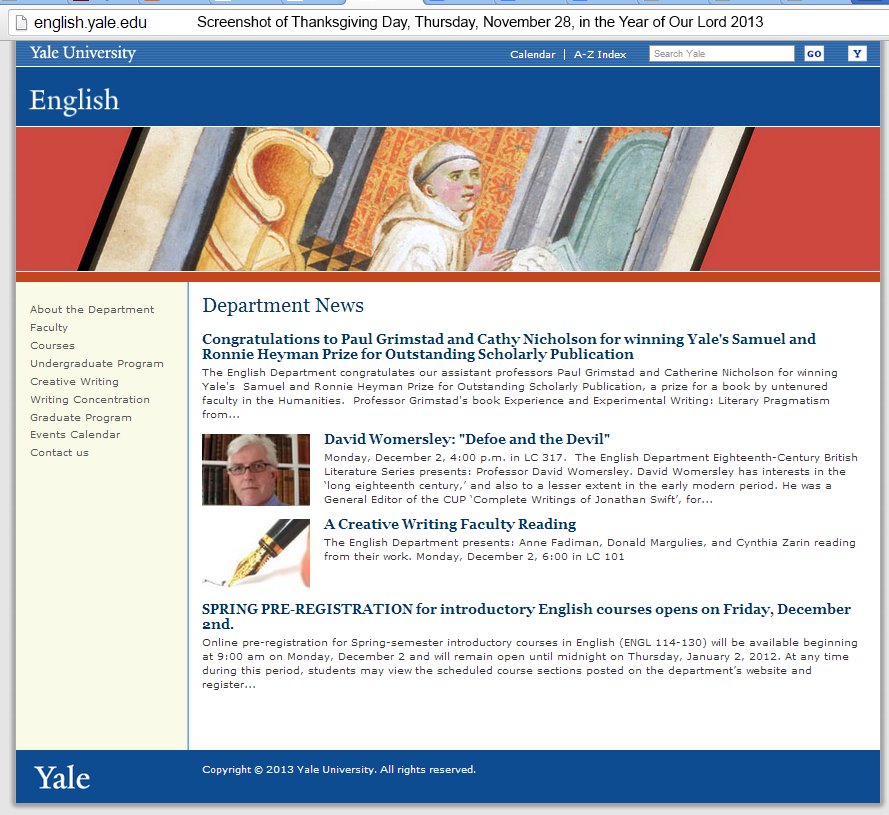
Goal
From "Why Was New Haven Divided into Nine Squares?"
"Of note on the Wadsworth Map of 1748 are…
the Grammar School, the 'Goal' or jail…."
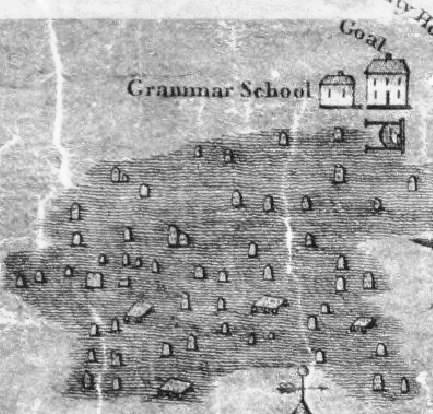
Related material: Puritan in this journal.
Non-Puritans may prefer the following image—

Source: Yale English Department banner
Comments Off on Goal
Thanksgiving
Continued from Deo Gratias , a post at noon last Saturday
that featured blues singer R. L. Burnside.
"It is a fresh spiritual that he defines"
— "An Ordinary Evening in New Haven"

Comments Off on Thanksgiving
Wednesday, November 27, 2013
The Professor’s Death
A Yale death between Saturday night and Sunday morning—
|
See is not believed to have committed suicide, according to
Judicial Department spokeswoman Rhonda Hebert
Mr. Samuel See was delivered to the |
Comments Off on The Professor’s Death
Monday, August 26, 2013
Dark Side Tales
"Got to keep the loonies on the path."
— Lyrics to Dark Side of the Moon
For those who, like Tom Stoppard, prefer the dark side—
|
NEW ANGLE:
INT. OFFICE BUILDING – NIGHT
NIGHT WATCHMAN
Bateman wheels around and shoots him.
NEW ANGLE:
INT. PIERCE & PIERCE LOBBY – NIGHT
— AMERICAN PSYCHO |
Not quite so dark—
"And then one day you find ten years have got behind you."
— Lyrics to Dark Side of the Moon
This journal ten years ago, on August 25, 2003—
|
… We seek
The poem of pure reality, untouched
At the exactest point at which it is itself,
The eye made clear of uncertainty, with the sight
Everything, the spirit's alchemicana
The solid, but the movable, the moment,
— Wallace Stevens, "An Ordinary Evening |
"A view of New Haven, say…." —
"This is the garden of Apollo,
the field of Reason…."
John Outram, architect
A similar version of this Apollonian image —

Detail:

Related material for the loonies:
Comments Off on Dark Side Tales
Tuesday, January 8, 2013
Vermont Throws Itself Together
"The way, when we climb a mountain,
Vermont throws itself together"
— Wallace Stevens, "July Mountain"

For another view of reality in New Haven, see the
brief biography of Vermont poet Frances Frost
at the Yale University Library. From that biography:
"She was survived by her son, the poet Paul Blackburn,
and by her daughter, Sister Marguerite of the Order
of St. Joseph."
See also a figure from The New York Times published
online on Epiphany, 2013:

Comments Off on Vermont Throws Itself Together
Tuesday, April 10, 2012
Death on Good Friday
|
Edward Reed Whittemore Jr. was born |
In memoriam:
PART I —

PART II —
Comments Off on Death on Good Friday
Wednesday, February 8, 2012
Old Sport


Comments Off on Old Sport
Tuesday, February 7, 2012
Random Walk
Comments Off on Random Walk
Saturday, October 8, 2011
An Ordinary Evening in Hartford
From Rebecca Goldstein's Talks and Appearances page—
• "36 (Bad) Arguments for the Existence of God,"
Annual Meeting of the Freedom from Religion Foundation,
Marriot, Hartford, CT, Oct 7 [2011], 7 PM
From Wallace Stevens—
"Reality is the beginning not the end,
Naked Alpha, not the hierophant Omega,
of dense investiture, with luminous vassals."
— “An Ordinary Evening in New Haven” VI
For those who prefer greater depth on Yom Kippur, yesterday's cinematic link suggests…
"Yo sé de un laberinto griego que es una línea única, recta."
—Borges, "La Muerte y la Brújula " ("Death and the Compass")
See also Alpha and Omega (Sept. 18, 2011) and some context from 1931.
Comments Off on An Ordinary Evening in Hartford
Thursday, September 1, 2011
Boundary (continued*)
It is now midnight. Yesterday was Odin's Day. Today is Thor's Day.
From a weblog post on Captain America and Thor—
"While all this [Captain America] is happening an SS officer, Johann Schmidt (Hugo Weaving), has found a religious artefact called the Tesseract which Schmidt describes as 'the jewel of Odin’s treasure room,' linking it in with the Thor storyline."
— That's Entertainment weblog, August 14, 2011
From Wallace Stevens, "An Ordinary Evening in New Haven," Canto III—
The point of vision and desire are the same.
It is to the hero of midnight that we pray
On a hill of stones to make beau mont thereof.
Captain America opened in the United States on Friday, July 22, 2011.
Thor opened in the United States on Friday, May 6, 2011.
"There is such a thing as a tesseract." —A Wrinkle in Time
* Continued from August 30.
Comments Off on Boundary (continued*)
Wednesday, June 15, 2011
A for Anastasios
The title was suggested by this evening's 4-digit NY lottery number.
"… the rhetoric might be a bit over the top."

According to Amazon.com, 2198 (i.e., 2/1/98) was the publication
date of Geometry of Vector Sheaves , Volume I, by Anastasios Mallios.
Related material—
The question of S.S. Chern quoted here June 10: —
"What is Geometry?"— and the remark by Stevens that
accompanied the quotation—
"Reality is the beginning not the end,
Naked Alpha, not the hierophant Omega,
of dense investiture, with luminous vassals."
— Wallace Stevens,
“An Ordinary Evening in New Haven” VI
The work of Mallios in pure mathematics cited above seems
quite respectable (unlike his later remarks on physics).
His Vector Sheaves appears to be trying to explore new territory;
hence the relevance of Stevens's "Alpha." See also the phrase
"A-Invariance" in an undated preprint by Mallios*.
For the evening 3-digit number, 533, see a Stevens poem—

This meditation by Stevens is related to the female form of Mallios's Christian name.
As for the afternoon numbers, see "62" in The Beauty Test (May 23, 2007), Geometry and Death, and "9181" as the date 9/1/81.
* Later published in International Journal of Theoretical Physics , Vol. 47, No. 7, cover date 2008-07-01
Comments Off on A for Anastasios
Friday, June 10, 2011
Hierophant
Some background for yesterday’s posts:
Midrash for Gnostics and related notes,
as well as yesterday’s New York Lottery.
…. “We seek
The poem of pure reality, untouched
By trope or deviation, straight to the word,
Straight to the transfixing object, to the object
At the exactest point at which it is itself,
Transfixing by being purely what it is….”
— Wallace Stevens (1879-1955),
“An Ordinary Evening in New Haven” IX
“Reality is the beginning not the end,
Naked Alpha, not the hierophant Omega,
of dense investiture, with luminous vassals.”
— Wallace Stevens,
“An Ordinary Evening in New Haven” VI
“A hierophant is a person who brings religious congregants into the presence of that which is deemed holy . The word comes from Ancient Greece, where it was constructed from the combination of ta hiera , ‘the holy,’ and phainein , ‘to show.’ In Attica it was the title of the chief priest at the Eleusinian Mysteries. A hierophant is an interpreter of sacred mysteries and arcane principles.”
Weyl as Alpha, Chern as Omega—

Postscript for Ellen Page, star of “Smart People”
and of “X-Men: The Last Stand“— a different page 679.
Your assignment, should you choose to accept it—
Interpret today’s NY lottery numbers— Midday 815, Evening 888.
My own bias is toward 815 as 8/15 and 888 as a trinity,
but there may be less obvious and more interesting approaches.
Comments Off on Hierophant
Wednesday, May 11, 2011
Succor
This morning's online New York Times on Paul Simon's latest show—
"Here was salvation and succor…."
The review mentions a song from Simon's new album that he did not play at last night's show—
Salvation:
After you climb up the ladder of time
The Lord God is near
Face-to-face in the vastness of space
Your words disappear
Succor:
You got to fill out a form first
And then you wait in the line
Simon is an accomplished poet, but I prefer Wallace Stevens.
… A figure like Ecclesiast,
Rugged and luminous, chants in the dark
A text that is an answer, although obscure.
— Wallace Stevens, “An Ordinary Evening in New Haven”
For clues about such a text, see yesterday's New York Lottery numbers.

Comments Off on Succor
Saturday, February 5, 2011
Zen and the Art of Philosophy
| An Ordinary Evening in New Haven | |
|---|---|
| line 540 (xxx.18): | In which hundreds of eyes, in one mind, see at once. |
The cover art of a 1976 monograph, "Diamond Theory," was described in this morning's post.
As Madeleine L'Engle noted in 1976, the cover art resembles the character Proginoskes in her novel A Wind in the Door.
A search today for Proginoskes yields a description by Brendan Kidwell…

A link at Kidwell's site leads to a weblog by Jeff Atwood, a founder of Stack Overflow, a programmers' question-and-answer site.
(Stack Overflow is said to have inspired the similar site for mathematicians, Math Overflow.)
Yesterday Atwood discussed technical writing.
This suggests a look at Robert M. Pirsig on that subject in his 1974 philosophical novel Zen and the Art of Motorcycle Maintenance.
(See also a document on Pirsig's technical-writing background.)
Pirsig describes his novel as "a sort of Chautauqua."
This, together with the Stevens and Proginoskes quotes above, leads back to the Log24 Feb. 1 post The Search.
An image from that post (click to enlarge)—

Here the apparently fragmented nature of the set of
images imagined as rising above the podium of the
Hall of Philosophy at Chautauqua rather naturally
echoes Stevens's "hundreds of eyes" remark.
Comments Off on Zen and the Art of Philosophy
Thursday, February 3, 2011
Brightness at Noon (continued)
"The predicate of bright origin"
— A phrase of Wallace Stevens from "An Ordinary Evening in New Haven" (1950)
Perhaps the predicate Stevens means is "bright."
If so, an apt illustration can be found on the cover of
the 1943 first edition of Hesse's Glasperlenspiel—

See also Stevens's use of the phrase "heaven-haven" in "Notes" (1942),
the original plan of New Haven, and related scholia in this journal.

… Todo lo sé por el lucero puro
que brilla en la diadema de la Muerte.
– Rubén Darío
An academic work from 2003 discusses Stevens's "Notes" as
"a perfect geometric whole."
Note that "perfect" means "complete, finished, done."
Comments Off on Brightness at Noon (continued)
Tuesday, February 1, 2011
The Search
An image suggested by last night's PBS hour "Chautauqua: An American Narrative"—
Click for larger versions of the image search and of the Hall of Philosophy.
Both the screenshot and the Chautauqua photo (by jbi46 at flickr.com) were taken on July 19th, 2010.
The screenshot appeared in the post "Pediments of Appearance" (which also included two much less complex images).
Some background — A webpage on Analytical Cubism and a related search in this journal.
From Wallace Stevens, who appears at top center in the image above—
An Ordinary Evening in New Haven, XXII
Professor Eucalyptus said, “The search
For reality is as momentous as
The search for god.” It is the philosopher’s search
For an interior made exterior
And the poet’s search for the same exterior made
Interior: breathless things broodingly abreath
With the Inhalations of original cold
And of original earliness. Yet the sense
Of cold and earliness is a daily sense,
Not the predicate of bright origin.
Creation is not renewed by images
Of lone wanderers. To re-create, to use
The cold and earliness and bright origin
Is to search. Likewise to say of the evening star,
The most ancient light in the most ancient sky,
That it is wholly an inner light, that it shines
From the sleepy bosom of the real, re-creates,
Searches a possible for its possibleness.
Comments Off on The Search
Wednesday, August 26, 2009
Wednesday August 26, 2009
“When New Haven was founded, the city was laid out into a grid of nine squares surrounded by a great wilderness.
Last year [2000] History of Art Professor Emeritus Vincent Scully said the original town plan reflected a feeling that the new city should be sacred.
Scully said the colony’s founders thought of their new Puritan settlement as a ‘nine-square paradise on Earth, heaven on earth, New Haven, New Jerusalem.'”
— Yale Daily News, Jan. 11, 2001
“Real and unreal are two in one:
New Haven
Before and after one arrives….”
— Wallace Stevens,
“An Ordinary Evening
in New Haven,” XXVIII
See also Art and Man at Yale.
Comments Off on Wednesday August 26, 2009
Friday, April 17, 2009
Friday April 17, 2009
Begettings of
the Broken Bold
Thanks for the following
quotation (“Non deve…
nella testa“) go to the
weblog writer who signs
himself “Conrad H. Roth.”
|
… Yesterday I took leave of my Captain, with a promise of visiting him at Bologna on my return. He is a true A PAPAL SOLDIER’S IDEAS OF PROTESTANTS 339 representative of the majority of his countrymen. Here, however, I would record a peculiarity which personally distinguished him. As I often sat quiet and lost in thought he once exclaimed “Che pensa? non deve mai pensar l’uomo, pensando s’invecchia;” which being interpreted is as much as to say, “What are you thinking about: a man ought never to think; thinking makes one old.” And now for another apophthegm of his; “Non deve fermarsi l’uomo in una sola cosa, perche allora divien matto; bisogna aver mille cose, una confusione nella testa;” in plain English, “A man ought not to rivet his thoughts exclusively on any one thing, otherwise he is sure to go mad; he ought to have in his head a thousand things, a regular medley.” Certainly the good man could not know that the very thing that made me so thoughtful was my having my head mazed by a regular confusion of things, old and new. The following anecdote will serve to elucidate still more clearly the mental character of an Italian of this class. Having soon discovered that I was a Protestant, he observed after some circumlocution, that he hoped I would allow him to ask me a few questions, for he had heard such strange things about us Protestants that he wished to know for a certainty what to think of us. |
Notes for Roth:
The title of this entry,
“Begettings of the Broken Bold,”
is from Wallace Stevens’s
“The Owl in the Sarcophagus”–
This was peace after death, the brother of sleep, The inhuman brother so much like, so near, Yet vested in a foreign absolute, Adorned with cryptic stones and sliding shines, An immaculate personage in nothingness, With the whole spirit sparkling in its cloth, Generations of the imagination piled In the manner of its stitchings, of its thread, In the weaving round the wonder of its need, And the first flowers upon it, an alphabet By which to spell out holy doom and end, A bee for the remembering of happiness. Peace stood with our last blood adorned, last mind, Damasked in the originals of green, A thousand begettings of the broken bold. This is that figure stationed at our end, Always, in brilliance, fatal, final, formed Out of our lives to keep us in our death.... |
Related material:
- Yesterday’s entry on Giordano Bruno and the Geometry of Language
- James Joyce and Heraldry
- “One might say that he [Joyce] invented a non-Euclidean geometry of language; and that he worked over it with doggedness and devotion….” —Unsigned notice in The New Republic, 20 January 1941
- Joyce’s “collideorscape” (scroll down for a citation)
- “A Hanukkah Tale” (Log24, Dec. 22, 2008)
- Stevens’s phrase from “An Ordinary Evening in New Haven” (Canto XXV)—
Some further context:
Roth’s entry of Nov. 3, 2006–
“Why blog, sinners?“–
and Log24 on that date:
“First to Illuminate.”
Comments Off on Friday April 17, 2009
Friday, March 7, 2008
Friday March 7, 2008
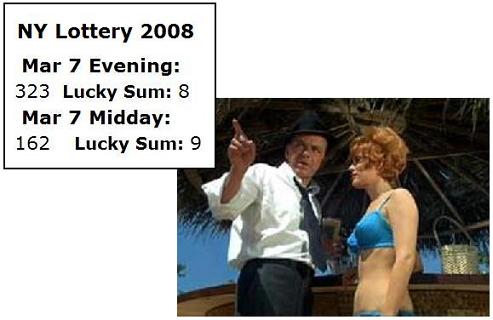
“We keep coming back
and coming back
To the real: to the hotel
instead of the hymns….”
— Wallace Stevens,
“An Ordinary Evening
in New Haven“
Comments Off on Friday March 7, 2008
Monday, July 2, 2007
Monday July 2, 2007
A figure like Ecclesiast/
Rugged and luminous,
chants in the dark/
A text that is an answer,
although obscure.
— Wallace Stevens,
"An Ordinary Evening
in New Haven"
|
Time and Chance |

From 8/02
in 2005:
| 50 Years Ago on this date, poet Wallace Stevens died. Memorial: at the Wallace Stevens Concordance, enter center. |
Result:
| The Man with the Blue Guitar | |
|---|---|
| line 150 (xiii.6): | The heraldic center of the world |
| Human Arrangement | |
| line 13: | The center of transformations that |
| This Solitude of Cataracts | |
| line 18: | Breathing his bronzen breath at the azury center of time. |
| A Primitive Like an Orb | |
| line 1 (i.1): | The essential poem at the center of things, |
| line 87 (xi.7): | At the center on the horizon, concentrum, grave |
| Reply to Papini | |
| line 33 (ii.15): | And final. This is the center. The poet is |
| Study of Images II | |
| line 7: | As if the center of images had its |
| An Ordinary Evening in New Haven | |
| line 291 (xvii.3): | It fails. The strength at the center is serious. |
| line 371 (xxi.11): | At the center, the object of the will, this place, |
| Things of August | |
| line 154 (ix.18): | At the center of the unintelligible, |
| The Hermitage at the Center | |
| Title: | The Hermitage at the Center |
| Owl's Clover, The Old Woman and the Statue (OP) | |
| line 13 (ii.9): | At the center of the mass, the haunches low, |
| The Sail of Ulysses (OP) | |
| line 50 (iv.6): | The center of the self, the self |
| Someone Puts a Pineapple Together (NA) | |
| line 6 (i.6): | The angel at the center of this rind, |
| Of Ideal Time and Choice (NA) | |
| line 29: | At last, the center of resemblance, found |
| line 32: | Stand at the center of ideal time, |
For a text on today's
mid-day number, see
Comments Off on Monday July 2, 2007
Sunday, January 7, 2007
Sunday January 7, 2007
Thursday, April 7, 2005 7:26 PM
In the Details
Wallace Stevens,
An Ordinary Evening in New Haven:
XXII
Professor Eucalyptus said, "The search
For reality is as momentous as
The search for God." It is the philosopher's search
For an interior made exterior
And the poet's search for the same exterior made
Interior….
… Likewise to say of the evening star,
The most ancient light in the most ancient sky,
That it is wholly an inner light, that it shines
From the sleepy bosom of the real, re-creates,
Searches a possible for its possibleness.
Julie Taymor, "Skewed Mirrors" interview:
"… they were performing for God. Now God can mean whatever you want it to mean. But for me, I understood it so totally. The detail….
They did it from the inside to the outside. And from the outside to the in. And that profoundly moved me then. It was…it was the most important thing that I ever experienced."
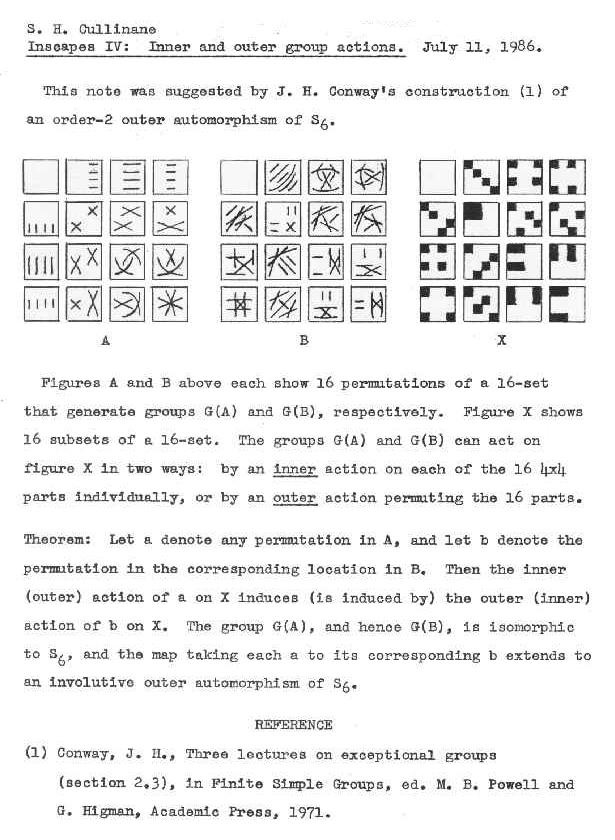
"Skewed Mirrors"
illustrated:
|
Click on the above to enlarge.
Details:

The above may be of interest to students
of iconology — what Dan Brown in
The Da Vinci Code calls "symbology" —
and of redheads.
The artist of Details,
"Brenda Starr" creator
Dale Messick, died on Tuesday,
April 5, 2005, at 98.

AP Photo
Dale Messick in 1982
For further details on
April 5, see
Art History:
The Pope of Hope

Comments Off on Sunday January 7, 2007
Saturday, December 2, 2006
Saturday December 2, 2006
Venus at
St. Anne's,
continued
In honor of
the film "Bobby,"
now playing.
("Venus at St. Anne's"
is the title of the final
chapter of
the C. S. Lewis classic
That Hideous Strength.)

Symbol of Venus
and
Symbol of Plato
Related symbols:


Click on pictures
for details related tp
the Feast of St. Anne
(July 26).
"The best theology today,
in its repudiation of a
rhetorical religious idealism,
finds itself in agreement
with a recurrent note
in contemporary poetry….
We keep coming back
and coming back/
To the real: to the hotel
instead of the hymns/
That fall upon it
out of the wind. We seek/
… Nothing beyond reality.
Within it/
Everything,
the spirit’s alchemicana….
(From 'An Ordinary Evening
in New Haven,'
in The Collected Poems
of Wallace Stevens….)
… Not grim/
Reality, but reality grimly seen….
(Ibid.)"
— "The Church's
New Concern with the Arts,"
by Amos N. Wilder,
Hollis Professor
of Divinity, Emeritus,
at Harvard Divinity School,
in Christianity and Crisis,
February 18, 1957.
 |
"All the truth in the world
adds up to one big lie."
— Dylan, "Things Have Changed"
Monday, October 9, 2006
Monday October 9, 2006
ART WARS:
To Apollo
To Apollo
“This is the garden of Apollo,
the field of Reason….”
John Outram, architect
To Apollo (10/09/02)
Art Wars: Apollo and Dionysus (10/09/02)
Balanchine’s Birthday (01/09/03)
Art Theory for Yom Kippur (10/05/03)
A Form (05/22/04)
Ineluctable (05/27/04)
A Form, continued (06/05/04)
Parallelisms (06/06/04)
Ado (06/25/04)
Deep Game (06/26/04)
Gameplayers of Zen (06/27/04)
And So To Bed (06/29/04)
Translation Plane for Rosh Hashanah (09/15/04)
Derrida Dead (10/09/04)
The Nine (11/09/04)
From Tate to Plato (11/19/04)
Art History (05/11/05)
A Miniature Rosetta Stone (08/06/05)
High Concept (8/23/05)
High Concept, Continued (8/24/05)
Analogical Train of Thought (8/25/05)
Today’s Sermon: Magical Thinking (10/09/05)
Balance (10/31/05)
Matrix (11/01/05)
Seven is Heaven, Eight is a Gate (11/12/05)
Nine is a Vine (11/12/05)
Apollo and Christ (12/02/05)
Hamilton’s Whirligig (01/05/06)
Cross (01/06/06)
On Beauty (01/26/06)
Sunday Morning (01/29/06)
Centre (01/29/06)
New Haven (01/29/06)
Washington Ballet (02/05/06)
Catholic Schools Sermon (02/05/06)
The Logic of Apollo (02/05/06)
Game Boy (08/06/06)
Art Wars Continued: The Krauss Cross (09/13/06)
Art Wars Continued: Pandora’s Box (09/16/06)
The Pope in Plato’s Cave (09/16/06)
Today’s Birthdays (09/26/06)
Symbology 101 (09/26/06)
Comments Off on Monday October 9, 2006
Sunday, January 29, 2006
Sunday January 29, 2006
New Haven
The eye’s plain version is a thing apart,
The vulgate of experience. Of this,
A few words, an and yet, and yet, and yet–
As part of the never-ending meditation,
Part of the question that is a giant himself:
Of what is this house composed if not of the sun,
These houses, these difficult objects, dilapidate
Appearances of what appearances,
Words, lines, not meanings, not communications,
Dark things without a double, after all,
Unless a second giant kills the first–
A recent imagining of reality,
Much like a new resemblance of the sun,
Down-pouring, up-springing and inevitable,
A larger poem for a larger audience,
As if the crude collops came together as one,
A mythological form, a festival sphere,
A great bosom, beard and being, alive with age.
— Wallace Stevens, opening lines of
“An Ordinary Evening in New Haven”
Sunday, October 2, 2005
Sunday October 2, 2005
Happy Birthday, Wallace Stevens
Readings for today:
At the Wallace Stevens online concordance, search for X and for primitive.
In the e-book edition of Bester's The Deceivers, search for X.
"We seek
Nothing beyond reality. Within it,
Everything, the spirit's alchemicana
Included, the spirit that goes roundabout
And through included, not merely the visible,
The solid, but the movable, the moment,
The coming on of feasts and the habits of saints,
The pattern of the heavens and high, night air."
— Wallace Stevens,
Oct. 2, 1879 – Aug. 2, 1955,
"An Ordinary Evening in New Haven"
IX.1-18, from The Auroras of Autumn,
Knopf, NY (1950)
Related material:
(Added Monday, Oct. 3, 8:45 AM)
"What if Shakespeare had been born in Teaneck, N.J., in 1973?
He would call himself Spear Daddy. His rap would exhibit a profound, nuanced understanding of the frailty of the human condition, exploring the personality in all its bewildering complexity: pretension, pride, vulnerability, emotional treachery, as well as the enduring triumph of love.
Spear Daddy would disappear from the charts in about six weeks."
— Gene Weingarten in the Washington Post,
Sunday, Oct. 2, 2005
Presenting…
Spear Daddy!

Continuing Bester's Maori theme,
students from Cullinane College:


(See Literature and Geography.)
Comments Off on Sunday October 2, 2005
Thursday, September 22, 2005
Thursday September 22, 2005
For Serge Lang
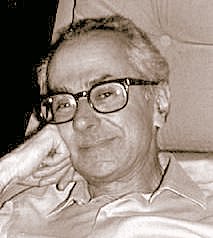
"Get the aggressively mediocre Yale Daily News obituary here ('he is remembered for his significant academic contributions'?? give me a break…)" — Tom
So far, the Yale Daily News obit is the only one showing up on a Google News search. Probably the New York Times will get around to Lang eventually. In the meantime, here's what an online newspaper and some blogs have to say.
The New Haven Independent
Obituary for Serge Lang
Weblog Entries on
Serge Lang's Death
Peter Woit's weblog
New AIDS Review
Locana
Weapon of Class Instruction
Simon's Rock College's Journal
Update of Sept. 24, 2004, 9:25 PM:
The New York Times now has an obituary.
Comments Off on Thursday September 22, 2005
Saturday, July 30, 2005
Saturday July 30, 2005
Born today: Laurence Fishburne
Matrix

“The nine-fold square has centre, periphery, axes and diagonals. But all are present only in their bare essentials. It is also a sequence of eight triads. Four pass through the centre and four do not. This is the garden of Apollo, the field of Reason, sheltered by the Gate from the turmoil of the Delta, with its endless cycles of erasure and reinscription. This is the Temple of Solomon, as inscribed, for example, by a nine-fold compartmentation to provide the ground plan of Yale….”– Architects John Outram Associates
on work at Rice University
on work at Rice University
Yale Daily News, Jan. 11, 2001:
“When New Haven was founded, the city was laid out into a grid of nine squares surrounded by a great wilderness.
Last year History of Art Professor Emeritus Vincent Scully said the original town plan reflected a feeling that the new city should be sacred.
Scully said the colony’s founders thought of their new Puritan settlement as a ‘nine-square paradise on Earth, heaven on earth, New Haven, New Jerusalem.'”
“Real and unreal are two in one:
New Haven
Before and after one arrives….”
— Wallace Stevens,
“An Ordinary Evening in New Haven,’ XXVIII
Thursday, April 7, 2005
Thursday April 7, 2005
In the Details
Wallace Stevens,
An Ordinary Evening in New Haven:
XXII
Professor Eucalyptus said, "The search
For reality is as momentous as
The search for God." It is the philosopher's search
For an interior made exterior
And the poet's search for the same exterior made
Interior….
… Likewise to say of the evening star,
The most ancient light in the most ancient sky,
That it is wholly an inner light, that it shines
From the sleepy bosom of the real, re-creates,
Searches a possible for its possibleness.
Julie Taymor, "Skewed Mirrors" interview:
"… they were performing for God. Now God can mean whatever you want it to mean. But for me, I understood it so totally. The detail….
They did it from the inside to the outside. And from the outside to the in. And that profoundly moved me then. It was…it was the most important thing that I ever experienced."
"Skewed Mirrors"
illustrated:

|
Click on the above to enlarge.
Details:
The above may be of interest to students
of iconology — what Dan Brown in
The Da Vinci Code calls "symbology" —
and of redheads.
The artist of Details,
"Brenda Starr" creator
Dale Messick, died on Tuesday,
April 5, 2005, at 98.
AP Photo
Dale Messick in 1982
For further details on
April 5, see
Art History:
The Pope of Hope
Thursday, December 2, 2004
Thursday December 2, 2004
The Poem of Pure Reality
"We seek
The poem of pure reality, untouched
By trope or deviation,
straight to the word,
Straight to the transfixing object,
to the object
At the exactest point at which it is itself,
Transfixing by being purely what it is…."
— Wallace Stevens (1879-1955)
"An Ordinary Evening in New Haven" IX,
from The Auroras of Autumn (1950)
(Collected Poems, pp. 465-489)
I have added new material to Geometry of the 4×4 Square, including links to a new commentary on a paper by Burkard Polster.
"It is a good light, then, for those
That know the ultimate Plato,
Tranquillizing with this jewel
The torments of confusion."
— Wallace Stevens,
Collected Poetry and Prose, page 21,
The Library of America, 1997
Friday, August 29, 2003
Friday August 29, 2003
The Shining of Park Place
Today is the birthday of Oliver Wendell Holmes, Sr., writer, dean of Harvard Medical School, father of Supreme Court Justice Oliver Wendell Holmes, Jr., and author of at least seven hymns.
It is also the feast day of Saint Lewis Henry Redner, author of the tune now known as “O Little Town of Bethlehem.” Redner was church organist for Phillips Brooks, who wrote the “Bethlehem” lyrics but then published the hymn under the facetious name “St. Louis,” a deliberate misspelling of Redner’s name.
Redner died on August 29, 1908, at the Marlborough Hotel in Atlantic City.
Since Holmes Sr. was both a poet and the father of a famous lawyer, a reference to poet-lawyer Wallace Stevens seems in order.
“We keep coming back and coming back
To the real: to the hotel
instead of the hymns….”
— Wallace Stevens,
“An Ordinary Evening in New Haven”
From Best Atlantic City Hotels:
Bally’s Park Place, located at Park Place and Boardwalk, partially stands on the site of the former Marlborough Hotel.
For some background on the theology of hotels, see Stephen King’s classic The Shining and my own note, Shining Forth.
Let us pray that any haunting at the current Park Place and Boardwalk location is done by the blessed spirit of Saint Lewis Redner.

Atlantic City |

|

|
Postscript of 7:11 PM —
From an old Dave Barry column:
“Beth thinks the casinos should offer more of what she described as ‘fun’ games, the type of entertainment-for-the-whole-family activities that people engage in to happily while away the hours. If Beth ran a casino, there would be a brightly lit table surrounded by high rollers in tuxedos and evening gowns, and the air would be charged with excitement as a player rolled the dice, and the crowd would lean forward, and the shout would ring out…
‘He landed on Park Place!’ “










Charles Lindbergh seems to have done
just that. See yesterday’s entry
and today’s New York Times story
Comments Off on Friday August 29, 2003
Thursday, August 28, 2003
Thursday August 28, 2003
Spirit
In memory of
Walter J. Ong, S. J.,
professor emeritus
at St. Louis University,
St. Louis, Missouri
"The Garden of Eden is behind us
and there is no road back to innocence;
we can only go forward."
— Anne Morrow Lindbergh,
Earth Shine, p. xii
Earth Shine, p. xiii:
We shall not cease from exploration
And the end of all our exploring
Will be to arrive where we started
And know the place for the first time.
— T. S. Eliot, Four Quartets.
Eliot was a native of St. Louis.
"Every city has its gates, which need not be of stone. Nor need soldiers be upon them or watchers before them. At first, when cities were jewels in a dark and mysterious world, they tended to be round and they had protective walls. To enter, one had to pass through gates, the reward for which was shelter from the overwhelming forests and seas, the merciless and taxing expanse of greens, whites, and blues–wild and free–that stopped at the city walls.
In time the ramparts became higher and the gates more massive, until they simply disappeared and were replaced by barriers, subtler than stone, that girded every city like a crown and held in its spirit."
— Mark Helprin, Winter's Tale
Book Cover,
1954:

"The pattern of the heavens
and high, night air"
— Wallace Stevens,
An Ordinary Evening in New Haven
See also my notes of
Monday, August 25, 2003
(the feast day of Saint Louis,
for whom the city is named).
For a more Eden-like city,
see my note of
October 23, 2002,
on Cuernavaca, Mexico,
where Charles Lindbergh
courted Anne Morrow.
Comments Off on Thursday August 28, 2003
Monday, August 25, 2003
Monday August 25, 2003
Words Are Events
August 12 was the date of death of Joseph Patrick Kennedy, Jr., and the date I entered some theological remarks in a new Harvard weblog. It turns out that August 12 was also the feast day of a new saint… Walter Jackson Ong, of St. Louis University, St. Louis, Missouri, a Jesuit institution.
Today, August 25, is the feast day of St. Louis himself, for whom the aforementioned city and university are named.
The New York Times states that Ong was "considered an outstanding postmodern theorist, whose ideas spawned college courses…."
There is, of course, no such thing as a postmodern Jesuit, although James Joyce came close.
From The Walter J. Ong Project:
"Ong's work is often presented alongside the postmodern and deconstruction theories of Claude Levi-Strauss, Jacques Derrida, Michel Foucault, Hélène Cixous, and others. His own work in orality and literacy shows deconstruction to be unnecessary: if you consider language to be fundamentally spoken, as language originally is, it does not consist of signs, but of events. Sound, including the spoken word, is an event. It takes time. The concept of 'sign,' by contrast, derives primarily not from the world of events, but from the world of vision. A sign can be physically carried around, an event cannot: it simply happens. Words are events."
|
From a commonplace book "We keep coming back and coming back The poem of pure reality, untouched At the exactest point at which The eye made clear of uncertainty, Everything, the spirit's alchemicana The solid, but the movable, Wallace Stevens (1879-1955) |
The web page where I found the Stevens quote also has the following:
|
Case 9 of Hekiganroku: A monk asked Joshu, Joshu said, Setcho's Verse: Its intention concealed, Setcho (980-1052), |
See also my previous entry for today,
"Gates to the City."
Comments Off on Monday August 25, 2003
Wednesday, November 27, 2002
Wednesday November 27, 2002
Waiting for Logos
Searching for background on the phrase "logos and logic" in yesterday's "Notes toward a Supreme Fact," I found this passage:
"…a theory of psychology based on the idea of the soul as the dialectical, self-contradictory syzygy of a) soul as anima and b) soul as animus. Jungian and archetypal psychology appear to have taken heed more or less of only one half of the whole syzygy, predominantly serving an anima cut loose from her own Other, the animus as logos and logic (whose first and most extreme phenomenological image is the killer of the anima, Bluebeard). Thus psychology tends to defend the virginal innocence of the anima and her imagination…"
— Wolfgang Giegerich, "Once More the Reality/Irreality Issue: A Reply to Hillman's Reply," website
The anima and other Jungian concepts are used to analyze Wallace Stevens in an excellent essay by Michael Bryson, "The Quest for the Fiction of an Absolute." Part of Bryson's motivation in this essay is the conflict between the trendy leftist nominalism of postmodern critics and the conservative realism of more traditional critics:
"David Jarraway, in his Stevens and the Question of Belief, writes about a Stevens figured as a proto-deconstructionist, insisting on 'Steven's insistence on dismantling the logocentric models of belief' (311) in 'An Ordinary Evening in New Haven.' In opposition to these readings comes a work like Janet McCann's Wallace Stevens Revisited: 'The Celestial Possible', in which the claim is made (speaking of the post-1940 period of Stevens' life) that 'God preoccupied him for the rest of his career.'"
Here "logocentric" is a buzz word for "Christian." Stevens, unlike the postmodernists, was not anti-Christian. He did, however, see that the old structures of belief could not be maintained indefinitely, and pondered what could be found to replace them. "Notes toward a Supreme Fiction" deals with this problem. In his essay on Stevens' "Notes," Bryson emphasizes the "negative capability" of Keats as a contemplative technique:
"The willingness to exist in a state of negative capability, to accept that sometimes what we are seeking is not that which reason can impose…."
For some related material, see Simone Weil's remarks on Electra waiting for her brother Orestes. Simone Weil's brother was one of the greatest mathematicians of the past century, André Weil.
"Electra did not seek Orestes, she waited for him…"
— Simone Weil
"…at the end, she pulls it all together brilliantly in the story of Electra and Orestes, where the importance of waiting on God rather than seeking is brought home forcefully."
— Tom Hinkle, review of Waiting for God
Compare her remarks on waiting for Orestes with the following passage from Waiting for God:
"We do not obtain the most precious gifts by going in search of them but by waiting for them. Man cannot discover them by his own powers, and if he sets out to seek for them he will find in their place counterfeits of which he will be unable to discern falsity.
The solution of a geometry problem does not in itself constitute a precious gift, but the same law applies to it because it is the image of something precious. Being a little fragment of particular truth, it is a pure image of the unique, eternal, and living Truth, the very Truth that once in a human voice declared: "I am the Truth."
Every school exercise, thought of in this way, is like a sacrament.
In every school exercise there is a special way of waiting upon truth, setting our hearts upon it, yet not allowing ourselves to go out in search of it. There is a way of giving our attention to the data of a problem in geometry without trying to find the solution…."
— Simone Weil, "Reflections on the Right Use of School Studies with a View to the Love of God"
Weil concludes the preceding essay with the following passage:
"Academic work is one of those fields containing a pearl so precious that it is worth while to sell all of our possessions, keeping nothing for ourselves, in order to be able to acquire it."
This biblical metaphor is also echoed in the work of Pascal, who combined in one person the theological talent of Simone Weil and the mathematical talent of her brother. After discussing how proofs should be written, Pascal says
"The method of not erring is sought by all the world. The logicians profess to guide to it, the geometricians alone attain it, and apart from their science, and the imitations of it, there are no true demonstrations. The whole art is included in the simple precepts that we have given; they alone are sufficient, they alone afford proofs; all other rules are useless or injurious. This I know by long experience of all kinds of books and persons.
And on this point I pass the same judgment as those who say that geometricians give them nothing new by these rules, because they possessed them in reality, but confounded with a multitude of others, either useless or false, from which they could not discriminate them, as those who, seeking a diamond of great price amidst a number of false ones, but from which they know not how to distinguish it, should boast, in holding them all together, of possessing the true one equally with him who without pausing at this mass of rubbish lays his hand upon the costly stone which they are seeking and for which they do not throw away the rest."
— Blaise Pascal, The Art of Persuasion
Comments Off on Wednesday November 27, 2002