Log24

Friday, February 13, 2026

Geometry for Friday the 13th

Filed under: General — Tags: , — m759 @ 1:13 pm

The previous post — "Cube Space" — and today's date
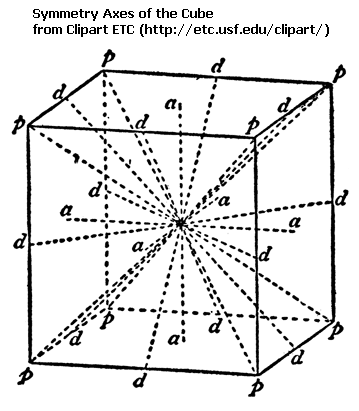
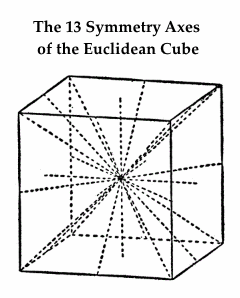
suggest a review of  the 13 symmetry axes of the cube.
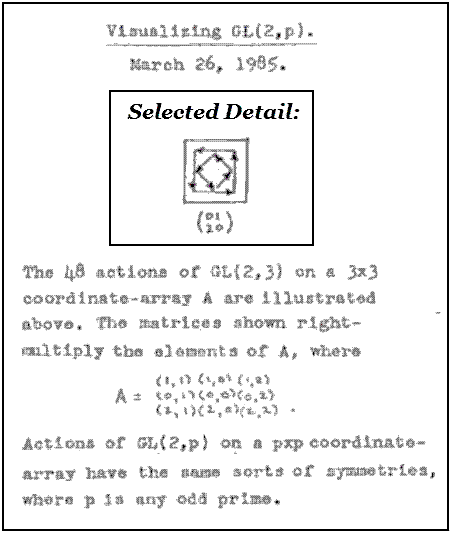
Related geometry —

By NotebookLM today —

Symmetry in Finite Geometry and Combinatorial Design

The provided sources explore the mathematical and artistic intersections of finite geometry, specifically focusing on the Cullinane diamond theorem and its square-based representations of PG(3,2). By utilizing 4×4 and 4×6 arrays, these works illustrate how combinatorial designs, such as Latin squares and Miracle Octad Generators, relate to highly symmetric structures like the Mathieu group M24 and the binary Golay code. The texts demonstrate that properties of symmetry, such as the affine group AGL(4,2), govern both abstract group theory and visual patterns found in puzzles, quilt designs, and sphere packings. This framework extends into coding theory and quantum mechanics, where geometric "bricks" and "lines" help simplify the analysis of complex lattices and error-correcting systems. Ultimately, the collection bridges rigorous algebraic abstraction with interactive visualization, showing that the logic of finite space underpins both mathematical truth and aesthetic form.

Friday, October 13, 2023

Lightbox for a Friday the 13th

Filed under: General — Tags: , — m759 @ 12:35 pm

For a different sort of Lightbox, more closely associated with
the number 13, see instances in this journal of . . .

IMAGE- The 13 symmetry axes of the cube

(Adapted from Encyclopaedia Britannica,
Eleventh Edition (1911), Crystallography .)

"Before time began . . . ." — Optimus Prime

Wednesday, January 13, 2021

Working Backwards: 13 in the 11th

Filed under: General — m759 @ 12:37 am

IMAGE- The 13 symmetry axes of the cube

(Adapted from Encyclopaedia Britannica,
Eleventh Edition (1911), Crystallography .)

Monday, April 13, 2020

Cubes and Axes

Filed under: General — Tags: , — m759 @ 12:55 pm

See also this  journal on November 29, 2011 —The Flight from Ennui.

Related illustration from earlier in 2011 —

See also this  journal on 20 Sept. 2011 — Relativity Problem Revisited —
as well as other posts tagged Congregated Light.

Friday, December 13, 2019

Apollo’s 13 Revisited

Filed under: General — Tags: — m759 @ 12:59 am

IMAGE- The 13 symmetry axes of the cube

(Adapted from Encyclopaedia Britannica,
 Eleventh Edition (1911), Crystallography .)

Monday, May 19, 2014

Un-Rubik Cube

Filed under: General,Geometry — Tags: , , , — m759 @ 10:48 am

IMAGE- Britannica 11th edition on the symmetry axes and planes of the cube

See also Cube Symmetry Planes  in this journal.

Friday, May 13, 2011

Apollo’s 13

Filed under: General,Geometry — Tags: — m759 @ 6:36 am

Continued … See related previous posts.

IMAGE- The 13 symmetry axes of the cube

Those who prefer narrative to mathematics
may consult Wikipedia on The Cosmic Cube.

Wednesday, August 13, 2025

AI Mode . . . “Particularly”

Filed under: General — Tags: — m759 @ 5:59 am

Plan 13 from Inner Space

IMAGE- The 13 symmetry axes of the cube

(Adapted from Encyclopaedia Britannica,
 Eleventh Edition (1911), Crystallography .)

Wednesday, November 27, 2024

For the Still Point: “Congregated Light”

Filed under: General — Tags: , , — m759 @ 11:28 am

An instance of T. S. Eliot's poetic "still point" is the
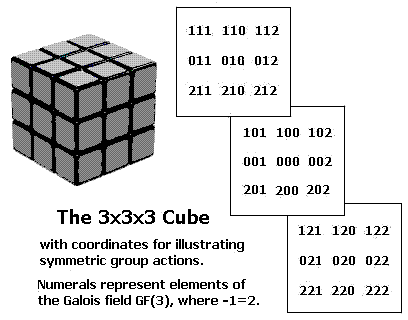
center of a 3x3x3 Galois  cube made up of 27 subcubes
Not  Rubik's puzzle, whose center is a mere mechanical contrivance.

Associated with that Galois cube is the set of
13 symmetry axes of its central subcube.

The figure above is not unrelated to the so-called "free will theorem."

Mathematician Peter J. Cameron's recent quotation of St. Bernard*
on free will and grace, while not impressive as a philosophical
statement, is at least preferable to the TV sitcom "Will and Grace."

See also the notion of free will in other posts tagged "Congregated Light."

Some context:  Tom Wolfe, below, on the word "clerisy." It seems that the
word applies to many academics besides those in areas named by Wolfe.

* Vide  http://www.catholictradition.org/Tradition/efficacious-grace3.htm#67
"De gratia et Libero arbitrio, chaps. 1 and 14."

Wednesday, September 13, 2023

Edgelord School

Filed under: General — Tags: , , , , , — m759 @ 9:20 am
 

Monday, May 8, 2017

New Pinterest Board

Filed under: Uncategorized — m759 @ 9:29 PM 

https://www.pinterest.com/stevenhcullinane/art-space/

The face at lower left above is that of an early Design edgelord.

A product of that edgelord's school

See a design by Prince-Ramus in today's New York Times —

Remarks quoted here  on the above San Diego date —

A related void —

IMAGE- The 13 symmetry axes of the cube

Sunday, July 2, 2023

Badlands Philosophy

Filed under: General — Tags: — m759 @ 12:29 pm

This afternoon's Windows lockscreen is Badlands National Park —

From this morning's post, a phrase from Schopenhauer

"Apparent Design in the Fate of the Individual."

An apparent design in the philosophy of Optimus Prime —

"Before time began, there was the Cube" —

IMAGE- The 13 symmetry axes of the cube

Click the image for further remarks.

Monday, June 27, 2022

Dealing With Cubism

Filed under: General — Tags: , , — m759 @ 7:59 pm

Continued from April 12, 2022.

"It’s important, as art historian Reinhard Spieler has noted,
that after a brief, unproductive stay in Paris, circa 1907,
Kandinsky chose to paint in Munich. That’s where he formed
the Expressionist art group Der Blaue Reiter  (The Blue Rider) —
and where he avoided having to deal with cubism."

— David Carrier, 

Remarks by Louis Menand in The New Yorker  today —

"The art world isn’t a fixed entity.
It’s continually being reconstituted
as new artistic styles emerge." 

IMAGE- The 13 symmetry axes of the cube

(Adapted from Encyclopaedia Britannica,
Eleventh Edition (1911), Crystallography .)

"Before time began, there was the Cube."
— Optimus Prime

See as well Verbum  (February 18, 2017).

Related dramatic music

"Westworld Season 4 begins at Hoover Dam,
with William looking to buy the famous landmark.
What does he consider to be 'stolen' data that is inside?" 

Saturday, March 26, 2022

Box Geometry: Space, Group, Art  (Work in Progress)

Filed under: General — Tags: , , , — m759 @ 2:06 am

Many structures of finite geometry can be modeled by
rectangular or cubical arrays ("boxes") —
of subsquares or subcubes (also "boxes").

Here is a draft for a table of related material, arranged
as internet URL labels.

Finite Geometry Notes — Summary Chart
 

Name Tag .Space .Group .Art
Box4

2×2 square representing the four-point finite affine geometry AG(2,2).

(Box4.space)

S4 = AGL(2,2)

(Box4.group)


(Box4.art)

Box6 3×2 (3-row, 2-column) rectangular array
representing the elements of an arbitrary 6-set.
S6  
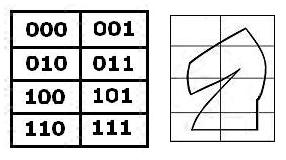
Box8 2x2x2 cube or  4×2 (4-row, 2-column) array. S8 or Aor  AGL(3,2) of order 1344, or  GL(3,2) of order 168  
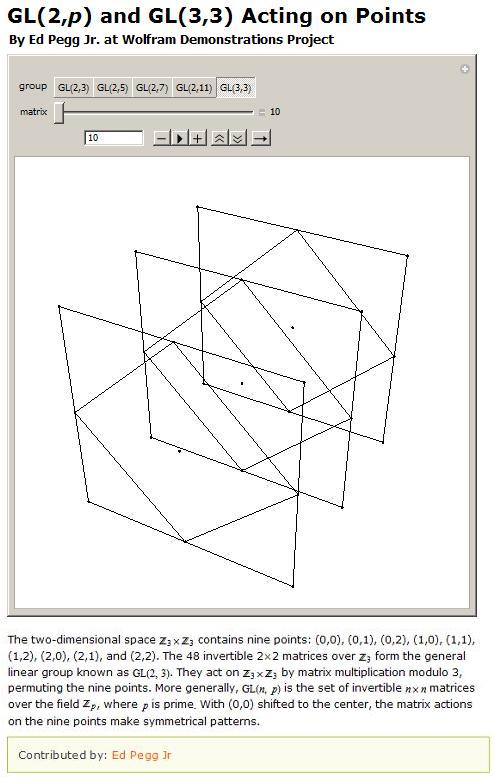
Box9 The 3×3 square. AGL(2,3) or  GL(2,3)  
Box12 The 12 edges of a cube, or  a 4×3  array for picturing the actions of the Mathieu group M12. Symmetries of the cube or  elements of the group M12  
Box13 The 13 symmetry axes of the cube. Symmetries of the cube.  
Box15 The 15 points of PG(3,2), the projective geometry
of 3 dimensions over the 2-element Galois field.
Collineations of PG(3,2)  
Box16 The 16 points of AG(4,2), the affine geometry
of 4 dimensions over the 2-element Galois field.

AGL(4,2), the affine group of 
322,560 permutations of the parts
of a 4×4 array (a Galois tesseract)

 
Box20 The configuration representing Desargues's theorem.    
Box21 The 21 points and 21 lines of PG(2,4).    
Box24 The 24 points of the Steiner system S(5, 8, 24).    
Box25 A 5×5 array representing PG(2,5).    
Box27 The 3-dimensional Galois affine space over the
3-element Galois field GF(3).
   
Box28 The 28 bitangents of a plane quartic curve.    
Box32 Pair of 4×4 arrays representing orthogonal 
Latin squares.
Used to represent
elements of AGL(4,2)
 
Box35 A 5-row-by-7-column array representing the 35
lines in the finite projective space PG(3,2)
PGL(3,2), order 20,160  
Box36 Eurler's 36-officer problem.    
Box45 The 45 Pascal points of the Pascal configuration.    
Box48 The 48 elements of the group  AGL(2,3). AGL(2,3).  
Box56

The 56 three-sets within an 8-set or
56 triangles in a model of Klein's quartic surface or
the 56 spreads in PG(3,2).

   
Box60 The Klein configuration.    
Box64 Solomon's cube.    

— Steven H. Cullinane, March 26-27, 2022

Sunday, March 13, 2022

Google News Spotlight

Filed under: General — m759 @ 5:44 pm

Before time began . . .

IMAGE- Massimo Vignelli, his wife Lella, and cube

Friday, December 31, 2021

Aesthetics in Academia

Filed under: General — Tags: , , — m759 @ 9:33 am

Related art — The non-Rubik 3x3x3 cube —

The above structure illustrates the affine space of three dimensions
over the three-element finite (i.e., Galois) field, GF(3). Enthusiasts
of Judith Brown's nihilistic philosophy may note the "radiance" of the
13 axes of symmetry within the "central, structuring" subcube.

I prefer the radiance  (in the sense of Aquinas) of the central, structuring 
eightfold cube at the center of the affine space of six dimensions over
the two-element field GF(2).

Friday, October 13, 2017

Speak, Memra

Filed under: General,Geometry — Tags: — m759 @ 11:59 am

The above was suggested by a Log24 review of October 13, 2002,
which in turn suggested a Log24 search for Carousel that yielded
(from Bloomsday Lottery) —

See as well Asimov's "prime radiant," and an illustration
of the number 13 as a radiant prime

"The Prime Radiant can be adjusted to your mind,
and all corrections and additions can be made
through mental rapport. There will be nothing to
indicate that the correction or addition is yours.
In all the history of the Plan there has been no
personalization. It is rather a creation of all of us 
together. Do you understand?"  

"Yes, Speaker!"

— Isaac Asimov, 
    Second Foundation , Ch. 8: Seldon's Plan

"Before time began, there was the Cube."
— Optimus Prime

See also Transformers in this journal.

Tuesday, June 20, 2017

All-Spark Notes

Filed under: General,Geometry — Tags: — m759 @ 1:55 pm

(Continued)

"For years, the AllSpark rested, sitting dormant
like a giant, useless art installation."

— Vinnie Mancuso at Collider.com yesterday

Related material —

Dormant cube

IMAGE- Britannica 11th edition on the symmetry axes and planes of the cube

Giant, useless art installation —

Sol LeWitt at MASS MoCA.  See also LeWitt in this journal.

Monday, April 3, 2017

Odd Core

Filed under: General,Geometry — Tags: , — m759 @ 9:00 pm


3x3x3 Galois cube, gray and white

Sunday, January 1, 2017

Like the Horizon

(Continued from a remark by art critic Peter Schjeldahl quoted here
last  year on New Year's Day in the post "Art as Religion.")

"The unhurried curve got me.
It was like the horizon of a world
that made a non-world of
all of the space outside it."

— Peter Schjeldahl, "Postscript: Ellsworth Kelly,"
The New Yorker , December 30, 2015

This suggests some further material from the paper
that was quoted here yesterday on New Year's Eve —

"In teaching a course on combinatorics I have found
students doubting the existence of a finite projective
plane geometry with thirteen points on the grounds
that they could not draw it (with 'straight' lines)
on paper although they had tried to do so. Such a
lack of appreciation of the spirit of the subject is but
a consequence of the elements of formal geometry
no longer being taught in undergraduate courses.
Yet these students were demanding the best proof of
existence, namely, production of the object described."

— Derrick Breach (See his obituary from 1996.)

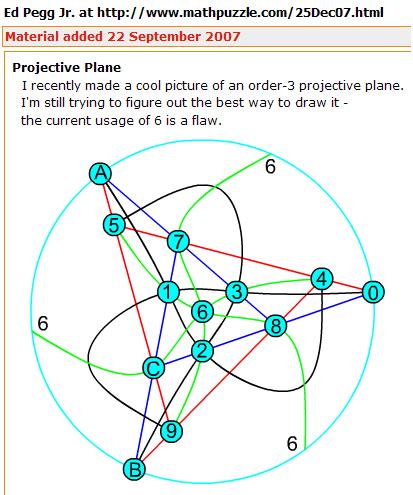
A related illustration of the 13-point projective plane
from the University of Western Australia:

Projective plane of order 3

(The four points on the curve
at the right of the image are
the points on the line at infinity .)

The above image is from a post of August 7, 2012,
"The Space of Horizons."  A related image —

Click on the above image for further remarks.

Saturday, September 17, 2016

Interior/Exterior

Filed under: General,Geometry — m759 @ 12:25 am


3x3x3 Galois cube, gray and white

Friday, September 2, 2016

Raiders of the Lost Birthday

Filed under: General — Tags: , , — m759 @ 10:00 am

Some images from the posts of last July 13
(Harrison Ford's birthday) may serve as funeral
ornaments for the late Prof. David Lavery.

IMAGE- Massimo Vignelli, his wife Lella, and cube

Magic cube and corresponding hexagram, or Star of David, with faces mapped to lines and edges mapped to points

See as well posts on "Silent Snow" and "Starlight Like Intuition."

Saturday, October 10, 2015

Epiphany in Paris

Filed under: General,Geometry — Tags: — m759 @ 10:00 pm

It's 10 PM …


Related material: Adam Gopnik, The King in the Window.

Wednesday, May 13, 2015

Space

Filed under: General,Geometry — Tags: , , — m759 @ 2:00 pm

Notes on space for day 13 of May, 2015 —

The 13 symmetry axes of the cube may be viewed as
the 13 points of the Galois projective space PG(2,3).
This space (a plane) may also be viewed as the nine points
of the Galois affine space AG(2,3) plus the four points on
an added "line at infinity."

Related poetic material:

The ninefold square and Apollo, as well as 

http://www.log24.com/log/pix11A/110426-ApolloAndDionysus.jpg

Thursday, December 18, 2014

Platonic Analogy

Filed under: General,Geometry — Tags: , , — m759 @ 2:23 pm

(Five by Five continued)

As the 3×3 grid underlies the order-3 finite projective plane,
whose 13 points may be modeled by
the 13 symmetry axes of the cube,
so the 5×5 grid underlies the order-5 finite projective plane,
whose 31 points may be modeled by
the 31 symmetry axes of the dodecahedron.

See posts tagged Galois-Plane Models.

Wednesday, November 26, 2014

Class Act

Filed under: General,Geometry — Tags: , — m759 @ 7:18 am

Update of Nov. 30, 2014 —

For further information on the geometry in
the remarks by Eberhart below, see
pp. 16-17 of A Geometrical Picture Book ,
by Burkard Polster (Springer, 1998). Polster
cites a different article by Lemay.

A search for background to the exercise in the previous post
yields a passage from the late Stephen Eberhart:

The first three primes p = 2, 3, and 5 therefore yield finite projective planes with 7, 13, and 31 points and lines, respectively. But these are just the numbers of symmetry axes of the five regular solids, as described in Plato's Timaeus : The tetrahedron has 4 pairs of face planes and corner points + 3 pairs of opposite edges, totalling 7 axes; the cube has 3 pairs of faces + 6 pairs of edges + 4 pairs of corners, totalling 13 axes (the octahedron simply interchanges the roles of faces and corners); and the pentagon dodecahedron has 6 pairs of faces + 15 pairs of edges + 10 pairs of corners, totalling 31 axes (the icosahedron again interchanging roles of faces and corners). This is such a suggestive result, one would expect to find it dealt with in most texts on related subjects; instead, while "well known to those who well know such things" (as Richard Guy likes to quip), it is scarcely to be found in the formal literature [9]. The reason for the common numbers, it turns out, is that the groups of symmetry motions of the regular solids are subgroups of the groups of collineations of the respective finite planes, a face axis being different from an edge axis of a regular solid but all points of a projective plane being alike, so the latter has more symmetries than the former.

[9] I am aware only of a series of in-house publications by Fernand Lemay of the Laboratoire de Didactique, Faculté des Sciences de I 'Éducation, Univ. Laval, Québec, in particular those collectively titled Genèse de la géométrie  I-X.

— Stephen Eberhart, Dept. of Mathematics,
California State University, Northridge, 
"Pythagorean and Platonic Bridges between
Geometry and Algebra," in BRIDGES: Mathematical
Connections in Art, Music, and Science 
, 1998,
archive.bridgesmathart.org/1998/bridges1998-121.pdf

Eberhart died of bone cancer in 2003. A memorial by his
high school class includes an Aug. 7, 2003, transcribed
letter from Eberhart to a classmate that ends…


… I earned MA’s in math (UW, Seattle) and history (UM, Missoula) where a math/history PhD program had been announced but canceled.  So 1984 to 2002 I taught math (esp. non-Euclidean geometry) at C.S.U. Northridge.  It’s been a rich life.  I’m grateful. 
 
Steve
 

See also another informative BRIDGES paper by Eberhart
on mathematics and the seven traditional liberal arts.

Tuesday, November 25, 2014

Euclidean-Galois Interplay

Filed under: General,Geometry — Tags: , , — m759 @ 11:00 am

For previous remarks on this topic, as it relates to
symmetry axes of the cube, see previous posts tagged Interplay.

The above posts discuss, among other things, the Galois
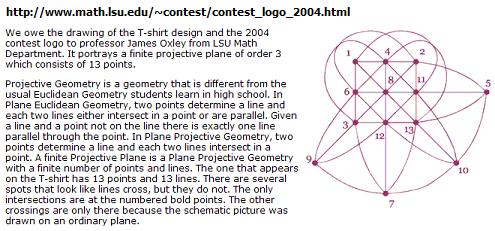
projective plane of order 3, with 13 points and 13 lines.

Oxley's 2004 drawing of the 13-point projective plane

These Galois points and lines may be modeled in Euclidean geometry
by the 13 symmetry axes and the 13 rotation planes
of the Euclidean cube. They may also be modeled in Galois geometry
by subsets of the 3x3x3 Galois cube (vector 3-space over GF(3)).

http://www.log24.com/log/pix11A/110427-Cube27.jpg

   The 3×3×3 Galois Cube 

Exercise: Is there any such analogy between the 31 points of the
order-5 Galois projective plane and the 31 symmetry axes of the
Euclidean dodecahedron and icosahedron? Also, how may the
31 projective points  be naturally pictured as lines  within the 
5x5x5 Galois cube (vector 3-space over GF(5))?

Update of Nov. 30, 2014 —

For background to the above exercise, see
pp. 16-17 of A Geometrical Picture Book ,
by Burkard Polster (Springer, 1998), esp.
the citation to a 1983 article by Lemay.

Thursday, November 13, 2014

Mort de Grothendieck

Filed under: General — m759 @ 5:55 pm

Alexandre Grothendieck est mort jeudi matin
à l’hôpital de Saint-Girons (Ariège), à l’âge de 86 ans.”

Update of 6: 16 PM ET:  A memorial of sorts, from May 27 this year:

IMAGE- Massimo Vignelli, his wife Lella, and cube

Monday, January 13, 2014

A Prime for Marissa

Filed under: General,Geometry — m759 @ 10:00 pm

"I don't like odd numbers, and I really don't like primes."

Marissa Mayer

See Cube Symmetry Axes in this journal.

IMAGE- The 13 symmetry axes of the cube

Saturday, April 13, 2013

Narrative

Filed under: General — m759 @ 6:16 pm

Two friends from Brooklyn —

"… both marveled at early Ingmar Bergman movies."

One of the friends' "humor was inspired by
surrealist painters and Franz Kafka."

Wikipedia

"Most of Marvel's fictional characters operate in
a single reality known as the Marvel Universe…."

This journal yesterday


Related material:  The Cosmic Cube.

Friday, April 12, 2013

Midnight in Paris

Filed under: General,Geometry — m759 @ 6:00 pm

Surreal requiem for the late Jonathan Winters:

"They 'burn, burn, burn like fabulous yellow roman candles
exploding like spiders across the stars,'
as Jack Kerouac once wrote. It was such a powerful
image that Wal-Mart sells it as a jigsaw puzzle."

— "When the Village Was the Vanguard,"
       by Henry Allen, in today's Wall Street Journal

See also Damnation Morning and the picture in
yesterday evening's remarks on art:


Older Posts »

Powered by WordPress