Log24

Tuesday, November 25, 2014

Euclidean-Galois Interplay

Filed under: General,Geometry — Tags: , , — m759 @ 11:00 am

For previous remarks on this topic, as it relates to
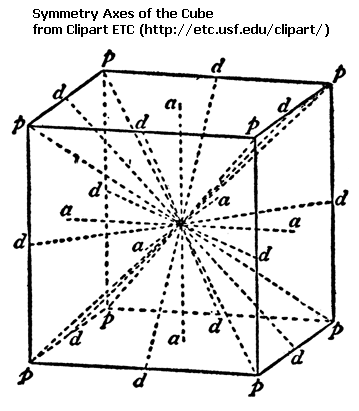
symmetry axes of the cube, see previous posts tagged Interplay.

The above posts discuss, among other things, the Galois
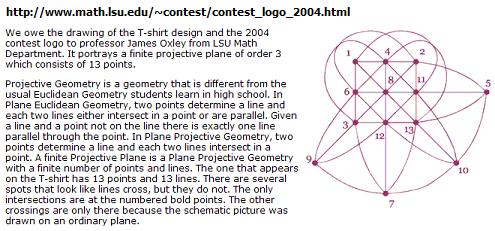
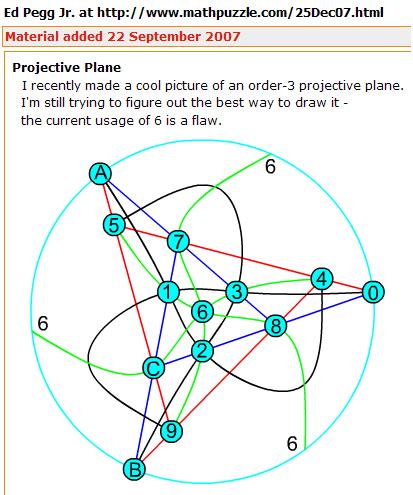
projective plane of order 3, with 13 points and 13 lines.

Oxley's 2004 drawing of the 13-point projective plane

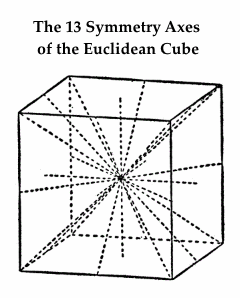
These Galois points and lines may be modeled in Euclidean geometry
by the 13 symmetry axes and the 13 rotation planes
of the Euclidean cube. They may also be modeled in Galois geometry
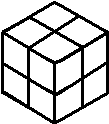
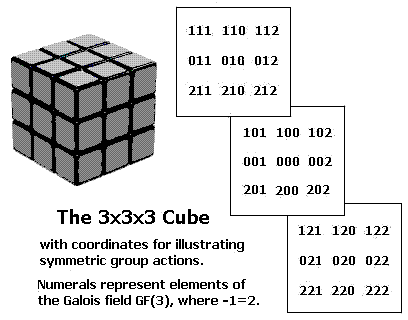
by subsets of the 3x3x3 Galois cube (vector 3-space over GF(3)).

http://www.log24.com/log/pix11A/110427-Cube27.jpg

   The 3×3×3 Galois Cube 

Exercise: Is there any such analogy between the 31 points of the
order-5 Galois projective plane and the 31 symmetry axes of the
Euclidean dodecahedron and icosahedron? Also, how may the
31 projective points  be naturally pictured as lines  within the 
5x5x5 Galois cube (vector 3-space over GF(5))?

Update of Nov. 30, 2014 —

For background to the above exercise, see
pp. 16-17 of A Geometrical Picture Book ,
by Burkard Polster (Springer, 1998), esp.
the citation to a 1983 article by Lemay.

Tuesday, July 10, 2012

Euclid vs. Galois

Filed under: General,Geometry — Tags: , , — m759 @ 11:01 am

(Continued)

Euclidean square and triangle

Galois square and triangle

Background—

This journal on the date of Hilton Kramer's death,
The Galois Tesseract, and The Purloined Diamond.

Friday, September 17, 2010

The Galois Window

Filed under: General,Geometry — Tags: , , , — m759 @ 5:01 am

Yesterday's excerpt from von Balthasar supplies some Catholic aesthetic background for Galois geometry.

That approach will appeal to few mathematicians, so here is another.

Euclid's Window: The Story of Geometry from Parallel Lines to Hyperspace  is a book by Leonard Mlodinow published in 2002.

More recently, Mlodinow is the co-author, with Stephen Hawking, of The Grand Design  (published on September 7, 2010).

A review of Mlodinow's book on geometry—

"This is a shallow book on deep matters, about which the author knows next to nothing."
— Robert P. Langlands, Notices of the American Mathematical Society,  May 2002

The Langlands remark is an apt introduction to Mlodinow's more recent work.

It also applies to Martin Gardner's comments on Galois in 2007 and, posthumously, in 2010.

For the latter, see a Google search done this morning—

http://www.log24.com/log/pix10B/100917-GardnerGalois.jpg

Here, for future reference, is a copy of the current Google cache of this journal's "paged=4" page.

Note the link at the bottom of the page in the May 5, 2010, post to Peter J. Cameron's web journal. Following the link, we find…

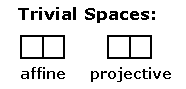
For n=4, there is only one factorisation, which we can write concisely as 12|34, 13|24, 14|23. Its automorphism group is the symmetric group S4, and acts as S3 on the set of three partitions, as we saw last time; the group of strong automorphisms is the Klein group.

This example generalises, by taking the factorisation to consist of the parallel classes of lines in an affine space over GF(2). The automorphism group is the affine group, and the group of strong automorphisms is its translation subgroup.

See also, in this  journal, Window and Window, continued (July 5 and 6, 2010).

Gardner scoffs at the importance of Galois's last letter —

"Galois had written several articles on group theory, and was
merely annotating and correcting those earlier published papers."
Last Recreations, page 156

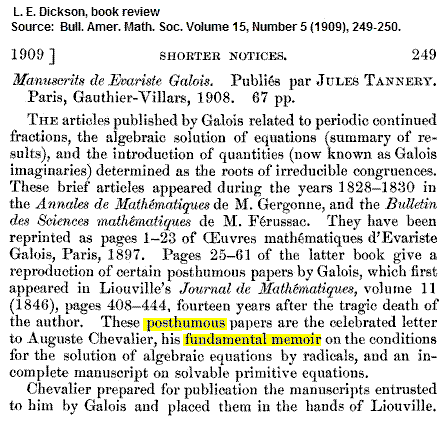
For refutations, see the Bulletin of the American Mathematical Society  in March 1899 and February 1909.

Sunday, March 21, 2010

Galois Field of Dreams

Filed under: General,Geometry — Tags: , — m759 @ 10:01 am

It is well known that the seven (22 + 2 +1) points of the projective plane of order 2 correspond to 2-point subspaces (lines) of the linear 3-space over the two-element field Galois field GF(2), and may be therefore be visualized as 2-cube subsets of the 2×2×2 cube.

Similarly, recent posts* have noted that the thirteen (32 + 3 + 1) points of the projective plane of order 3 may be seen as 3-cube subsets in the 3×3×3 cube.

The twenty-one (42 + 4 +1) points of the (unique) projective plane of order 4 may also be visualized as subsets of a cube– in this case, the 4×4×4 cube. This visualization is somewhat more complicated than the 3×3×3 case, since the 4×4×4 cube has no central subcube, and each projective-plane point corresponds to four, not three, subcubes.

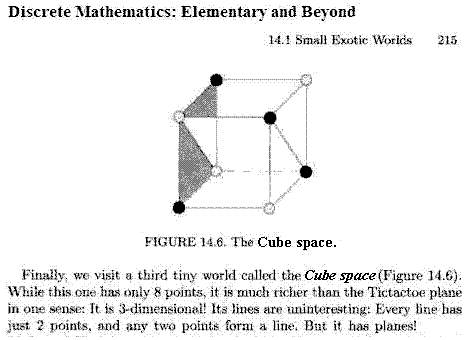
These three cubes, with 8, 27, and 64 subcubes, thus serve as geometric models in a straightforward way– first as models of finite linear spaces, hence as models for small Galois geometries derived from the linear spaces. (The cubes with 8 and 64 subcubes also serve in a less straightforward, and new, way as finite-geometry models– see The Eightfold Cube, Block Designs, and Solomon's Cube.)

A group of collineations** of the 21-point plane is one of two nonisomorphic simple groups of order 20,160. The other is the linear group acting on the linear 4-space over the two-element Galois field  GF(2). The 1899 paper establishing the nonisomorphism notes that "the expression Galois Field is perhaps not yet in general use."

Coordinates of the 4×4×4 cube's subcubes can, of course, be regarded as elements of the Galois field GF(64).

The preceding remarks were purely mathematical. The "dreams" of this post's title are not. See…

Number and Time, by Marie-Louise von Franz

See also Geometry of the I Ching and a search in this journal for "Galois + Ching."

* February 27 and March 13

** G20160 in Mitchell 1910,  LF(3,22) in Edge 1965

— Mitchell, Ulysses Grant, "Geometry and Collineation Groups
   of the Finite Projective Plane PG(2,22),"
   Princeton Ph.D. dissertation (1910)

— Edge, W. L., "Some Implications of the Geometry of
   the 21-Point Plane," Math. Zeitschr. 87, 348-362 (1965)

Monday, February 10, 2025

Brick Space: Points with Parts

Filed under: General — Tags: , , , , — m759 @ 3:47 pm

This post's "Points with Parts" title may serve as an introduction to
what has been called "the most powerful diagram in mathematics" —
the "Miracle Octad Generator" (MOG) of Robert T. Curtis.

The Miracle Octad Generator (MOG) of R. T. Curtis

Curtis himself has apparently not written on the geometric background
of his diagram — the finite projective spaces PG(5,2) and PG(3,2), of 
five and of three dimensions over the two-element Galois field GF(2).

The component parts of the MOG diagram, the 2×4 Curtis "bricks,"
may be regarded* as forming both PG(5,2) and PG(3,2) . . .
Pace  Euclid, points with parts. For more on the MOG's geometric
background, see the Klein correspondence  in the previous post.

For a simpler example of "points with parts, see
http://m759.net/wordpress/?s=200229.

* Use the notions of Galois (XOR, or "symmetric-difference") addition
of even  subsets, and such addition "modulo complementation," to
decrease the number of dimensions of the spaces involved.

Tuesday, August 27, 2024

For Rubik Worshippers

Filed under: General — Tags: , , , — m759 @ 2:37 pm

Galois space of six dimensions represented in Euclidean spaces of three and of two dimensions

The above is six-dimensional as an affine  space, but only five-dimensional
as a  projective  space . . . the space PG(5, 2).

As the domain of the smallest model of the Klein correspondence and the
Klein quadric, PG (5,2) is not without mathematical importance.

See Chess Bricks and Ovid.group.

This post was suggested by the date July 6, 2024 in a Warren, PA obituary
and by that date in this  journal.

Friday, November 10, 2023

Logos

Filed under: General — Tags: , , , , — m759 @ 12:08 pm

Related art —

(For some backstory, see Geometry of the I Ching
and the history of Chinese philosophy.)

Galois space of six dimensions represented in Euclidean spaces of three and of two dimensions

Monday, February 27, 2023

For Gen Z: The Mark of Zorro

Filed under: General — m759 @ 12:50 pm

Galois space of six dimensions represented in Euclidean spaces of three and of two dimensions

Friday, December 30, 2022

Bullshit Studies: The View from East Lansing

Filed under: General — Tags: — m759 @ 1:40 pm

Detail of the above screen (click to enlarge) —

See also this  journal on the above date  — June 10, 2021.

From this journal on May 6, 2009

A related picture of images that "reappear metamorphosed
in the coordinate system of the high region" —

(For the backstory, see Geometry of the I Ching
and the history of Chinese philosophy.)

Galois space of six dimensions represented in Euclidean spaces of three and of two dimensions

Friday, May 27, 2022

Great Escapes

Filed under: General — Tags: — m759 @ 2:12 pm

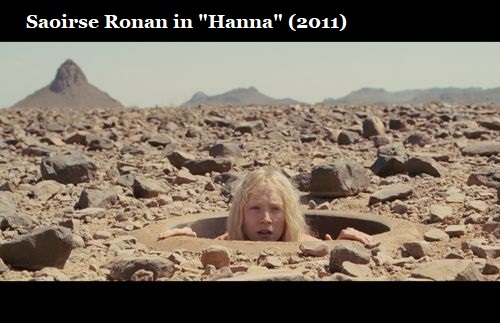
The above scene from "Hanna" comes from a webpage
dated August 29, 2011. See also

this journal on that date  —

Galois space of six dimensions represented in Euclidean spaces of three and of two dimensions

and today's previous "Escape" post.

Thursday, March 5, 2020

“Generated by Reflections”

Filed under: General — Tags: — m759 @ 8:42 pm

See the title in this journal.

Such generation occurs both in Euclidean space 

Order-8 group generated by reflections in midplanes of cube parallel to faces

… and in some Galois spaces —

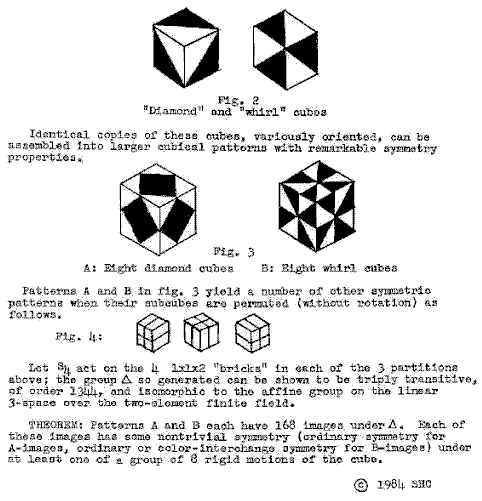
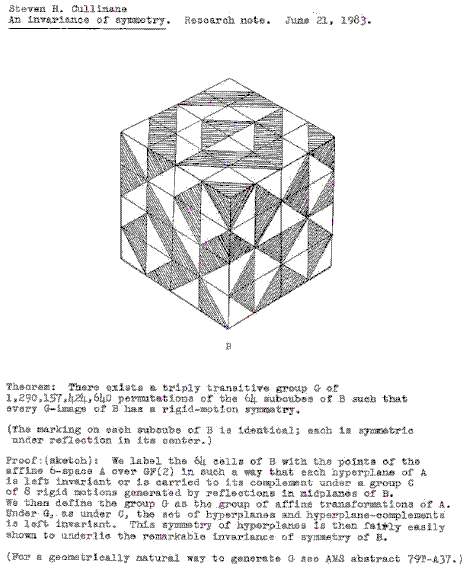
Generating permutations for the Klein simple group of order 168 acting on the eightfold cube .

In Galois spaces, some care must be taken in defining "reflection."

Tuesday, July 2, 2019

Depth Psychology Meets Inscape Geometry

Filed under: General — m759 @ 3:00 am

An illustration from the previous post may be interpreted
as an attempt to unbokeh  an inscape

The 15 lines above are Euclidean  lines based on pairs within a six-set. 
For examples of Galois  lines so based, see Six-Set Geometry:

Monday, August 27, 2018

Geometry and Simplicity

Filed under: General,Geometry — Tags: , — m759 @ 9:27 pm

From

Thinking in Four Dimensions
By Dusa McDuff

"I’ve got the rather foolhardy idea of trying to explain
to you the kind of mathematics I do, and the kind of
ideas that seem simple to me. For me, the search
for simplicity is almost synonymous with the search
for structure.

I’m a geometer and topologist, which means that
I study the structure of space
. . . .

In each dimension there is a simplest space
called Euclidean space … "

— In Roman Kossak, ed.,
Simplicity:  Ideals of Practice in Mathematics and the Arts
(Kindle Locations 705-710, 735). Kindle Edition.

For some much simpler spaces of various
dimensions, see Galois Space in this journal.

Some small Galois spaces (the Cullinane models)

http://www.log24.com/log/pix18/180827-Simplicity-Springer-April_2013_conference.jpg

Friday, February 16, 2018

Two Kinds of Symmetry

Filed under: General,Geometry — Tags: , — m759 @ 11:29 pm

The Institute for Advanced Study (IAS) at Princeton in its Fall 2015 Letter 
revived "Beautiful Mathematics" as a title:

This ugly phrase was earlier used by Truman State University
professor Martin Erickson as a book title. See below. 

In the same IAS Fall 2015 Letter appear the following remarks
by Freeman Dyson —

". . . a special case of a much deeper connection that Ian Macdonald 
discovered between two kinds of symmetry which we call modular and affine.
The two kinds of symmetry were originally found in separate parts of science,
modular in pure mathematics and affine in physics. Modular symmetry is
displayed for everyone to see in the drawings of flying angels and devils
by the artist Maurits Escher. Escher understood the mathematics and got the
details right. Affine symmetry is displayed in the peculiar groupings of particles
created by physicists with high-energy accelerators. The mathematician
Robert Langlands was the first to conjecture a connection between these and
other kinds of symmetry. . . ." (Wikipedia link added.)

The adjective "modular"  might aptly be applied to . . .

The adjective "affine"  might aptly be applied to . . .

From 'Beautiful Mathematics,' by Martin Erickson, an excerpt on the Cullinane diamond theorem (with source not mentioned)

The geometry of the 4×4 square combines modular symmetry
(i.e., related to theta functions) with the affine symmetry above.

Hudson's 1905 discussion of modular symmetry (that of Rosenhain
tetrads and Göpel tetrads) in the 4×4 square used a parametrization
of that square by the digit 0 and the fifteen 2-subsets of a 6-set, but 
did not discuss the 4×4 square as an affine space.

For the connection of the 15 Kummer modular 2-subsets with the 16-
element affine space over the two-element Galois field GF(2), see my note
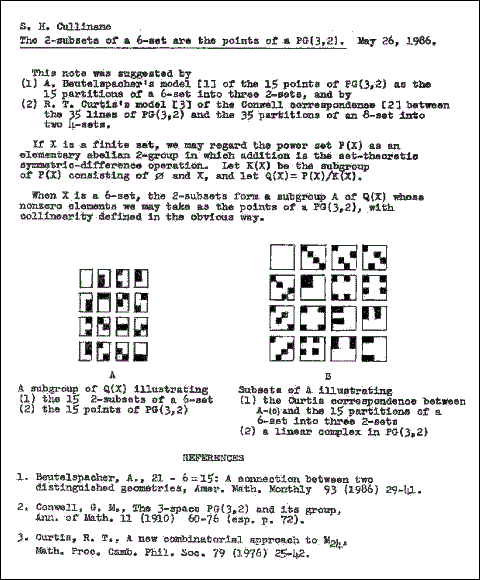
of May 26, 1986, "The 2-subsets of a 6-set are the points of a PG(3,2)" —

— and the affine structure in the 1979 AMS abstract
"Symmetry invariance in a diamond ring" —

For some historical background on the symmetry investigations by
Dyson and Macdonald, see Dyson's 1972 article "MIssed Opportunities."

For Macdonald's own  use of the words "modular" and "affine," see
Macdonald, I. G., "Affine Lie algebras and modular forms," 
Séminaire N. Bourbaki , Vol. 23 (1980-1981), Talk no. 577, pp. 258-276.

Sunday, February 12, 2017

Religious Art for Sunday

Filed under: General,Geometry — Tags: — m759 @ 11:02 am

Euclidean  square and triangle

Galois  square and triangle

For some backstory, see the "preface" of the 
previous post and Soifer in this journal.

Wednesday, August 24, 2016

Core Statements

Filed under: General,Geometry — Tags: , — m759 @ 1:06 pm

"That in which space itself is contained" — Wallace Stevens

An image by Steven H. Cullinane from April 1, 2013:

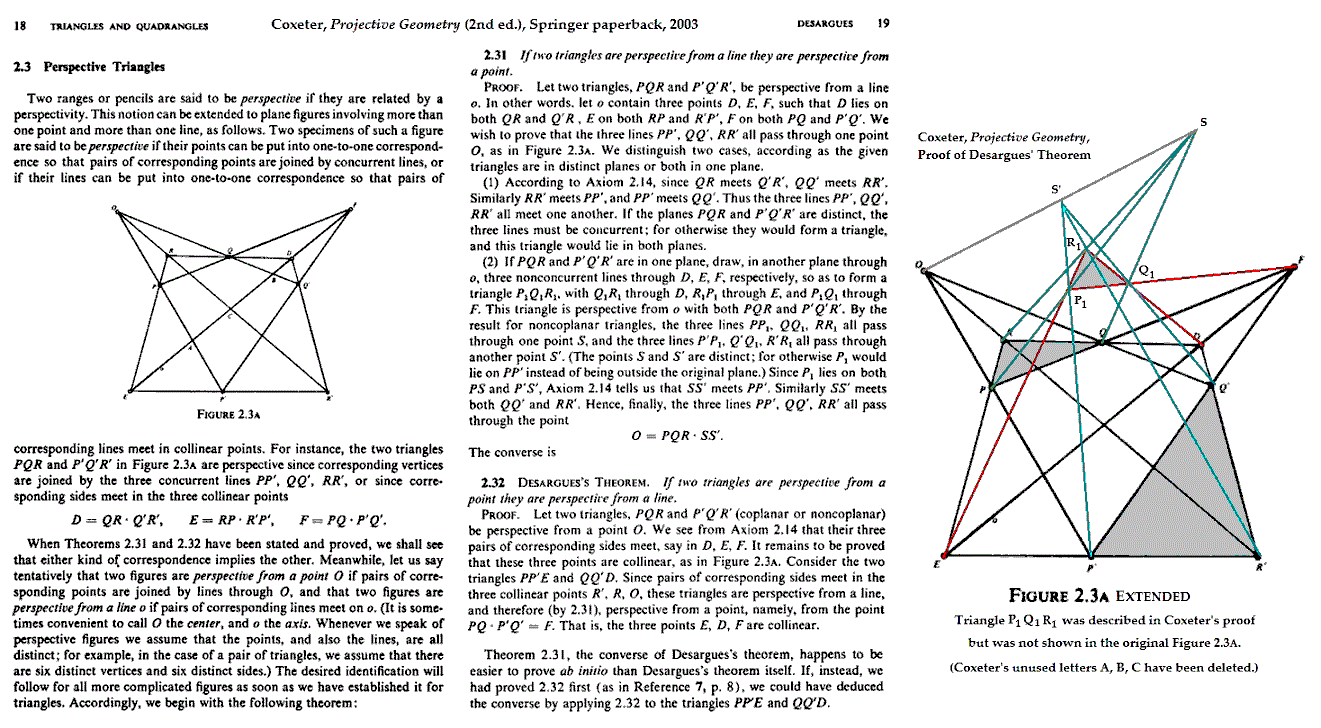
The large Desargues configuration of Euclidean 3-space can be 
mapped canonically to the 4×4 square of Galois geometry —

'Desargues via Rosenhain'- April 1, 2013- The large Desargues configuration mapped canonically to the 4x4 square

On an Auckland University of Technology thesis by Kate Cullinane —
On Kate Cullinane's book 'Sample Copy' - 'The core statement of this work...'
The thesis reportedly won an Art Directors Club award on April 5, 2013.

Monday, June 27, 2016

Interplay

Filed under: General,Geometry — Tags: — m759 @ 12:00 am

From a search in this journal for Euclid + Galois + Interplay

http://www.log24.com/log/pix11A/110427-Cube27.jpg

   The 3×3×3 Galois Cube
 

A tune suggested by the first image above —

Thursday, January 21, 2016

Dividing the Indivisible

Filed under: General,Geometry — Tags: — m759 @ 11:00 am

My statement yesterday morning that the 15 points
of the finite projective space PG(3,2) are indivisible 
was wrong.  I was misled by quoting the powerful
rhetoric of Lincoln Barnett (LIFE magazine, 1949).

Points of Euclidean  space are of course indivisible
"A point is that which has no parts" (in some translations).

And the 15 points of PG(3,2) may be pictured as 15
Euclidean  points in a square array (with one point removed)
or tetrahedral array (with 11 points added).

The geometry of  PG(3,2) becomes more interesting,
however, when the 15 points are each divided  into
several parts. For one approach to such a division,
see Mere Geometry. For another approach, click on the
image below.

IMAGE- 'Nocciolo': A 'kernel' for Pascal's Hexagrammum Mysticum: The 15 2-subsets of a 6-set as points in a Galois geometry.

Saturday, August 15, 2015

Schoolboy Problem

Filed under: General,Geometry — Tags: — m759 @ 10:07 am

Sir Laurence Olivier, in "Term of Trial" (1962), dangles
a participle in front of schoolboy Terence Stamp:

"Walking to school today
my arithmetic book
fell into the gutter"

Were Stamp a Galois, the reply might be "Try this one, sir."

Thursday, April 16, 2015

National Library Week

Filed under: General,Geometry — Tags: , — m759 @ 7:00 pm

"Celebrate National Library Week 2015 (April 12-18, 2015)
with the theme "Unlimited possibilities @ your library®."

See also Library of Hell.

A page from Princeton University Press on March 18, 2012:

IMAGE- 'Circles Disturbed: The Interplay of Mathematics and Narrative,' p. xvi

… "mathematics and narrative…." (top of page xvii).

I prefer the interplay of Euclidean  and Galois  mathematics.

Wednesday, November 26, 2014

A Tetrahedral Fano-Plane Model

Filed under: General,Geometry — Tags: , — m759 @ 5:30 pm

Update of Nov. 30, 2014 —

It turns out that the following construction appears on
pages 16-17 of A Geometrical Picture Book , by 
Burkard Polster (Springer, 1998).

"Experienced mathematicians know that often the hardest
part of researching a problem is understanding precisely
what that problem says. They often follow Polya's wise
advice: 'If you can't solve a problem, then there is an
easier problem you can't solve: find it.'"

—John H. Conway, foreword to the 2004 Princeton
Science Library edition of How to Solve It , by G. Polya

For a similar but more difficult problem involving the
31-point projective plane, see yesterday's post
"Euclidean-Galois Interplay."

The above new [see update above] Fano-plane model was
suggested by some 1998 remarks of the late Stephen Eberhart.
See this morning's followup to "Euclidean-Galois Interplay" 
quoting Eberhart on the topic of how some of the smallest finite
projective planes relate to the symmetries of the five Platonic solids.

Update of Nov. 27, 2014: The seventh "line" of the tetrahedral
Fano model was redefined for greater symmetry.

Class Act

Filed under: General,Geometry — Tags: , — m759 @ 7:18 am

Update of Nov. 30, 2014 —

For further information on the geometry in
the remarks by Eberhart below, see
pp. 16-17 of A Geometrical Picture Book ,
by Burkard Polster (Springer, 1998). Polster
cites a different article by Lemay.

A search for background to the exercise in the previous post
yields a passage from the late Stephen Eberhart:

The first three primes p = 2, 3, and 5 therefore yield finite projective planes with 7, 13, and 31 points and lines, respectively. But these are just the numbers of symmetry axes of the five regular solids, as described in Plato's Timaeus : The tetrahedron has 4 pairs of face planes and corner points + 3 pairs of opposite edges, totalling 7 axes; the cube has 3 pairs of faces + 6 pairs of edges + 4 pairs of corners, totalling 13 axes (the octahedron simply interchanges the roles of faces and corners); and the pentagon dodecahedron has 6 pairs of faces + 15 pairs of edges + 10 pairs of corners, totalling 31 axes (the icosahedron again interchanging roles of faces and corners). This is such a suggestive result, one would expect to find it dealt with in most texts on related subjects; instead, while "well known to those who well know such things" (as Richard Guy likes to quip), it is scarcely to be found in the formal literature [9]. The reason for the common numbers, it turns out, is that the groups of symmetry motions of the regular solids are subgroups of the groups of collineations of the respective finite planes, a face axis being different from an edge axis of a regular solid but all points of a projective plane being alike, so the latter has more symmetries than the former.

[9] I am aware only of a series of in-house publications by Fernand Lemay of the Laboratoire de Didactique, Faculté des Sciences de I 'Éducation, Univ. Laval, Québec, in particular those collectively titled Genèse de la géométrie  I-X.

— Stephen Eberhart, Dept. of Mathematics,
California State University, Northridge, 
"Pythagorean and Platonic Bridges between
Geometry and Algebra," in BRIDGES: Mathematical
Connections in Art, Music, and Science 
, 1998,
archive.bridgesmathart.org/1998/bridges1998-121.pdf

Eberhart died of bone cancer in 2003. A memorial by his
high school class includes an Aug. 7, 2003, transcribed
letter from Eberhart to a classmate that ends…


… I earned MA’s in math (UW, Seattle) and history (UM, Missoula) where a math/history PhD program had been announced but canceled.  So 1984 to 2002 I taught math (esp. non-Euclidean geometry) at C.S.U. Northridge.  It’s been a rich life.  I’m grateful. 
 
Steve
 

See also another informative BRIDGES paper by Eberhart
on mathematics and the seven traditional liberal arts.

Monday, October 27, 2014

Revolutions in Geometry

Filed under: General,Geometry — m759 @ 9:00 am

A post in honor of Évariste Galois (25 October 1811 – 31 May 1832)

From a book by Richard J. Trudeau titled The Non-Euclidean Revolution

See also “non-Euclidean” in this journal.

One might argue that Galois geometry, a field ignored by Trudeau,
is also “non-Euclidean,” and  (for those who like rhetoric) revolutionary.

Saturday, October 25, 2014

Foundation Square

Filed under: General,Geometry — Tags: , , , — m759 @ 2:56 pm

In the above illustration of the 3-4-5 Pythagorean triangle,
the grids on each side may be regarded as figures of
Euclidean  geometry or of Galois  geometry.

In Euclidean geometry, these grids illustrate a property of
the inner triangle.

In elementary Galois geometry, ignoring the connection with
the inner triangle, the grids may be regarded instead as
illustrating vector spaces over finite (i.e., Galois) fields.
Previous posts in this journal have dealt with properties of
the 3×3 and 4×4 grids.  This suggests a look at properties of
the next larger grid, the 5×5 array, viewed as a picture of the
two-dimensional vector space (or affine plane) over the finite
Galois field GF(5) (also known as ℤ5).

The 5×5 array may be coordinatized in a natural way, as illustrated
in (for instance) Matters Mathematical , by I.N. Herstein and
Irving Kaplansky, 2nd ed., Chelsea Publishing, 1978, p. 171:

See Herstein and Kaplansky for the elementary Galois geometry of
the 5×5 array.

For 5×5 geometry that is not so elementary, see…

Hafner's abstract:

We describe the Hoffman-Singleton graph geometrically, showing that
it is closely related to the incidence graph of the affine plane over ℤ5.
This allows us to construct all automorphisms of the graph.

The remarks of Brouwer on graphs connect the 5×5-related geometry discussed
by Hafner with the 4×4 geometry related to the Steiner system S(5,8,24).
(See the Miracle Octad Generator of R. T. Curtis and the related coordinatization
by Cullinane of the 4×4 array as a four-dimensional vector space over GF(2).)

Monday, September 22, 2014

Space

Filed under: General,Geometry — Tags: — m759 @ 11:17 am

Review of an image from a post of May 6, 2009:

Galois space of six dimensions represented in Euclidean spaces of three and of two dimensions

Thursday, July 17, 2014

Paradigm Shift:


Continuous Euclidean space to discrete Galois space*

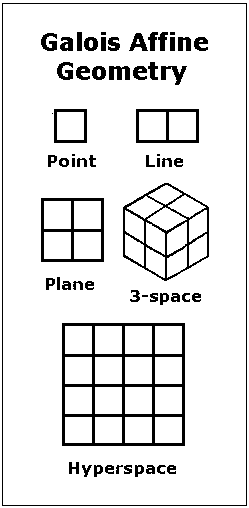
Euclidean space:

Point, line, square, cube, tesseract

From a page by Bryan Clair

Counting symmetries in Euclidean space:

Galois space:

Image-- examples from Galois affine geometry

Counting symmetries of  Galois space:
IMAGE - The Diamond Theorem

The reason for these graphic symmetries in affine Galois space —

symmetries of the underlying projective Galois space:

* For related remarks, see posts of May 26-28, 2012.

Wednesday, February 5, 2014

Mystery Box II

Filed under: General,Geometry — Tags: , — m759 @ 4:07 pm

Continued from previous post and from Sept. 8, 2009.

Box containing Froebel's Third Gift-- The Eightfold Cube

Examination of the box's contents does not solve
the contents' real mystery. That requires knowledge
of the non-Euclidean geometry of Galois space.

In this case, without that knowledge, prattle (as in
today's online New York Times ) about creativity and
"thinking outside the box" is pointless.

Thursday, November 7, 2013

Pattern Grammar

Filed under: General,Geometry — Tags: , — m759 @ 10:31 am

Yesterday afternoon's post linked to efforts by
the late Robert de Marrais to defend a mathematical  
approach to structuralism and kaleidoscopic patterns. 

Two examples of non-mathematical discourse on
such patterns:

1.  A Royal Society paper from 2012—

Click the above image for related material in this journal.

2.  A book by Junichi Toyota from 2009—

Kaleidoscopic Grammar: Investigation into the Nature of Binarism

I find such non-mathematical approaches much less interesting
than those based on the mathematics of reflection groups . 

De Marrais described the approaches of Vladimir Arnold and,
earlier, of H. S. M. Coxeter, to such groups. These approaches
dealt only with groups of reflections in Euclidean  spaces.
My own interest is in groups of reflections in Galois  spaces.
See, for instance, A Simple Reflection Group of Order 168

Galois spaces over fields of characteristic 2  are particularly
relevant to what Toyota calls binarism .

Monday, April 1, 2013

Desargues via Rosenhain

Filed under: General,Geometry — Tags: , , , — m759 @ 6:00 pm

Background: Rosenhain and Göpel Tetrads in PG(3,2)

Introduction:

The Large Desargues Configuration

Added by Steven H. Cullinane on Friday, April 19, 2013

Desargues' theorem according to a standard textbook:

"If two triangles are perspective from a point
they are perspective from a line."

The converse, from the same book:

"If two triangles are perspective from a line
they are perspective from a point."

Desargues' theorem according to Wikipedia 
combines the above statements:

"Two triangles are in perspective axially  [i.e., from a line]
if and only if they are in perspective centrally  [i.e., from a point]."

A figure often used to illustrate the theorem, 
the Desargues configuration , has 10 points and 10 lines,
with 3 points on each line and 3 lines on each point.

A discussion of the "if and only if" version of the theorem
in light of Galois geometry requires a larger configuration—
15 points and 20 lines, with 3 points on each line 
and 4 lines on each point.

This large  Desargues configuration involves a third triangle,
needed for the proof   (though not the statement ) of the 
"if and only if" version of the theorem. Labeled simply
"Desargues' Theorem," the large  configuration is the
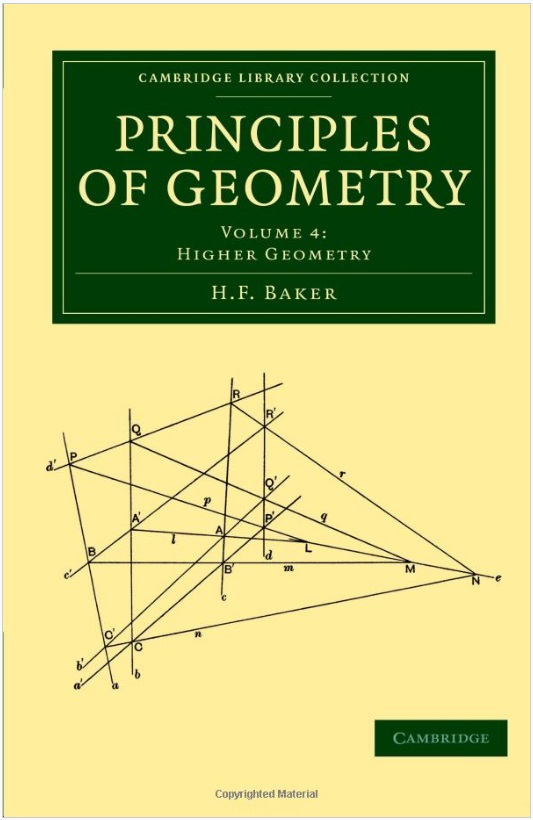
frontispiece to Volume I (Foundations)  of Baker's 6-volume
Principles of Geometry .

Point-line incidence in this larger configuration is,
as noted in the post of April 1 that follows
this introduction, described concisely 
by 20 Rosenhain tetrads  (defined in 1905 by
R. W. H. T. Hudson in Kummer's Quartic Surface ).

The third triangle, within the larger configuration,
is pictured below.

IMAGE- The proof of the converse of Desargues' theorem involves a third triangle.


A connection discovered today (April 1, 2013)—

(Click to enlarge the image below.)

Update of April 18, 2013

Note that  Baker's Desargues-theorem figure has three triangles,
ABC, A'B'C', A"B"C", instead of the two triangles that occur in
the statement of the theorem. The third triangle appears in the
course of proving, not just stating, the theorem (or, more precisely,
its converse). See, for instance, a note on a standard textbook for 
further details.

(End of April 18, 2013 update.)

Update of April 14, 2013

See Baker's Proof (Edited for the Web) for a detailed explanation 
of the above picture of Baker's Desargues-theorem frontispiece.

(End of April 14, 2013 update.)

Update of April 12, 2013

A different figure, from a site at National Tsing Hua University,
shows the three triangles of Baker's figure more clearly:

IMAGE- Desargues' theorem with three triangles, and Galois-geometry version

(End of update of April 12, 2013)

Update of April 13, 2013

Another in a series of figures illustrating
Desargues's theorem in light of Galois geometry:
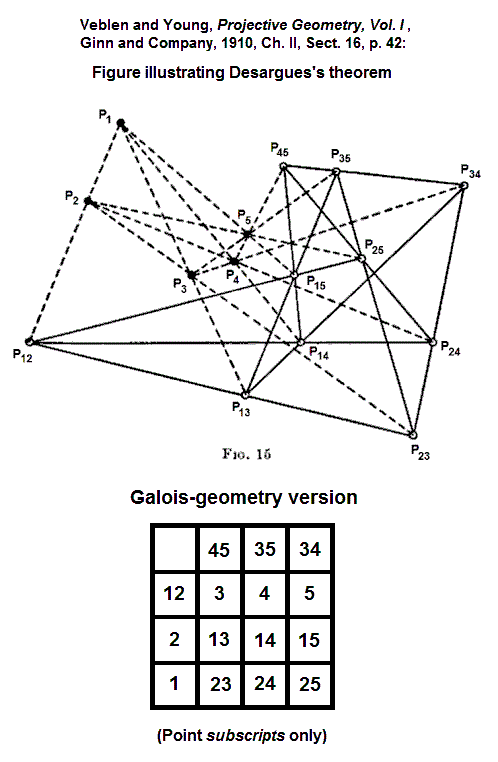
IMAGE- Veblen and Young 1910 Desargues illustration, with 2013 Galois-geometry version

See also the original Veblen-Young figure in context.

(End of update of April 13, 2013)

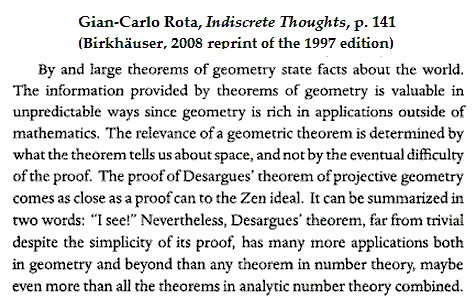
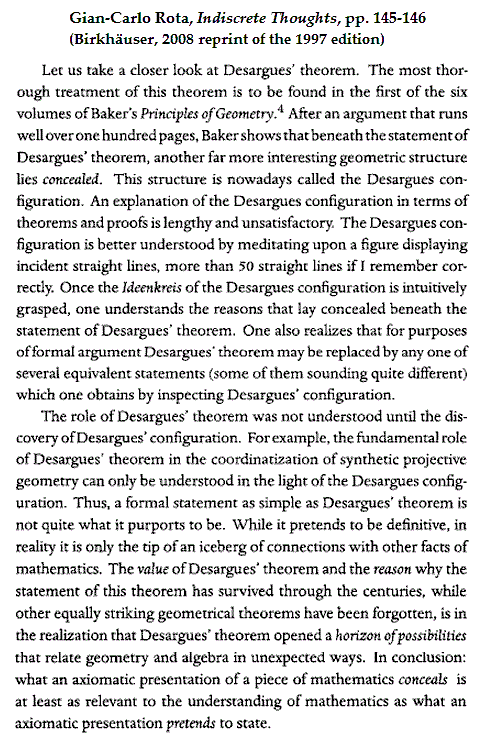
Rota's remarks, while perhaps not completely accurate, provide some context
for the above Desargues-Rosenhain connection.  For some other context,
see the interplay in this journal between classical and finite geometry, i.e.
between Euclid and Galois.

For the recent  context of the above finite-geometry version of Baker's Vol. I
frontispiece, see Sunday evening's finite-geometry version of Baker's Vol. IV
frontispiece, featuring the Göpel, rather than the Rosenhain, tetrads.

For a 1986 illustration of Göpel and Rosenhain tetrads (though not under
those names), see Picturing the Smallest Projective 3-Space.

In summary… the following classical-geometry figures
are closely related to the Galois geometry PG(3,2):

Volume I of Baker's Principles  
has a cover closely related to 
the Rosenhain tetrads in PG(3,2)
Volume IV of Baker's Principles 
has a cover closely related to
the Göpel tetrads in PG(3,2) 
Foundations
(click to enlarge)


Higher Geometry
(click to enlarge)


Tuesday, February 19, 2013

Configurations

Filed under: General,Geometry — Tags: , , , — m759 @ 12:24 pm

Yesterday's post Permanence dealt with the cube
as a symmetric model of the finite projective plane
PG(2,3), which has 13 points and 13 lines. The points
and lines of the finite geometry occur in the cube as
the 13 axes of symmetry and the 13 planes through
the center perpendicular to those axes. If the three
axes lying in  a plane that cuts the cube in a hexagon
are supplemented by the axis perpendicular  to that
plane, each plane is associated with four axes and,
dually, each axis is associated with four planes.

My web page on this topic, Cubist Geometries, was
written on February 27, 2010, and first saved to the
Internet Archive on Oct. 4, 2010

For a more recent treatment of this topic that makes
exactly the same points as the 2010 page, see p. 218
of Configurations from a Graphical Viewpoint , by
Tomaž Pisanski and Brigitte Servatius, published by
Springer on Sept. 23, 2012 (date from both Google
Books
and Amazon.com):

For a similar 1998 treatment of the topic, see Burkard Polster's 
A Geometrical Picture Book  (Springer, 1998), pp. 103-104.

The Pisanski-Servatius book reinforces my argument of Jan. 13, 2013,
that the 13 planes through the cube's center that are perpendicular
to the 13 axes of symmetry of the cube should be called the cube's 
symmetry planes , contradicting the usual use of of that term.

That argument concerns the interplay  between Euclidean and
Galois geometry. Pisanski and Servatius (and, in 1998, Polster)
emphasize the Euclidean square and cube as guides* to
describing the structure of a Galois space. My Jan. 13 argument
uses Galois  structures as a guide to re-describing those of Euclid .
(For a similar strategy at a much more sophisticated level,
see a recent Harvard Math Table.)

Related material:  Remarks on configurations in this journal
during the month that saw publication of the Pisanski-Servatius book.

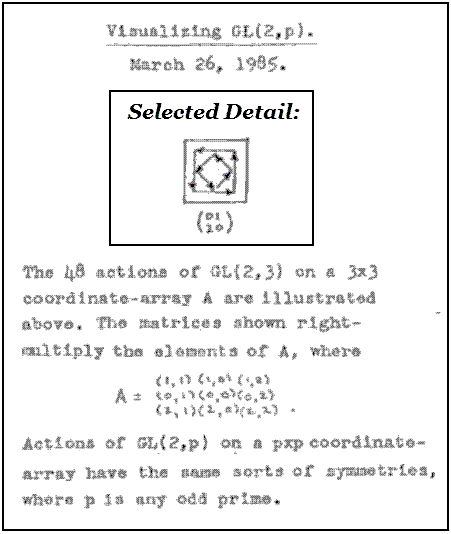
* Earlier guides: the diamond theorem (1978), similar theorems for
  2x2x2 (1984) and 4x4x4 cubes (1983), and Visualizing GL(2,p)
  (1985). See also Spaces as Hypercubes (2012).

Older Posts »

Powered by WordPress